Explainer
What Is a Fireball Meteor? Bolides, Booms and How to Report One
A green-white flash streaks across the sky, lights up the ground and is gone in seconds. That was most likely a fireball, a meteor much brighter than usual. Here is what makes one, when it booms or drops meteorites, how it differs from a satellite reentry, and what to note so your report counts.
Key takeaways
- A fireball is a very bright meteor. The American Meteor Society (AMS) defines it as brighter than magnitude -4, about as bright as Venus; NASA's CNEOS uses magnitude -3 or brighter seen overhead.
- A bolide is a fireball that explodes in a bright terminal flash, often breaking into visible fragments.
- Fireballs are common: the AMS says several thousand of fireball brightness enter the atmosphere every day, but most happen over oceans, empty land or in daylight.
- Very bright fireballs that explode below about 50 km can cause sonic booms heard 1.5 to 4 minutes later, and only the brightest, magnitude -8 to -10 or more, can drop meteorites.
- If you see one, report it on the AMS fireball form (shared with the International Meteor Organization) with the time, direction, brightness, duration and path across the sky.
A fireball meteor is simply a meteor that is much brighter than normal. The American Meteor Society defines it as a meteor brighter than magnitude -4, "about the same magnitude of the planet Venus in the morning or evening sky." It is caused by a larger-than-usual piece of space rock slamming into the atmosphere at many kilometres per second and glowing as it burns up. A fireball that ends in a bright explosion is called a bolide. Most last only a few seconds, and they are more common than you might think: several thousand of fireball brightness happen somewhere on Earth every day.
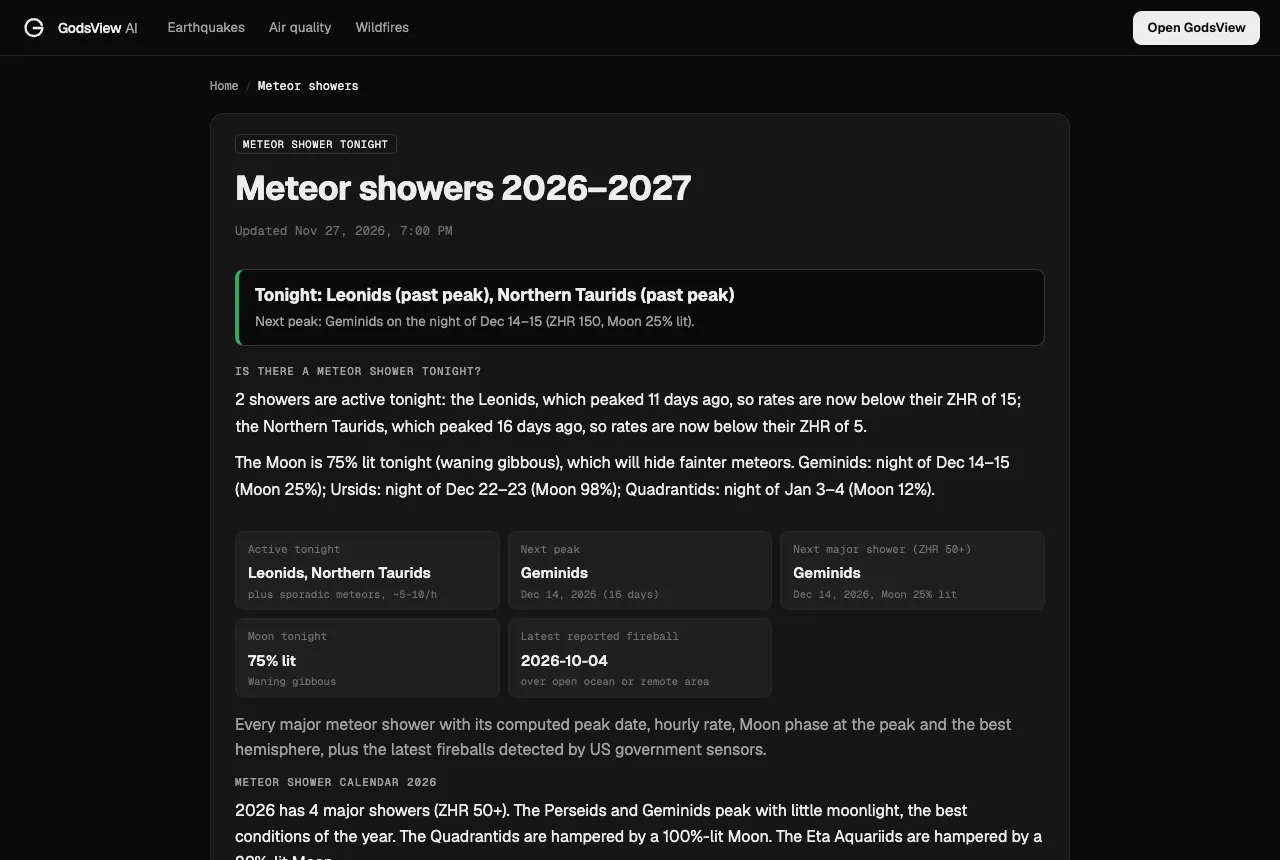
If you saw one, the most useful thing you can do is report it to the American Meteor Society, which shares its reports with the International Meteor Organization. GodsView's meteor showers page lists what showers are active tonight and the latest fireballs recorded in NASA JPL's CNEOS data.
See active showers and recent fireballs
Fireball, bolide, meteor, meteorite: the terms
| Term | What it means |
|---|---|
| Meteoroid | The rock or dust particle while it is still in space |
| Meteor | The streak of light when it hits the atmosphere and burns |
| Fireball | A very bright meteor: brighter than magnitude -4 (AMS), or -3 or brighter seen overhead (NASA CNEOS) |
| Bolide | A fireball that explodes in a bright terminal flash, often with visible fragments (AMS) |
| Meteorite | A piece that survives the fall and reaches the ground |
NASA's Center for Near Earth Object Studies (CNEOS) notes that "the terms fireballs and bolides are often used interchangeably", and that the objects behind the larger events it records can exceed one metre in size.
What causes a fireball
Meteors happen when bits of comets and asteroids meet Earth. Ordinary shower meteors come from dust grains. Fireballs come from bigger, heavier pieces, which carry more energy and so make more light. Speed matters too: the International Meteor Organization's 2026 calendar lists the Geminids hitting the atmosphere at 35 km/s and the Leonids at 71 km/s.
Fireballs can happen on any night, from any direction. Some showers are richer in them than others:
- The Geminids are "known for bright meteors and fireballs", according to the IMO; they peak on December 14, 2026 (see our Geminids 2026 guide).
- The Quadrantids are known for bright fireballs, says NASA; they peak on January 4, 2027 (see the Quadrantids 2027 guide).
- The Taurids, active through October and November, are slow: the IMO lists them at 27 to 29 km/s, and slow meteors linger longer in the sky.
How common are fireballs?
More common than most people expect. The AMS says "several thousand meteors of fireball magnitude occur in the Earth's atmosphere each day." Most go unseen because they happen over the oceans, over uninhabited land, or in daylight; a fireball has to be about magnitude -6 or brighter to be noticed in the daytime sky away from the Sun.
Brighter ones are rarer. The AMS says an experienced observer can expect to see a magnitude -4 fireball about once every 20 hours of watching, but a magnitude -6 fireball only about once every 200 hours.
NASA's CNEOS keeps a database of the brightest events detected by US government sensors, with data going back to 1988. For each event it lists the time, location, altitude and speed at peak brightness, and energy, measured in kilotons of TNT (1 kt is 4.185 × 10^12 joules). CNEOS stresses that it is a record of the brightest fireballs only, not a complete catalogue.
Why some fireballs boom
Fireballs are usually silent, but not always. The AMS describes two kinds of sound:
- Sonic booms. When a very bright fireball, magnitude -8 or brighter, penetrates below about 50 km before breaking up, its shock wave can reach the ground as a boom or rumble. Because sound is slow compared with light, it arrives 1.5 to 4 minutes after the flash. If you hear a boom several minutes after a bright flash, the two can be the same event.
- Electrophonic sounds. Some witnesses report hissing, sizzling or popping at the same moment as the fireball, often near metal objects. The AMS says the cause is not understood scientifically.
If you heard a boom but saw nothing, there are many other possible causes; our guide to what was that loud boom goes through them, from aircraft to quarries to earthquakes.
Trails, colours and the light show
Bright fireballs can leave something behind. The AMS describes two types of trail:
- Trains: glowing trails of ionized air that can last from seconds to minutes. They form above about 80 km.
- Smoke trails: non-glowing dust trails left by fireballs that get below about 80 km. They can look like an aircraft contrail.
Colour is one of the details the AMS asks witnesses to report, along with brightness and duration. Different showers have different looks: NASA says most Geminids appear yellow.
When does a fireball drop meteorites?
Only rarely, and only the brightest. The AMS says a fireball usually needs to reach magnitude -8 to -10 or brighter to drop meteorites. It estimates that 10 to 50 meteorite-dropping events happen around the world each day, but only 2 to 12 of those fall where anyone could hope to find them.
Fresh meteorites usually have a dark fusion crust from melting on the way down, and the AMS notes that most contain iron and nickel, so they are often magnetic.
The most powerful fireball of recent times shows the extreme end. NASA's CNEOS describes the Chelyabinsk fireball over Russia on February 15, 2013 (03:20:33 GMT) as the most energetic impact recognized since the 1908 Tunguska blast. The asteroid was about 17 to 20 metres across with a mass of roughly 11,000 tonnes. It was moving at 18.6 km/s at peak brightness, reached maximum brightness at 23.3 km altitude, and released an estimated total impact energy of about 440 kilotons of TNT.
Fireball or satellite reentry?
Not every fireball is natural. Old satellites and rocket stages reenter every day, and some put on a show. The AMS uses witness reports to tell them apart. In one case it described, a 2015 reentry of a Chinese rocket body over the western US, witnesses saw it last up to 45 seconds, while "a normal fireball would last 3-5 seconds", and each fragment of the breaking stage made its own "mini fireball".
- Fireball: fast, a few seconds, one bright head, sometimes ending in a flash.
- Reentry: slow, often 30 seconds or more, a train of many burning fragments crossing much of the sky.
Our explainer on satellite reentry covers how reentries are predicted, and the GodsView live satellite tracker shows where catalogued satellites are now.
How to report a fireball
The AMS runs an online fireball report form, used together with the International Meteor Organization, at fireball.amsmeteors.org. Reports from several witnesses in different places help reconstruct a fireball's path. Note these details as soon as you can, while your memory is fresh:
- Your exact location, or the address you were at.
- The time, as precisely as possible.
- Where it started and ended, by compass direction and height above the horizon (a fist at arm's length is about 10 degrees), or relative to stars and constellations you know.
- How bright it was, compared with Venus, the full Moon or the brightest stars.
- How long it lasted, in seconds.
- Its colour, any fragmentation or terminal flash, any train or smoke trail.
- Any sound, and how long after the flash you heard it.
Video helps. If you have a doorbell camera, dashcam or security camera facing the sky, check its recording for the time of the sighting. GodsView's live cameras pages list public camera feeds by city.
The short version
A fireball is a meteor brighter than Venus, caused by a larger-than-usual piece of space rock burning up. Thousands happen daily, mostly unseen. A bolide ends in an explosion; the brightest can boom 1.5 to 4 minutes later, and only those at magnitude -8 to -10 or brighter may drop meteorites. If you see one, note the time, direction, brightness and duration, and report it to the American Meteor Society.
Open the meteor showers calendar
Frequently asked questions
What is a fireball meteor?
A very bright meteor. The American Meteor Society defines a fireball as brighter than magnitude -4, about as bright as Venus. NASA's CNEOS uses magnitude -3 or brighter as seen overhead.
What is the difference between a fireball and a bolide?
A bolide is a fireball that explodes in a bright terminal flash, often with visible fragmentation. NASA notes the two terms are often used interchangeably.
How do I report a fireball I saw last night?
Use the American Meteor Society's online fireball report form at fireball.amsmeteors.org, which it shares with the International Meteor Organization. Include your location, the time, where the fireball started and ended, its brightness, duration, colour and any sound.
Can a fireball make a sonic boom?
Yes. The AMS says very bright fireballs (magnitude -8 or brighter) that penetrate below about 50 km can produce sonic booms, which arrive 1.5 to 4 minutes after the flash.
Do fireballs leave meteorites?
Rarely. The AMS says a fireball usually needs to be magnitude -8 to -10 or brighter to drop meteorites. It estimates 10 to 50 meteorite-dropping events a day worldwide, of which only 2 to 12 fall where they could be found.
Was it a fireball or a satellite reentry?
Duration is the best clue. The AMS says a normal fireball lasts 3 to 5 seconds, while reentering space debris moves slower, breaks into many glowing fragments and can last 45 seconds or more.
Sources
- American Meteor Society — Fireball FAQ
- NASA JPL CNEOS — Fireball and bolide data
- NASA JPL CNEOS — Additional details on the large fireball event over Russia on Feb. 15, 2013
- American Meteor Society — Space debris reentry over western USA (2015)
- International Meteor Organization — 2026 Meteor Shower Calendar (PDF)
- NASA — Geminids
- NASA — Quadrantids
Facts checked on against each provider's own site.