Guide
How to Watch a SpaceX Launch: Live, in Person and in the Sky
SpaceX launches so often that one is almost always days away. Here is how to find the next one, read its launch time, pick a viewing spot on the Space Coast, cope with scrubs, and catch the Starlink satellites the night after.
Key takeaways
- To find the next SpaceX launch, use a launch schedule such as the GodsView space launch tracker, which lists upcoming launches from Launch Library 2 with their pads and target times, and treat the official webcast as the final word.
- Launch times are given as NET, "no earlier than": a target, not a promise. The Kennedy Space Center Visitor Complex says scrubs can be called days ahead or moments before liftoff, for weather, technical problems or boats and aircraft in the safety zone.
- In Florida, the Kennedy Space Center Visitor Complex offers viewing with admission and paid add-ons; its closest public site, the Gantry at LC-39, is 3.4 miles from Falcon 9 pad SLC-40.
- Viewing at the Visitor Complex depends on US Space Force Eastern Range safety rules and launch time, and not every location opens for every mission.
- After a Starlink launch, the new satellites can be seen as a line of moving dots for a short time, because they are low and bright until they raise their orbits.
To watch a SpaceX launch, first find the next one on a launch schedule, note its target time in your time zone, and then either follow the official webcast or go to a viewing spot near the pad. Launch times are "no earlier than" targets, so build in slack: launches slip and scrub often. Most SpaceX launches fly Falcon 9 from Cape Canaveral or Kennedy Space Center in Florida, or from Vandenberg in California.
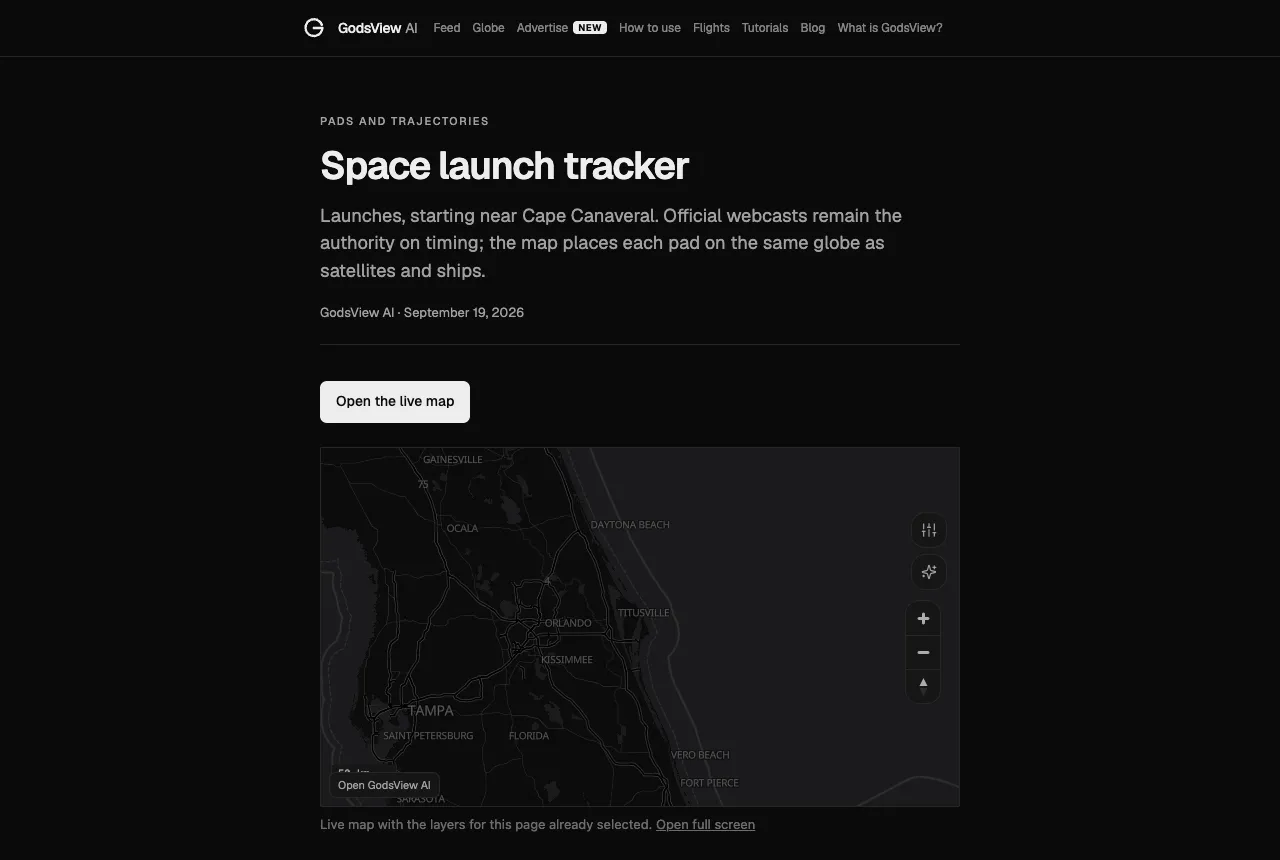
The GodsView space launch tracker lists upcoming and recent launches from Launch Library 2 at their pads on a map, so you can see what is next and where it flies from. For the minute-by-minute countdown, the official webcast is the authority.
How to find the next SpaceX launch
Launch schedules change daily, so use a live list rather than a news article. On November 28, 2026, the Launch Library 2 data on GodsView showed these next SpaceX flights:
| Mission | Rocket | Pad | Target (UTC) | Status |
|---|---|---|---|---|
| USSF-380 | Falcon 9 | SLC-4E, Vandenberg SFB, California | November 29, 06:26 | Go for launch |
| Cygnus NG-25 (space station cargo) | Falcon 9 | SLC-40, Cape Canaveral SFS, Florida | November 29, 15:47 | Go for launch |
| NROL-132 | Falcon 9 | SLC-4E, Vandenberg SFB | December 2, 20:30 | To be confirmed |
| CHORUS | Falcon 9 | SLC-40, Cape Canaveral SFS | December 4, 12:55 | Go for launch |
That list will be out of date within days, which is the point: always check a live source. The space launch tracker also lists launches by other providers, so you can see everything flying from the Space Coast or anywhere else that week.
Understanding launch times, windows and NET
NET means "no earlier than". A launch listed as NET November 29 will not fly before then, but may fly later. The Kennedy Space Center Visitor Complex uses the same convention on its own launch calendar.
A launch window is the period when the rocket can fly. Some missions can launch at any time over a few hours. Others, such as flights to the International Space Station, depend on where the target is in its orbit. The Visitor Complex explains that after a scrub, a new attempt depends on repair time, turnaround and the destination's position; for station missions, teams must calculate the ISS's position "for a successful rendezvous."
Convert from UTC. Schedules often give times in UTC. Subtract 5 hours for US Eastern Standard Time and 8 for Pacific Standard Time in winter.
Why SpaceX launches scrub
A scrub means "the attempt to launch the rocket has been canceled for that day, and a new date/time must be selected," in the Visitor Complex's words. It lists the common reasons:
- Weather: thunderstorms, strong upper-level winds or cold temperatures.
- Technical issues picked up by sensors on the rocket, spacecraft, payload or ground systems.
- Range safety: aircraft or boats entering the safety zone.
- The unexpected: the Visitor Complex recalls that a woodpecker once delayed a shuttle launch by pecking holes in the fuel tank.
Scrubs "can occur days, weeks, or months in advance, but a scrub can also be called moments before liftoff." If you are travelling to see a launch, plan a spare day.
Watching a SpaceX launch live online
The simplest way to watch is the launch provider's own webcast, which carries the live countdown and liftoff. A few tips:
- Join a few minutes early. Webcasts usually start before liftoff and count down live.
- Trust the webcast over any app. Third-party lists, including ours, update from public data and can lag a last-minute hold.
- Use a map for context. On GodsView the space launch tracker shows the pad, and the same globe shows satellites in orbit, so you can see where a new batch of satellites is heading. Trajectory sketches on the map are illustrative; hazard areas are set by the launch range.
Watching in person: Florida's Space Coast
Most SpaceX launches from Florida use Space Launch Complex 40 (SLC-40) at Cape Canaveral Space Force Station or Launch Complex 39A (LC-39A) at Kennedy Space Center. The Kennedy Space Center Visitor Complex runs official viewing areas and publishes distances from each:
| Viewing area | To Falcon 9 at SLC-40 | To Falcon 9 at LC-39A | Access |
|---|---|---|---|
| Main Visitor Complex | 6.7 miles (10.8 km) | 7.5 miles (12 km) | Included with admission when offered; bleacher and lawn seating with commentary |
| Banana Creek, Apollo/Saturn V Center | 6.2 miles (10 km) | 3.9 miles (6.27 km) | Bleachers and lawn, first come, first served, when offered |
| The Gantry at LC-39 | 3.4 miles (5.5 km) | Not available for 39A launches | Separate add-on ticket; bleachers, lawn and a limited observation deck |
The Visitor Complex says it may offer three kinds of viewing: viewing included with admission, Launch Transportation Tickets sold on top of admission, and Rocket Launch Packages that include admission, return visits in case of a scrub, and extras. Availability depends on the safety rules of the US Space Force Eastern Range and on the time of day, and not every location opens for every mission. Check the Visitor Complex launch calendar for the specific flight before you buy.
Outside the Visitor Complex, many people watch from public beaches, parks and causeways along the Space Coast. Rules and closures for those spots are set locally, so check the county or city before you go.
What to expect on the day:
- Arrive early. The Visitor Complex warns of longer lines on launch days.
- Watch, then listen. At several miles, the sound of the engines arrives noticeably after you see liftoff.
- Be ready to come back. A scrub can come at the last minute; packages with return visits exist for this reason.
Watching from California and elsewhere
SpaceX also flies Falcon 9 from Space Launch Complex 4E at Vandenberg Space Force Base on the California coast, including missions to polar orbit. Two of the four flights in the table above were scheduled from there. Public viewing is from outside the base, so check local guidance for access before you go.
If you live in the wider region around a launch site, check the launch time and direction: on a clear night a rising rocket can be visible from far away, so you may be able to see it from home.
Seeing Starlink satellites after a launch
Many SpaceX launches carry Starlink satellites, and those are often visible in the night sky afterwards as a train, a line of dots moving one after another.
SpaceX explains why in its brightness guidance. Starlink satellites are designed to be hard to see from the ground once they reach their operating orbit, but they are expected to be visible in a few phases:
- Immediately after launch, "during their first several orbits", while they stabilize and deploy antennas and solar arrays.
- During orbit raising, when they need to maximize power and minimize drag and cannot angle their solar arrays away.
- At the end of life, while they lower their orbits before burning up on reentry.
SpaceX also notes that satellites are typically visible during the first several hours of night and before dawn, when they are still in sunlight while the ground below is dark. So the best time to look for a fresh train is in the evening or before sunrise in the day or two after a Starlink launch, when the train passes over you. Our guides on how to see Starlink satellites tonight and how to spot satellites tonight cover timing and tools, and the Starlink tracker shows the constellation on a 3D globe.
Quick checklist for launch day
- Check a live schedule, such as the space launch tracker, on the morning of the launch.
- Convert the target time from UTC to your time zone.
- Check the official viewing information for the location you plan to use.
- Pack water, sun protection or warm layers, and something to sit on.
- Keep the official webcast open on your phone for countdown holds.
- If it was a Starlink mission, look up for the train over the next evenings.
The short version
Find the next launch on a live schedule, read the time as "no earlier than", and keep the official webcast handy. In Florida, the Kennedy Space Center Visitor Complex sells official viewing, with its closest spot 3.4 miles from SLC-40; elsewhere, check local access rules. Expect scrubs, plan a spare day, and after a Starlink launch look for the satellite train in the evening or before dawn.
Frequently asked questions
When is the next SpaceX launch?
It changes daily. On November 28, 2026, the next listed SpaceX flights were USSF-380 from Vandenberg (target November 29, 06:26 UTC) and Cygnus NG-25 from Cape Canaveral SLC-40 (target November 29, 15:47 UTC). Check the space launch tracker for the current list.
What does NET mean for a launch?
NET means "no earlier than". The launch will not happen before that date and time but can slip later because of weather, technical issues or range conflicts.
Where is the best place to watch a SpaceX launch in Florida?
The Kennedy Space Center Visitor Complex offers official viewing. Its closest public site, the Gantry at LC-39, is 3.4 miles from Falcon 9 pad SLC-40, and Banana Creek is 3.9 miles from LC-39A. Availability varies by mission and some sites need an add-on ticket.
Why do SpaceX launches get scrubbed?
Common reasons are weather (thunderstorms, upper-level winds, cold), technical issues detected by sensors, and aircraft or boats entering the safety zone. Scrubs can be called days ahead or seconds before liftoff.
Can I see Starlink satellites after a launch?
Often, yes. For their first several orbits and during orbit raising, new Starlink satellites are brighter, and they appear as a line of moving dots in the evening or before dawn, a day or two after launch, when they pass over you.
Is watching a launch from the Kennedy Space Center Visitor Complex free?
Viewing is sometimes included with admission, and sometimes sold as Launch Transportation Tickets or Rocket Launch Packages on top of admission. It depends on the mission and on Space Force range safety rules.
Sources
- Kennedy Space Center Visitor Complex — Launch viewing locations
- Kennedy Space Center Visitor Complex — What to expect on launch day
- Kennedy Space Center Visitor Complex — Launches and events
- SpaceX — Brightness mitigation best practices for satellite operators (PDF)
- The Space Devs — Launch Library 2 upcoming launches
Facts checked on against each provider's own site.