How-to
What Was That Loud Boom? How to Find Out in 5 Minutes
The windows rattled, the dog barked and nobody knows why. Most mystery booms have an ordinary cause, and you can usually narrow it down in a few minutes if you check the right sources in the right order.
Key takeaways
- Start with the clues you already have: was there a flash, did the ground shake, how cold was it, and did the power go out?
- Check the USGS earthquake map first. Small, shallow quakes can be heard as a boom, and they show up within minutes.
- Sonic booms from military jets are a common answer near training areas and coasts. Civil supersonic flight over US land is still banned under FAA rule 14 CFR 91.817; the FAA proposed lifting it in July 2026.
- A boom 1.5 to 4 minutes after a bright flash in the sky points to a fireball. Report it to the American Meteor Society.
- Frost quakes, quarry blasts, transformer failures, rocket booster landings, thunder and fireworks explain most of the rest. Some booms are never explained.
A sudden loud boom is usually one of a handful of things: a sonic boom from a military jet or a returning rocket booster, a small shallow earthquake or frost quake, a meteor (fireball) breaking up, a quarry or construction blast, a failing electrical transformer, thunder, or fireworks. To find out which, check in this order: the USGS earthquake map, live military flights, fireball reports, then local news, police and your utility.
The order matters because the fast, official sources go first. An earthquake shows up on the USGS map within minutes. A fireball report takes longer, and a news story about "mystery booms" can take hours. Below is the five-minute version, then a closer look at each cause and the clues that give it away.
Check earthquakes in the last hour
How to check a mystery boom in 5 minutes
Before you open anything, write down three things while they are fresh: the exact time, whether you felt the ground or the house shake, and whether you saw a flash. Those details do most of the sorting.
- Minute 1: check for an earthquake. Open earthquakes today or the USGS map and look for a quake near you at the time you heard the boom. Small, shallow quakes are often heard before or instead of being felt. If you find one, our guide to was that an earthquake just now explains what to do next, including how to file a USGS "Did You Feel It?" report.
- Minute 2: check military flights. Open the military flight tracker and look at the area around you. Fighter jets often don't broadcast their position, but tankers, transports and other aircraft supporting a training exercise often do. A cluster of military traffic near you is a strong hint.
- Minute 3: check for a fireball or a launch. If anyone saw a bright light, look at the American Meteor Society's fireball log for reports from your area and time. Also check the space launch tracker: a rocket launch or booster landing within a couple of hundred kilometres can explain a boom.
- Minute 4: check power and the weather. A boom with a flash and the lights going out is very often a transformer. Look at the power outage map for an outage that started at the same moment. Check whether there were thunderstorms nearby, and how fast the temperature fell overnight.
- Minute 5: check local channels. Police, fire departments, emergency management offices and local newsrooms often post an explanation, or at least confirm they are looking into it. Neighbourhood groups help you work out how far the sound carried, which says a lot about the cause.
If all five come up empty, the boom may stay a mystery. The USGS itself says many "boom stories" are never explained, though the ones that are traced usually turn out to be human activity (USGS).
Boom types and the clues that give them away
Use this table to match what you noticed with the most likely cause.
| Cause | Typical clues | Where to check |
|---|---|---|
| Sonic boom (military jet) | Sharp double bang, rattling windows, heard over a wide area, no flash, often daytime | Military flight tracker, nearby base's social media |
| Rocket booster landing | Two or three quick bangs minutes after a launch, near a launch site or landing zone | Launch schedules, base or launch provider advisories |
| Small shallow earthquake | Boom or rumble, sometimes a jolt, heard only nearby | USGS map, earthquakes today |
| Frost quake (cryoseism) | Loud crack or bang on a bitterly cold night after rain or thaw, little or no snow cover | Overnight temperatures, local reports; not on seismographs |
| Fireball (meteor) | Bright light in the sky, then a boom 1.5 to 4 minutes later | AMS fireball reports, NASA JPL CNEOS |
| Quarry or construction blast | Single thump on a weekday during working hours, same spot repeatedly | Local quarry or project schedule; sometimes in the USGS catalog as a blast |
| Transformer failure | Bang with a blue or green flash, lights flicker or go out | Power outage map, your utility |
| Thunder | Rolling rumble, storms in the area, flashes in the clouds | Radar, weather warnings |
| Fireworks | Several bangs, evenings, weekends and holidays, crackling | Local events, police non-emergency line |
Sonic booms from military jets
A sonic boom happens when an aircraft flies faster than the speed of sound. The air can't get out of the way gradually, so it piles up into shock waves that sweep along the ground behind the aircraft. People under the path hear them as a sharp bang, often a double one, because there's a shock wave at the nose and another at the tail.
Two facts surprise most people. First, the boom isn't a one-off made at the moment the aircraft "breaks the sound barrier": it's produced the whole time the aircraft is supersonic, so everyone along the path hears it in turn. Second, it covers a wide strip. NASA's sonic boom fact sheet says the boom "carpet" is about one mile wide for every 1,000 feet of altitude, so a jet at 50,000 feet can be heard across a band about 50 miles wide (NASA). Supersonic aircraft at normal operating altitudes produce overpressures of about 1 to 2 pounds per square foot. That's enough to rattle windows and set off car alarms, and NASA notes that structures in good condition have come through tests of up to 11 pounds per square foot undamaged.
Why booms over land are rare in the US. FAA rule 14 CFR 91.817 has banned civil aircraft from flying faster than Mach 1 over the United States since 1973. In July 2026 the FAA proposed repealing that ban and replacing it with a noise limit at ground level, following a June 2025 executive order. As of November 2026 the proposal had not been finalised, so a civil airliner going supersonic over US land is still not a realistic explanation. The military isn't bound by that civil rule, but it usually confines supersonic flight to designated training areas and offshore airspace. That's why sonic booms cluster near ranges, coasts and bases, and why they are often reported during exercises or when fighters are scrambled to intercept an aircraft that has stopped responding to air traffic control.
How to check. The military flight tracker shows military aircraft that broadcast ADS-B, next to civil traffic. It's a GodsView Plus layer. Don't expect to see the fighter that caused the boom: combat aircraft often fly with their transponder's public broadcast off. What you can often see is the supporting cast, such as air refuelling tankers orbiting nearby. Our guide to military aircraft tracking explains what does and doesn't show up, and why.
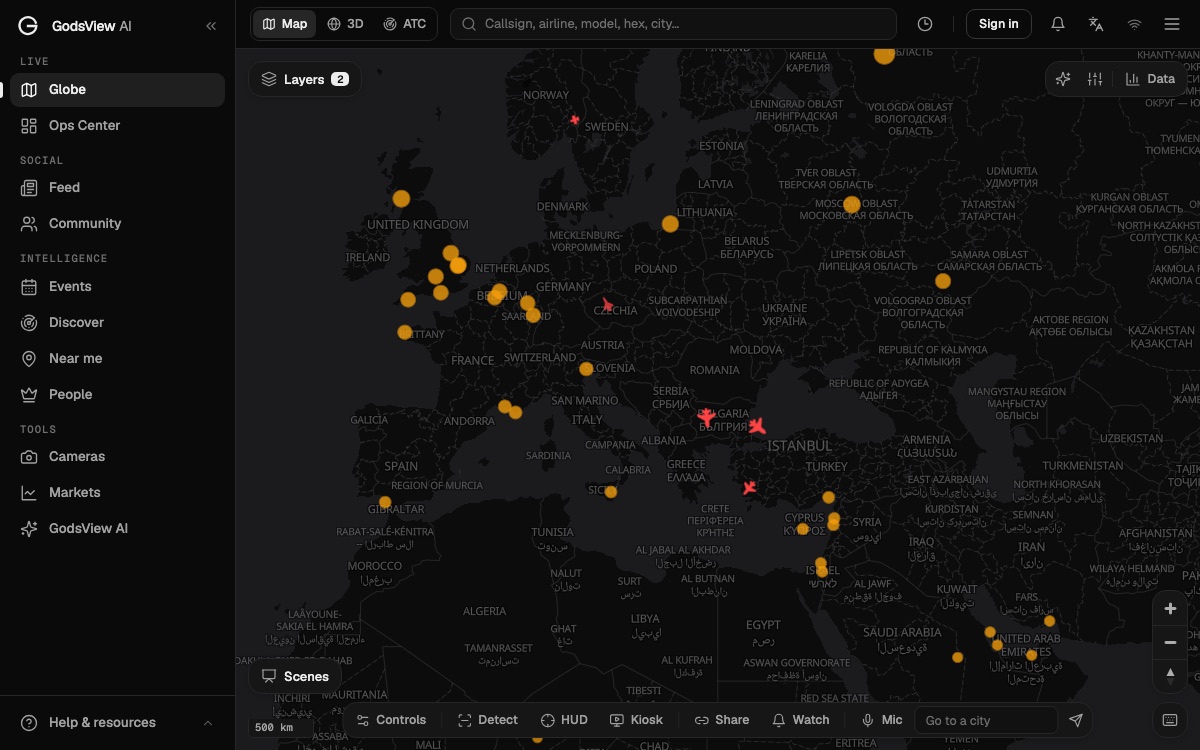
If you can't find anything on the map, look at the social media accounts of the nearest air base or national guard unit. When a boom is reported widely, they often confirm whether their aircraft were flying supersonic.
Rocket launches and booster landings
If you live near Cape Canaveral in Florida or Vandenberg Space Force Base in California, rockets are a leading suspect. A first-stage booster returning to a landing zone falls through the atmosphere faster than sound and makes a sonic boom of its own. Vandenberg's sonic boom guidance explains that a Falcon 9 booster's shape, with its engines, landing legs and grid fins, produces a distinctive three-part boom rather than the usual double bang (Vandenberg SFB). Landing advisories there have warned that people in Santa Barbara, Ventura and San Luis Obispo counties may hear one or more booms. Launch providers and bases usually announce in advance when a landing may be heard.
The space launch tracker lists upcoming and recent launches, so you can line up a launch time with the boom. A launch at night can also explain a strange light in the sky; see what was that light in the sky for how to tell a rocket plume from a meteor or the Northern Lights.
Small earthquakes: heard before they're felt
Small, shallow earthquakes often make a sound. The USGS explains that high-frequency vibrations from a shallow quake produce the booming noise people describe; when a quake is deeper, those vibrations don't reach the surface. In some places these booms are common enough to have local names, such as the "Seneca guns" reported around New York's Finger Lakes and along the coasts of the Carolinas and Virginia.
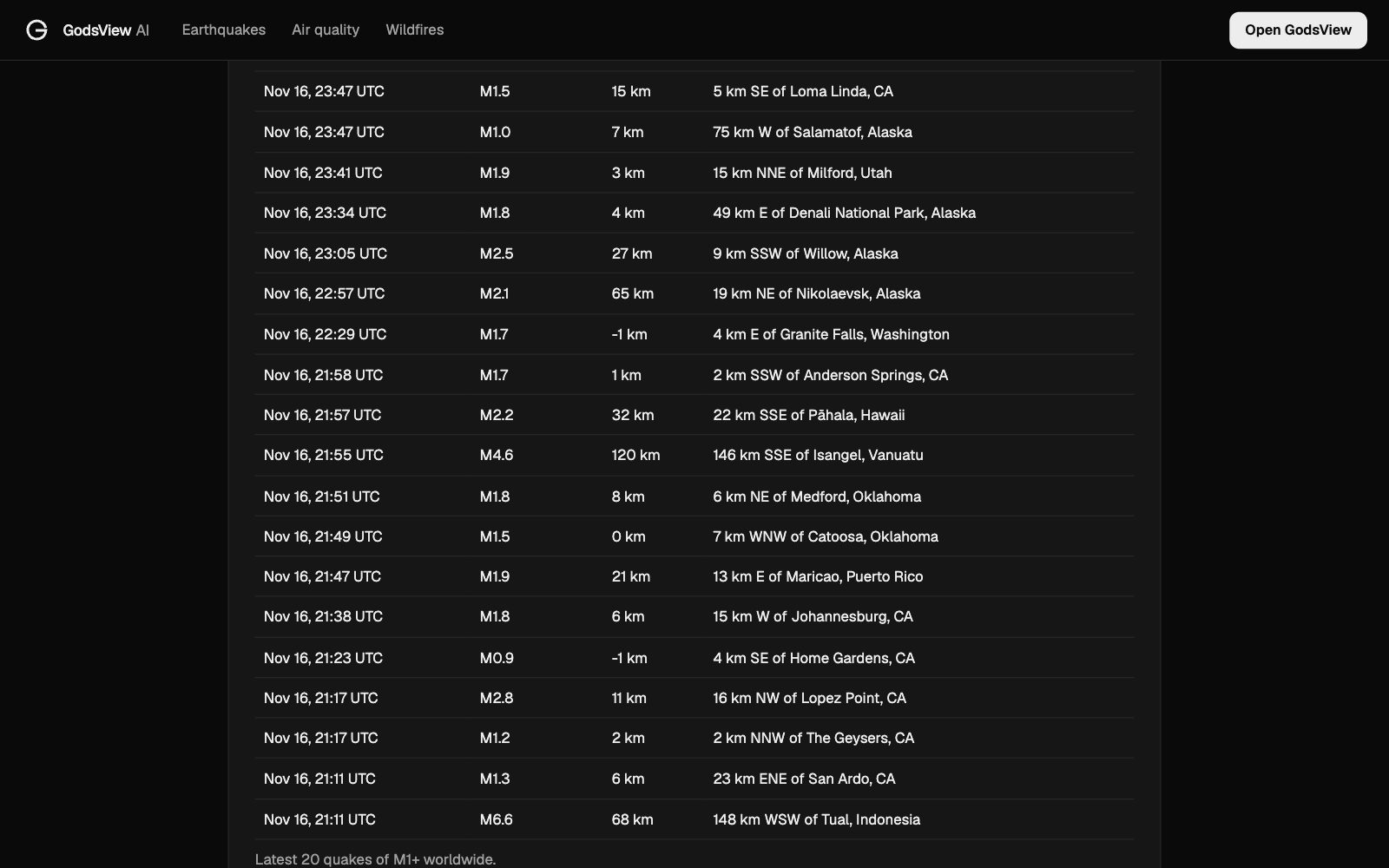
The check is quick. Open earthquakes today, which lists every quake the USGS has located worldwide in the last 24 hours. On November 16, 2026 it showed 31 quakes of magnitude 2.5 or more in the previous 24 hours, 16 of them in the United States. Small local quakes can take a few minutes to appear, and very small ones may only appear once a regional network has reviewed them. For more about reading the map, see the live earthquake map.
If a quake did occur, filing a "Did You Feel It?" report with the USGS helps seismologists map how strongly it was felt, even when it was tiny.
Frost quakes (cryoseisms)
On a bitterly cold night, a loud bang that seems to come from the ground or the house may be a frost quake. The USGS describes them as shallow groundwater freezing, expanding and making the frozen soil and rock around it crack. They tend to happen when the ground is saturated from rain or a thaw, there's little snow cover to insulate it, and the temperature drops sharply in a few hours. Reports cluster in Canada, New England and the Great Lakes states.
Two clues separate a frost quake from a real earthquake. It's very local, often heard by one street or one neighbourhood. And it doesn't show up on seismographs, so the USGS map will be empty. Houses also crack and pop as their frames contract in extreme cold, which the USGS lists as another explanation for cold-snap booms.
Meteors and fireballs
A fireball is a very bright meteor, brighter than about magnitude -4, which is roughly the brightness of Venus. The American Meteor Society says several thousand of them hit the atmosphere every day, though most go unseen over oceans or in daylight (AMS). Only the largest make a sound on the ground. According to the AMS, a very bright fireball that gets below about 50 km altitude may produce a sonic boom, and because sound is slow it generally arrives 1.5 to 4 minutes after the flash.
That delay is the giveaway. If people saw a brilliant light and then, a couple of minutes later, heard a boom, a fireball is the likely answer. Report what you saw to the AMS; enough reports let them reconstruct the meteor's path, and sometimes find where fragments fell.
The very largest fireballs are also picked up by US government sensors and published by NASA JPL's Center for Near Earth Object Studies (CNEOS). GodsView lists the latest of them on the meteor showers page, along with the calendar of showers.
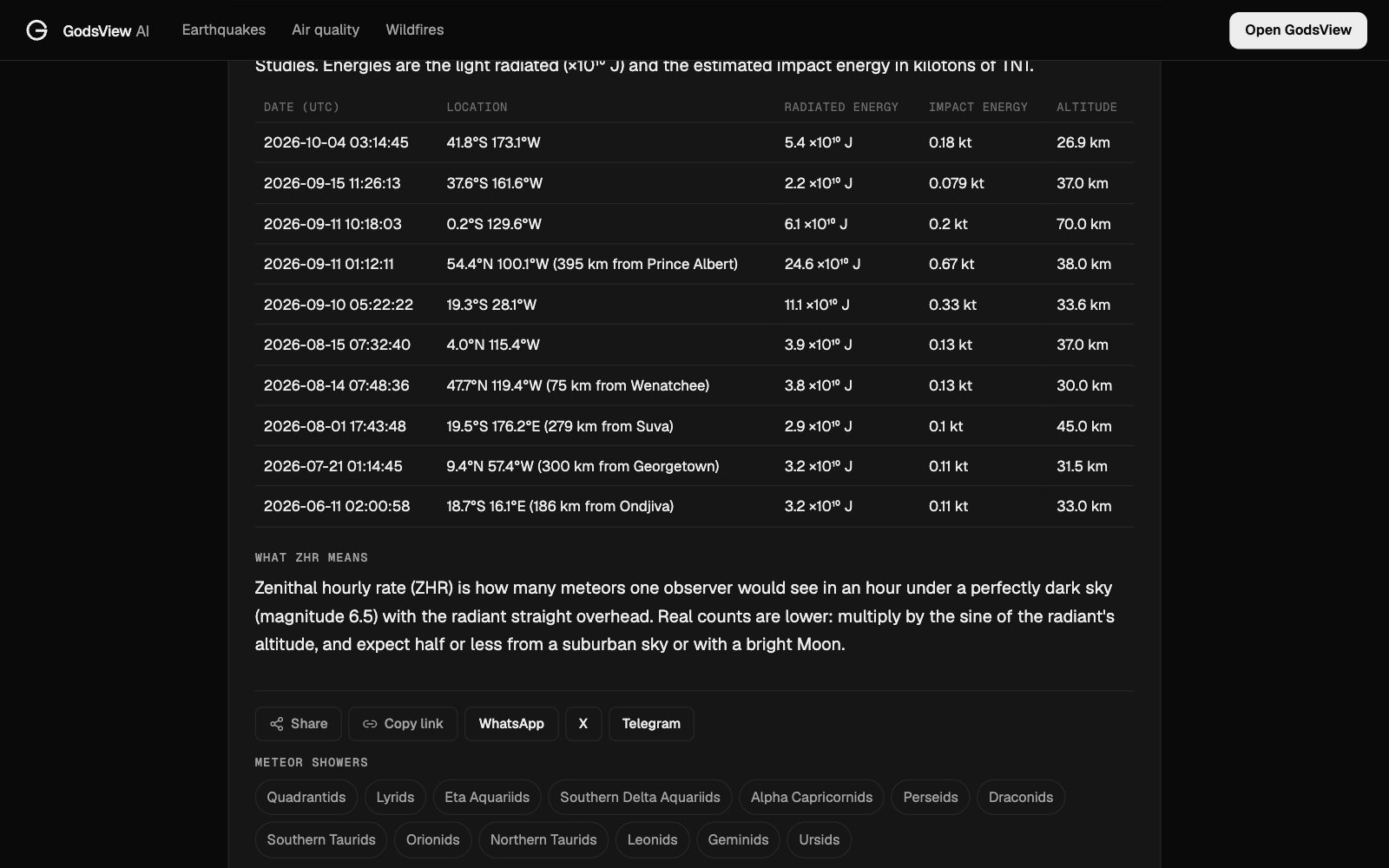
CNEOS data takes time to be published, so a fireball from tonight won't be there yet. The AMS log is the faster check.
Quarry blasts, construction and industry
Many booms that get traced turn out to be human activity, and quarries are high on the list. Blasting is usually done on weekdays during working hours, often at a similar time each day, and the sound is a single deep thump. If you hear the same boom at the same time on different days, a quarry or a large construction project is the likely source.
Large blasts are sometimes picked up by seismic networks, and the USGS catalog labels some events as quarry blasts or explosions rather than earthquakes. Factories, refineries, rail yards and military ranges are other common sources. Gas explosions are rarer, and if you smell gas or see smoke, call emergency services before investigating anything.
Transformer explosions and power cuts
An overloaded or failing transformer can fail with a loud bang and a bright flash, often blue or green, especially during storms, heat waves or when a tree branch or animal makes contact with equipment. The giveaway is the power: lights flicker or go out at the same moment, either for you or for nearby streets.
Check the power outage map for an outage that started at the time of the boom, then your utility's own outage page. Our guide to the power outage map near me explains how outage numbers are reported and why they lag. Stay well away from downed lines.
Thunder and fireworks
Thunder is the most ordinary boom of all, but it still fools people when a storm is far enough away that the lightning isn't obvious. The National Weather Service says thunder can be heard up to about 10 miles from a lightning strike, and if you can hear it you're close enough to be struck. A single loud clap from a distant storm, with no rain at your house, is easy to mistake for an explosion. Check the radar or weather warnings for storms nearby.
Fireworks are the answer far more often than people expect, especially on weekends, holidays and around sports events. They usually come in a series, often with crackling between bangs.
Still not sure? Use the live map
When nothing obvious turns up, putting everything on one screen helps. The GodsView live map shows earthquakes, flights, weather and news together, so you can look at the time and place of the boom across all of them at once. If you also heard a helicopter afterwards, it may be police or medical crews responding; our guide to why a helicopter is circling shows how to identify it.
A few final tips:
- Compare notes on distance. A boom heard across a whole county points to a sonic boom or fireball. One heard on a single street points to a frost quake, a transformer or something nearby.
- Note any shaking. Earthquakes, sonic booms and frost quakes can all rattle windows. Only a real earthquake shows on the USGS map.
- Report it. USGS "Did You Feel It?" reports and AMS fireball reports both help scientists, even if your boom turns out to be nothing.
Frequently asked questions
What was that loud boom just now?
Most mystery booms are sonic booms from military jets or rocket boosters, small shallow earthquakes, frost quakes, fireballs, quarry blasts, transformer failures, thunder or fireworks. Check the earthquakes today page first, then military flights, fireball reports, power outages and local news.
How do I know if it was a sonic boom?
A sonic boom is usually a sharp double bang heard over a wide area, with rattling windows but no flash and no ground shaking afterwards. Check for military aircraft nearby and for posts from the nearest air base. Booms near Florida and California launch sites may be returning rocket boosters.
Can planes break the sound barrier over land?
Civil aircraft can't fly supersonic over the United States under FAA rule 14 CFR 91.817. The FAA proposed lifting the ban in July 2026 but had not finalised it as of November 2026. Military aircraft fly supersonic mostly in designated training areas and offshore.
Do frost quakes show up on earthquake maps?
No. The USGS says frost quakes are caused by freezing groundwater cracking frozen soil and rock, and they aren't recorded on seismographs. A loud boom on a very cold night with nothing on the USGS map is often a frost quake.
Can a meteor make a boom?
Yes, but only very bright fireballs that penetrate deep into the atmosphere. The American Meteor Society says the boom usually arrives 1.5 to 4 minutes after the flash because sound travels slowly.
Why did I hear a boom and then the power went out?
That pattern usually means a transformer or other electrical equipment failed. Check the power outage map and your utility, and keep clear of any downed lines.
Sources
- USGS: Earthquake booms, Seneca guns and other sounds
- NASA Armstrong fact sheet: Sonic booms
- eCFR: 14 CFR 91.817, Civil aircraft sonic boom
- American Meteor Society: Fireball FAQ
- NASA JPL CNEOS: Fireball and bolide data
- Vandenberg Space Force Base: Sonic booms 101
- NOAA National Weather Service: Understanding lightning, thunder
Facts checked on against each provider's own site.