Explainer
Allerta Meteo in Italy: Yellow, Orange and Red Alerts
An Italian allerta meteo is not just a weather forecast: it is a civil protection alert about floods, landslides and storms, issued region by region. Here is what each colour means, who decides it, and where to check today's alerts and weather warnings.
Key takeaways
- Italy's allerta meteo-idro is issued by the regions' civil protection functional centres with the national Civil Protection Department, for each alert zone, based on expected flooding, landslides and storms.
- Allerta gialla (yellow) matches ordinary criticality, arancione (orange) moderate criticality and rossa (red) high criticality, with scenarios that range from occasional to serious danger to life.
- Alerts come in three types: hydrogeological (landslides, flash floods, urban flooding), hydraulic (major rivers) and thunderstorms; thunderstorm alerts only go up to orange.
- Every alert, even yellow, is passed to the mayors of the area, who activate their municipal emergency plans; regional procedures differ, so check your region's civil protection site.
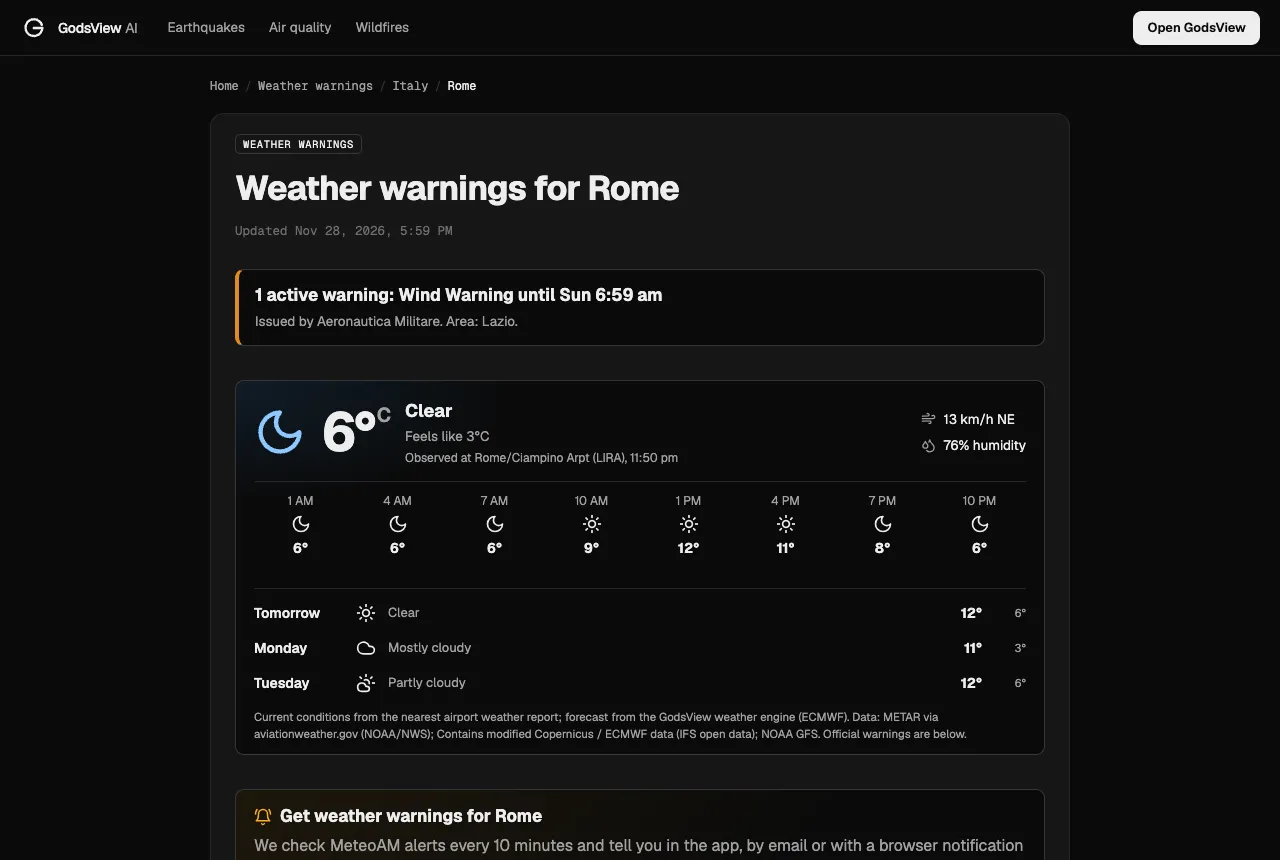
- GodsView shows the national weather service's MeteoAlarm warnings for Italy matched to each city, such as the wind warning for Lazio on Rome's page on November 28, 2026.
An allerta meteo in Italy is a civil protection alert about what the weather could do to the ground: floods, landslides and dangerous storms. It comes in three colours. Allerta gialla (yellow) means ordinary criticality: local flooding, small landslides and occasional danger to people. Allerta arancione (orange) means moderate criticality: more widespread flooding and landslides, with a danger to life. Allerta rossa (red) means high criticality: serious, widespread flooding and landslides, with a grave danger to life. Each region issues them for its own alert zones, and mayors act on them locally.
GodsView shows Italy's official weather warnings, published by the national weather service through MeteoAlarm, matched to each city: see Rome, Milan, Naples, Florence, Genoa or the full Italy weather warnings page. For the civil protection allerta colour of your comune, your regional civil protection site is the reference.
Check Italy weather warnings now
Allerta gialla, arancione, rossa: what each colour means
Italy's national civil protection guidance ties each colour to a level of criticità (criticality) and to a standard scenario of what can happen on the ground.
| Allerta | Criticità | What can happen (summary of the national scenario) | Danger to people |
|---|---|---|---|
| Nessuna allerta | No significant phenomena expected | Local lightning, hail, gusts or small floods from overwhelmed drains still possible in storms | Isolated damage |
| Gialla (yellow) | Ordinaria (ordinary) | Localised erosion, shallow landslides and mudflows in small catchments; minor streams rising and flooding nearby areas; water running down streets and drains backing up in low-lying urban areas; falling rocks | Occasional danger, with possible loss of life from incidental causes |
| Arancione (orange) | Moderata (moderate) | The same phenomena, but more widespread and intense, including larger rivers rising | Danger to people, with possible loss of life |
| Rossa (red) | Elevata (high) | Numerous, extensive landslides and floods, with major rivers potentially overflowing | Serious danger to people, with possible loss of life |
Typical effects listed for even a yellow hydrogeological alert include flooded basements and ground floors, temporary closure of roads and railways near channels and underpasses, and, in thunderstorms, roof damage, falling trees and branches, hail damage to cars and crops, and lightning strikes. That is why Italian authorities treat yellow as a real alert and not as a formality.
The three types of alert
Each alert names its risk type, and the colour can differ between types on the same day.
- Idrogeologica (hydrogeological): landslides, mudflows, flash floods on small streams, and urban flooding. Yellow, orange or red.
- Idraulica (hydraulic): flooding from the main rivers, such as the Po, Arno or Tiber, as water levels rise along the river network. Yellow, orange or red.
- Temporali (thunderstorms): intense, short downpours with lightning, hail and gusts. Yellow or orange only.
Why no red for thunderstorms? The national guidance says storms are too uncertain to forecast precisely in place, time and intensity, and that when storms come with intense, widespread rain, the situation is already covered by a red hydrogeological alert. So "allerta arancione per temporali" is the highest storm level you will see, and a red alert always means large-scale flooding and landslide risk.
Some regions also add their own types, such as wind, snow or avalanches, using the same colour scale with the national department's agreement.
Who issues an allerta meteo
This is what makes Italy different from most countries. The colours are not issued by a single national weather office.
- The forecast: the national Civil Protection Department and the regional Centri Funzionali (functional centres) assess the expected weather and its effects. The department publishes a national weather vigilance bulletin (Bollettino di vigilanza meteorologica nazionale) and a national criticality bulletin (Bollettino di criticità).
- The alert zones: each region is divided into zone di allerta, areas that react similarly to rain, each with its own rain thresholds and scenarios set by the region.
- The alert: the regional civil protection declares the alert level for each zone and the corresponding operational phase.
- The mayor: the alert, even a yellow one, is always sent to the mayors, and municipalities activate the procedures in their emergency plans. Local decisions such as closing schools, parks, cemeteries or underpasses are taken by the mayor.
Because each region sets its own procedures, the timing and wording vary across Italy. National guidance has pushed regions to use the same colour words, but you will still see differences between, say, Liguria, Emilia-Romagna and Campania.
Allerta vs MeteoAlarm warning
You may see two different maps for the same day:
- the civil protection allerta (gialla, arancione, rossa) for flood, landslide and storm risk, by alert zone; and
- the weather warning on MeteoAlarm, the European warnings site, which describes the weather itself, such as wind, rain, snow, thunderstorms or high temperatures, by area.
They answer different questions. A strong wind warning, like the one for Lazio in the screenshot above, may come with no hydrogeological allerta at all, while a yellow allerta for landslides can follow days of rain that never triggered a high weather warning. Our MeteoAlarm guide explains the European colour system.
What to do under each alert
Allerta gialla
- Check your region's bulletin and your comune's social pages in the evening.
- Avoid underpasses, riverbanks and basements during heavy showers.
- Secure balcony pots, awnings and loose objects if storms or wind are forecast.
Allerta arancione
- Do not sleep or stay in basements or ground floors in flood-prone streets.
- Move cars away from rivers and channels and out of underground garages in risk areas.
- Follow school closures and road closures ordered by the mayor.
- Do not cross fords, bridges over swollen streams or flooded roads.
Allerta rossa
- Follow civil protection instructions at once, including evacuation if ordered.
- Go to upper floors if water is rising; do not go down to garages or cellars to save belongings.
- Stay away from slopes, river embankments and coastal roads during the event.
- Keep a phone charged and listen to local radio and official channels.
IT-alert: warnings on your phone
Italy's national public warning system is IT-alert, run by the Civil Protection Department, which sends messages to mobile phones in an area affected by a serious emergency. The department itself stresses that IT-alert alone is not enough: you should also know the risks where you live and how to protect yourself. For phone settings and other alert sources, see our guide to weather alerts in your area.
Checking Italy's weather today
- Your city on GodsView: open Rome, Turin, Venice, Bologna, Palermo, Bari or Catania for active weather warnings, live conditions and a forecast, free and without an account.
- The whole country: the Italy weather warnings page lists every city under a warning.
- Live rain: watch storms on the weather radar.
- Alerts for saved places: GodsView Plus ($10.99 a month or $99.99 a year).
- Civil protection allerta: the national Civil Protection Department's criticality bulletin and your regional civil protection site.
Italy also has frequent earthquakes and active volcanoes: see earthquakes in Italy and is a volcano erupting right now. In summer, check the Italy and Europe wildfire map.
The short version
Allerta gialla means ordinary criticality: local floods, small landslides, occasional danger. Arancione means moderate criticality and a danger to life; rossa means high criticality and serious danger, with large rivers and widespread landslides. Thunderstorm alerts stop at orange. The regions issue the alerts by zone, the mayors act on them, and the national weather warnings on MeteoAlarm describe the weather itself. Check both before a rainy day out.
Frequently asked questions
What does allerta gialla mean in Italy?
Yellow alert (allerta gialla) matches "ordinary criticality": localised flooding, small landslides and mudflows, streams rising and drains overflowing in low-lying urban areas, with occasional danger to people. Mayors are always notified and municipal emergency plans are activated.
What is the difference between allerta arancione and allerta rossa?
Orange (moderate criticality) means more widespread flooding and landslides with a danger to life. Red (high criticality) means numerous, extensive landslides and floods, possibly including major rivers, with serious danger to life.
Why is there no red alert for thunderstorms in Italy?
National guidance caps thunderstorm alerts at orange because storms are too uncertain to forecast precisely, and widespread intense rain is already covered by a red hydrogeological alert.
Who issues the allerta meteo?
The regions' civil protection, with their functional centres and the national Civil Protection Department, for each alert zone. The alert is passed to mayors, who decide local measures such as closing schools.
Where can I check weather alerts in Italy today?
Your regional civil protection site for the allerta, and GodsView's Italy weather warnings page for the national weather warnings matched to each city, free.
Sources
- Dipartimento della Protezione Civile — Livelli di criticità e di allerta e relativi scenari d'evento (Allegato 1)
- Civil Protection Department — Meteo-hydro risk: alert
- IT-alert — National public warning system
- MeteoAlarm — warning levels documentation
Facts checked on against each provider's own site.