Explainer
Red Flag Warning Meaning: Fire Weather, Humidity and Wind Criteria
A red flag warning does not mean a fire is burning. It means the weather and dry vegetation are set up so that any spark could become a fast-moving wildfire. Here is what triggers one in different parts of the US, how it differs from a fire weather watch, and the everyday activities to avoid.
Key takeaways
- A Red Flag Warning means critical fire weather is occurring or about to: a mix of dry fuels and weather such as very low humidity, strong wind, a dry cold front or dry lightning that could cause extreme fire behavior.
- Criteria are set locally with land management agencies: around Grand Junction and Denver it is typically humidity of 15% or less with 25 mph winds or gusts for at least 3 hours in a 12-hour period.
- A Fire Weather Watch is issued 18 to 96 hours ahead when Red Flag conditions are possible; a Red Flag Warning means high confidence they will occur within 48 hours or less.
- During a warning, avoid anything that can spark: outdoor burning, grilling, fireworks, target shooting, dragging trailer chains, parking on dry grass and mowing dry vegetation.
- Burn bans are separate from Red Flag Warnings and are set by local or state authorities; in Texas, by a county judge or commissioners court.
A red flag warning means the National Weather Service has high confidence that critical fire weather is occurring or about to occur: a combination of dry vegetation and weather, usually very low humidity and strong, gusty wind, that could make any new fire spread rapidly and become hard to control. It does not mean there is a fire near you. It means a fire that starts today could get out of hand fast. The NWS message is "Take Action": be extremely careful with open flames.
The warning is written mainly for firefighters and land managers, but it applies to everyone: on a red flag day, everyday things that can make a spark, such as a dragging trailer chain or a lawn mower on dry grass, become dangerous.
See active red flag warnings now
What a red flag warning means
The NWS fire weather instruction (NWSI 10-401, updated August 25, 2025) says forecasters issue Fire Weather Watches and Red Flag Warnings when the combination of fuels and weather supports extreme fire danger and/or fire behavior. That alerts land management agencies to the risk of many new fires starting, or of existing fires becoming hard to control, both of which can threaten life and property.
Red Flag criteria have two halves:
- Fuels: how dry the grass, brush and timber are. NWS fire weather staff track fire danger indices and talk with land managers about fuel conditions before a warning.
- Weather: the instruction lists lightning episodes, significant dry frontal passages, strong winds, very low relative humidity and dry thunderstorms.
The NWS coordinates with local fire and land managers before issuing a watch or warning, but the final authority to issue it rests with the NWS.
Red flag warning vs fire weather watch
| Alert | What it means | Lead time | NWS message |
|---|---|---|---|
| Fire Weather Watch | Upcoming weather could lead to extensive wildfire occurrence or extreme fire behavior; critical conditions are possible but not imminent | Issued 18 to 96 hours before the expected start | Be prepared |
| Red Flag Warning | Critical fire weather is ongoing or expected soon, with high confidence | Conditions expected within 48 hours or less, or already occurring | Take action: be extremely careful with open flames |
The instruction says a Fire Weather Watch should not be issued to signal low confidence or borderline conditions; those go into the routine fire weather forecast instead. A watch is meant to give fire agencies at least a day's notice to move crews and equipment. The warning, once issued, stays in effect for as long as critical conditions are expected, and for prolonged events it may cover a whole multi-day period rather than switching on and off.
Exceptional red flag warnings
In rare cases, when Red Flag criteria are greatly exceeded or near record levels, the NWS instruction tells the office to spell out the exceptional nature of the hazard in the headline and text, and allows it to highlight particularly dangerous conditions for the public in coordination with emergency and fire managers. The product name stays "Red Flag Warning", so read the headline: special wording there means the event is far beyond the usual criteria.
Red flag warning criteria by region
There is no single national number. Each NWS office agrees its criteria with land management agencies in an annual operating plan, and they vary widely with climate and vegetation. Here are real criteria from NWS office pages, checked on November 28, 2026.
| Area (NWS office) | Main Red Flag criteria |
|---|---|
| Western Colorado and eastern Utah (Grand Junction) | Relative humidity of 15% or less with sustained winds or frequent gusts of 25 mph or more, together for at least 3 hours in a 12-hour period; or widely scattered dry thunderstorms (15% coverage or more, a "dry" storm producing under 0.10 inch of rain) |
| Denver/Boulder | Frequent gusts of 25 mph or more and relative humidity of 15% or less, for 3 hours or more in a 12-hour period; dry thunderstorms; first significant lightning after a hot, dry spell; poor overnight humidity recovery (staying at 40% or lower) |
| Oklahoma and Texas Panhandles (Amarillo) | Minimum relative humidity of 15% or less, with 20-foot winds of 20 mph or more and/or gusts of 35 mph or more, together for any 3 hours |
| New York City, Long Island and nearby (Upton, NY) | Winds sustained or frequently gusting above 25 mph, relative humidity under 30%, under a quarter inch of rain in the previous 3 or more days in spring and fall (5 or more in summer), plus a drought index threshold for fuels |
| North Florida, south Georgia and southeast Alabama (Tallahassee) | Different criteria in each of the three states, set in each state's annual operating plan, mixing humidity, wind and fuel dryness |
The NWS glossary gives a general picture used in many places: a dry spell of a week or two (or less before spring green-up or after fall color), fire danger high to extreme, and forecast sustained winds of 15 mph or more, relative humidity of 25% or less and temperatures above 75°F. In some states, dry lightning and unstable air are criteria too.
Notice how much lower the humidity threshold is in the dry West (15%) than around New York City (under 30%): each office sets criteria for its own climate and fuels.
Why dry air, wind and lightning matter
The NWS office in Tallahassee describes the purpose of these alerts as warning of critical weather and fuel moisture conditions that could lead to rapid or dramatic increases in wildfire activity, due to low relative humidity, strong winds, dry fuels or any combination of them. Local criteria pages add a few specific setups:
- Long dry, hot spells: Grand Junction lists long-term drought, much higher than normal temperatures with very low humidity, low fuel moisture and poor overnight humidity recovery among conditions that can create a critical fire situation.
- Dry cold fronts bring sudden wind shifts. The Grand Junction office singles out fronts with little or no rain when fires or prescribed burns are already active, because a fire's direction can change abruptly.
- Dry lightning starts fires with no rain to put them out. The Grand Junction and Denver offices also flag the first significant lightning after a hot, dry period, wet or dry, because it can readily start wildfires.
Red flag warnings right now
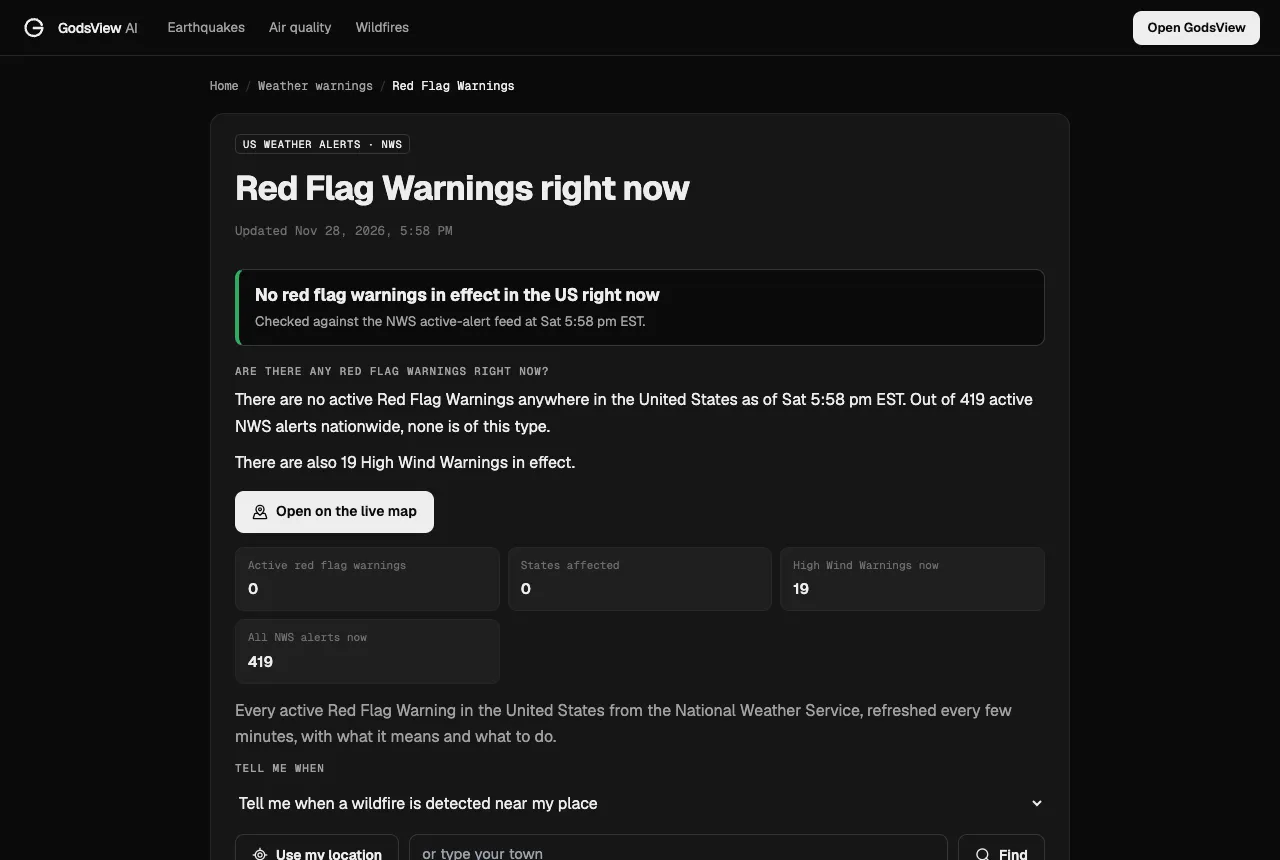
GodsView reads the NWS active-alert feed and keeps a live list of every Red Flag Warning in the US, with the zones covered and end times, free and without sign-in.
On November 28, 2026, there were none in effect. To check a place, open its page, for example Los Angeles, San Diego, Denver, Boulder, Amarillo, Reno or Phoenix. Strong wind often comes with red flag days: see live High Wind Warnings and our guide to what a wind advisory means.
To see fires that are actually burning, the live wildfire map shows NASA FIRMS satellite fire detections, with regional pages for California and Oregon. Our guides to whether there is a fire near you right now and how the NASA FIRMS wildfire map works explain what the satellite dots mean. If smoke is already in the air, check air quality in Los Angeles or your own city.
What not to do during a red flag warning
The Nebraska Forest Service, part of the University of Nebraska–Lincoln, gives a practical list for red flag days. Avoid or stop:
- Prescribed burns and open fires, including burning yard debris. Cancel planned burns immediately.
- Grilling and campfires outdoors.
- Fireworks and target shooting.
- Dragging chains. Check that trailer safety chains are not touching the road, since they throw sparks.
- Dropping cigarettes. Never drop lit cigarettes or throw them from a vehicle.
- Parking vehicles or leaving equipment on dry vegetation.
- Mowing dry grass, or do it only before 10 a.m. while the grass is still moist.
In its own advice, the NWS sums it up: be extremely careful with open flames.
Be ready to leave
A red flag warning by itself is not an evacuation order. Evacuation orders come from local emergency officials, so make sure you know how your county sends them, and keep your phone charged on red flag days.
Burn bans and red flag warnings
A burn ban is different from a red flag warning. The NWS issues red flag warnings about the weather; burn bans are restrictions set by local or state governments. In Texas, for example, the Texas A&M Forest Service explains that a county judge or county commissioners court can put a burn ban in place, restricting outdoor burning for public safety when drought conditions exist, with the details set by the local government. Check your county or fire department's rules before any outdoor burning.
Getting fire weather alerts
Red flag warnings are not on the NWS list of warnings that trigger Wireless Emergency Alerts, so your phone will not sound on its own. Turn on alerts in your weather app (our guide to weather alerts in your area explains how), and follow your county emergency management for evacuation alerts. GodsView Plus ($10.99 a month or $99.99 a year, see pricing) sends alerts for severe US weather warnings at your saved places.
The short version
A red flag warning means the weather and dry vegetation are primed for fast-spreading wildfire, typically very low humidity with strong, gusty wind, or dry lightning. It is not a sign of an existing fire, but any spark could start one. Skip outdoor burning, grilling, fireworks and mowing dry grass, secure trailer chains, and keep an eye on the live fire map and your local officials.
Check fire weather alerts for my city
Frequently asked questions
What does a red flag warning mean?
It means the National Weather Service has high confidence that critical fire weather, a combination of dry fuels and weather such as very low humidity, strong wind or dry lightning, is occurring or will occur soon. Any fire that starts could spread rapidly. It does not mean a fire is burning near you.
What is the difference between a fire weather watch and a red flag warning?
A Fire Weather Watch is issued 18 to 96 hours ahead when critical fire weather is possible but not imminent. A Red Flag Warning means there is high confidence that critical conditions will occur within 48 hours or less, or are already happening.
What humidity and wind cause a red flag warning?
It varies by NWS office. Around Grand Junction and Denver it is typically relative humidity of 15% or less with winds or gusts of 25 mph or more for at least 3 hours. In the Texas and Oklahoma Panhandles it is humidity of 15% or less with 20 mph winds or 35 mph gusts. Around New York City it is humidity under 30% with winds above 25 mph after a dry spell.
What should you not do during a red flag warning?
Avoid outdoor burning, campfires and grilling, fireworks, target shooting, dragging trailer chains, dropping cigarettes, parking on dry grass and mowing dry vegetation. Cancel any planned prescribed burns.
Is a red flag warning the same as a burn ban?
No. A red flag warning is a weather alert from the NWS. A burn ban is a legal restriction on outdoor burning set by local or state authorities; in Texas, for example, by a county judge or commissioners court. Check your local rules before burning anything.
Can I have a campfire during a red flag warning?
You should not. The Nebraska Forest Service advises avoiding open fires and grilling on red flag days, and the NWS says to be extremely careful with open flames. Check your county or fire department for any burn ban.
Sources
- National Weather Service — Understanding wildfire warnings, watches and behavior
- NWS Instruction 10-401, Fire Weather Services Product Specification (August 25, 2025)
- National Weather Service glossary — Red Flag Warning
- NWS Grand Junction — Fire weather criteria
- NWS Denver/Boulder — Red Flag Warning definitions
- NWS Amarillo — Fire weather products criteria
- NWS New York (Upton) — Fire weather watches and warnings
- NWS Tallahassee — Fire weather watch and red flag warning criteria
- Nebraska Forest Service — Red Flag Warnings: critical fire weather conditions
- Texas A&M Forest Service — Burn bans
Facts checked on against each provider's own site.