Explainer
Winter Storm Warning Meaning: Snow Totals, Criteria and What to Do
A winter storm warning means your local National Weather Service office is confident that snow, sleet, ice or blowing snow will be bad enough to threaten life and make travel difficult or impossible. Here is what triggers one where you live, and what to do before it starts.
Key takeaways
- A Winter Storm Warning means a significant winter storm of snow, sleet, ice or blowing snow is occurring, imminent or very likely, and travel will become difficult or impossible in places.
- The NWS issues warnings and advisories when forecasters have 80 percent or greater confidence that local criteria will be met; a Winter Storm Watch needs 50 percent or greater confidence.
- There is no single national snow total: central Illinois warns for 6 inches in 12 hours or 8 inches in 24 hours, while much of the Memphis area warns for 3 inches in 12 hours or 4 inches in 24 hours.
- Blizzard Warnings and Ice Storm Warnings are separate products for wind-driven whiteouts and damaging ice; a Winter Weather Advisory is the lower tier for snow and ice below warning level.
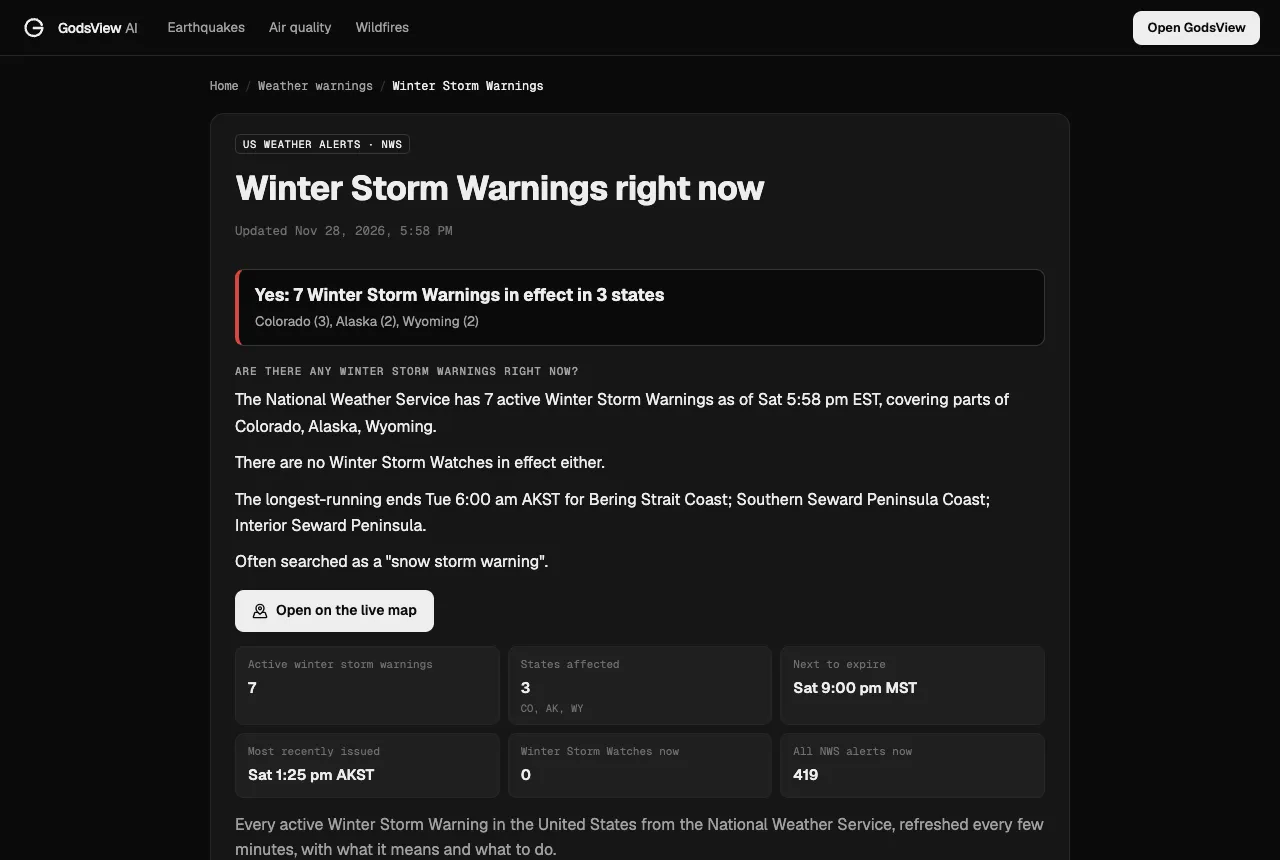
- GodsView's Winter Storm Warning page lists every active NWS warning by state, free and without sign-in; on November 28, 2026 it showed 7 warnings in Colorado, Alaska and Wyoming.
A winter storm warning means your local National Weather Service (NWS) office expects a significant winter storm, with heavy snow, sleet, freezing rain, blowing snow or a mix of them, and is confident enough to warn that travel will become difficult or impossible in some places. The NWS advice is short: delay your travel plans until conditions improve. People often search for a "snow storm warning", but in the US the official product is the Winter Storm Warning; there is no separate national "snow storm warning".
The amount of snow it takes depends on where you live. The NWS says the snow that triggers a Winter Storm Warning in the Northern Plains is typically much higher than the amount needed in the Southeast. Below you will find real criteria from several NWS offices, how a warning compares with a watch and an advisory, and a checklist for the hours before the storm.
See every active Winter Storm Warning now
What a winter storm warning means right now
The NWS defines three tiers for winter weather, and the warning sits at the top for ordinary snow and ice storms:
- Winter Storm Warning: a significant winter weather event with snow, ice, sleet or blowing snow, or a combination, is occurring, imminent or has a very high chance of happening. It is used for conditions that pose a threat to life or property.
- Winter Storm Watch: conditions are favorable for a significant winter storm, but its occurrence, location or timing is still uncertain.
- Winter Weather Advisory: wintry weather is expected but should not be hazardous enough to meet warning criteria. It still means slippery roads and travel trouble.
Two more warnings cover the most dangerous specific hazards. A Blizzard Warning is for strong wind (sustained or frequent gusts of 35 mph or more) with falling or blowing snow that frequently cuts visibility to under a quarter mile for three hours or more. An Ice Storm Warning is for damaging ice, usually around a quarter inch or more of freezing rain. If one of those is in effect, it replaces the Winter Storm Warning for that area. Our guides to the blizzard warning and the ice storm warning explain each in detail.
Winter storm watch vs warning vs advisory
The NWS winter weather instruction (NWSI 10-513, effective November 6, 2024) ties each product to how sure forecasters are:
| Product | What it means | Forecaster confidence | Typical action |
|---|---|---|---|
| Hazardous Weather Outlook | A hazardous winter storm may develop in the coming days | Low, early heads-up | Watch the forecast |
| Winter Storm Watch | Risk has increased; occurrence, location or timing still uncertain | 50 percent or greater that warning criteria will be met | Plan: stock up, check the car, adjust travel |
| Winter Storm Warning | Hazardous winter weather occurring, imminent or very likely; threat to life or property | 80 percent or greater | Delay travel; finish preparations now |
| Winter Weather Advisory | Wintry weather below warning criteria, but a significant inconvenience | 80 percent or greater | Allow extra time; drive with caution |
The same instruction says a watch should not be issued within 12 hours of the storm's start: by then the office either upgrades it to a warning or advisory, or cancels it. That is why you often see a watch one or two days ahead and a warning the evening before. A single winter weather event should not run longer than 48 hours unless absolutely necessary; longer storms are split or the warning focuses on the worst period.
For the full ladder of alert words across all hazards, our guide to weather watch vs warning covers every level.
How much snow for a winter storm warning?
There is no national number. Each of the NWS's local offices sets its own criteria, and the national map of heavy snow criteria is kept at weather.gov/snow-criteria. The table shows real examples from each office's own criteria pages, checked on November 28, 2026.
| Area (NWS office) | Snow needed for a Winter Storm Warning | Other triggers |
|---|---|---|
| Central Illinois (Lincoln) | At least 6 inches in 12 hours, or at least 8 inches in 24 hours | Sleet of at least half an inch |
| Eastern Nebraska and western Iowa (Omaha) | 5 to 6 inches or more, depending on location | Sleet of half an inch or more; near-blizzard conditions |
| Central New York (Binghamton) | 7 inches or more from one event | Half an inch of ice brings an Ice Storm Warning instead |
| Northeast Pennsylvania (Binghamton) | 6 inches or more from one event | Half an inch of ice brings an Ice Storm Warning instead |
| Most of the Memphis area | 3 inches in 12 hours, or 4 inches in 24 hours | Quarter inch of freezing rain; half inch of sleet; 2 inches of snow with any ice or sleet |
| North Mississippi counties (Memphis) | 2 inches in 12 hours, or 3 inches in 24 hours | As above |
| Anchorage area, most zones | 12 inches in 12 hours, or 24 inches in 24 hours | |
| Fairbanks area, some zones | 7 inches in 24 hours | |
| Hawaii summits (Mauna Kea, Mauna Loa, Haleakala) | More than 6 inches in 24 hours | Flat ice over a quarter inch on roads and structures |
The pattern is clear: places that rarely see snow warn for smaller amounts, because a few inches there close roads and schools that are not set up for it.
The midpoint rule
NWS offices decide using the midpoint of the forecast range, rounded up to the nearest inch. The national instruction gives this example: if the local warning threshold is 6 inches, a forecast of 4 to 8 inches (midpoint 6) gets a warning, but a forecast of 3 to 6 inches (midpoint 4.5) does not. So "4 to 8 inches" on your forecast and a warning on your phone are consistent even if your town ends up with 5.
Impact-based warnings
The criteria are guidance, not strict thresholds. The NWS instruction says protection of life comes first, so a forecaster may issue a warning for less snow when timing makes it worse, such as a storm at rush hour or early in the season when people are not yet used to winter driving. The reverse also happens: offices can choose other messaging where heavy snow is routine at high elevations.
What is inside a winter storm warning
Every NWS winter warning follows the same layout, so you can find what matters quickly:
- WHAT: the hazard and amounts, for example "Heavy snow expected. Total snow accumulations of 8 to 12 inches."
- WHERE: the counties or zones covered.
- WHEN: start and end times, in local time.
- IMPACTS: how it will affect you, for example roads becoming impassable or power outages from heavy wet snow.
- ADDITIONAL DETAILS: optional extra notes, such as peak snowfall rates.
- PRECAUTIONARY/PREPAREDNESS ACTIONS: what to do.
Read the WHEN line carefully. Warnings are often issued many hours before the first flakes, and the headline gives the exact window, such as "in effect from 7 AM this morning to 11 AM EST Wednesday".
Winter storm warnings right now
GodsView reads the NWS active-alert feed and keeps a live list of every Winter Storm Warning in the US, by state, with the areas covered and the issue and end times. It is free and needs no account.
When the screenshot above was taken, on the evening of November 28, 2026, there were seven warnings: three in Colorado, two in Alaska and two in Wyoming. The Winter Weather Advisory page showed six advisories in the same three states at the same time, a common pairing: the heaviest snow gets the warning and the edges of the storm get the advisory.
To check a single place, open its city page, for example Denver, Anchorage, Cheyenne, Minneapolis or Buffalo. Each shows any active alert, the current weather and the forecast. For watches issued a day or two ahead, see the Winter Storm Watch page.
What to do when a winter storm warning is issued
The NWS advice for a warning is to delay travel until conditions improve. Use the time before the storm starts:
- Stock the house. The NWS lists a battery-powered NOAA Weather Radio, food that needs no cooking or refrigeration, water, and enough heating fuel, since deliveries may not reach you for days after a storm.
- Plan for a power cut. Check that your carbon monoxide detector works and its outside vent is clear. Never run a generator in an enclosed space. Our power outage map guide shows how to check outages near you.
- Prepare the car if you must drive. Keep the gas tank near full, check lights, heater and wipers, and carry a winter survival kit. Tell someone your route and timetable, and call 511 for road conditions before you leave.
- Bring pets and animals in or to shelter, with water. The NWS notes that most animals that die in winter storms die from dehydration.
- Watch the clock on the warning. Conditions can go downhill fast once heavy snow starts; finish errands before the WHEN time.
If you have to drive
Weather is a big factor in road deaths: the NWS says that on average more than 5,000 people are killed and more than 418,000 injured each year in weather-related vehicle crashes. Slow down, clear all snow and ice from the car before setting off, and leave much more space. If you start to skid, ease off the gas and steer where you want the front of the car to go; with anti-lock brakes, apply steady pressure and do not pump them.
If you get stranded
The NWS advice is to stay with your vehicle, because you can become disoriented quickly in wind-driven snow. Run the engine for about 10 minutes each hour for heat, open a window slightly for fresh air, and clear snow from the exhaust pipe to avoid carbon monoxide poisoning. Turn on the dome light at night while the engine runs, tie a bright cloth to the antenna or door, and raise the hood once the snow stops to show you need help.
Winter storm warnings in Canada and elsewhere
Other countries use different names and scales. Environment and Climate Change Canada no longer publishes fixed numeric criteria: it uses Weather Impact Guides to choose a colour, yellow, orange or red, for each alert, and has separate guides for snow, winter storms, ice and visibility (including blizzards). Its "Winter storm" guide describes impacts such as travel disruption and road closures at the moderate level, up to stranded vehicles and prolonged, widespread utility outages at the extreme level. See Canada's live warnings or a city such as Toronto or Winnipeg.
In Europe, most national weather services publish snow and ice warnings in yellow, orange and red through MeteoAlarm, and GodsView shows them on each country page from the weather warnings hub.
How to get winter storm alerts on your phone
Winter Storm Warnings do not set off the Wireless Emergency Alerts that tornado warnings do; the NWS list of warnings that trigger those phone alerts includes Snow Squall Warnings but not Winter Storm or Blizzard Warnings. So if you want a push alert, you have to set one up:
- Use your phone's weather app or a dedicated alert app; our guide to weather alerts in your area walks through the settings.
- Keep a NOAA Weather Radio with a battery backup for overnight warnings.
- On GodsView, the free weather warnings pages show active alerts; GodsView Plus ($10.99 a month or $99.99 a year, see pricing) sends alerts for severe US weather warnings at your saved places.
Forecast amounts change as a storm gets closer. The warning text from your local NWS office is always the reference.
The short version
A Winter Storm Warning means a significant snow, sleet or ice storm is very likely, with travel difficult or impossible. The snow total that triggers one is set locally, from 2 or 3 inches in parts of the South to 12 inches in 12 hours around Anchorage. When one is issued, finish preparations, avoid travel during the WHEN window, and keep a kit in the car in case you get stuck.
Check winter storm warnings for my city
Frequently asked questions
What does a winter storm warning mean?
It means your local National Weather Service office expects a significant winter storm with snow, sleet, ice or blowing snow, or a combination, that is occurring, imminent or very likely. Travel will become difficult or impossible in some places, and the NWS advises delaying travel until conditions improve.
How many inches of snow is a winter storm warning?
It depends on where you live. Central Illinois warns for at least 6 inches in 12 hours or 8 inches in 24 hours, central New York for 7 inches or more per event, most of the Memphis area for 3 inches in 12 hours or 4 inches in 24 hours, and parts of the Anchorage area for 12 inches in 12 hours.
What is the difference between a winter storm watch and a winter storm warning?
A watch means a significant winter storm is possible but its timing or location is still uncertain; the NWS issues one at 50 percent or greater confidence. A warning means the storm is occurring or very likely, at 80 percent or greater confidence. A watch is a time to prepare; a warning is a time to act.
Is a winter storm warning worse than a winter weather advisory?
Yes. A Winter Weather Advisory covers snow, sleet or ice that is expected to stay below warning criteria: still slippery and disruptive, but less dangerous. A Winter Storm Warning is used for conditions that threaten life or property.
Is there such a thing as a snow storm warning?
Not as an official US product. The National Weather Service issues Winter Storm Warnings for heavy snow, sleet, ice or a mix, and separate Blizzard, Ice Storm, Lake Effect Snow and Snow Squall Warnings for specific hazards.
Where can I see all active winter storm warnings?
GodsView's Winter Storm Warning page lists every active NWS Winter Storm Warning by state, with areas and end times, free and without sign-in. City pages such as Denver show alerts for one place.
Sources
- National Weather Service — Winter weather warnings, watches and advisories
- NWS Instruction 10-513, WFO Winter Weather Products Specification (November 6, 2024)
- NWS Lincoln, IL — Winter storm watch, warning and advisory criteria
- NWS Omaha — Winter products
- NWS Binghamton — Expanded winter weather terminology
- NWS Memphis — Criteria for winter storm watches, warnings and advisories
- National Weather Service — Prepare for a winter storm
- National Weather Service — What to do if caught in a winter storm
- National Weather Service — Wireless Emergency Alerts
- Environment and Climate Change Canada — Weather Impact Guides
Facts checked on against each provider's own site.