Explainer
Special Weather Statement Meaning: Why It Is Not a Warning
Your phone or weather app says "Special Weather Statement" and nothing more. It is not a warning, but it is not nothing either. Here is what the National Weather Service uses it for, how long it lasts, and when it is a sign to change your plans.
Key takeaways
- A Special Weather Statement (SPS) is a National Weather Service product that gives information about ongoing or imminent weather hazards that call for heightened awareness or action, usually within the next 6 hours.
- It is not a watch, warning or advisory. Its most common use is a strong thunderstorm that is close to, but below, severe criteria: gusts of 40 to 57 mph, hail under 1 inch, frequent lightning, or funnel clouds not expected to become tornadoes.
- Offices also use it for short hazards such as black ice, brief lake-effect snow bands, heavy rain not expected to flood, or wind chills near advisory level for an hour or two, and to flag a major event more than 6 hours away.
- An SPS expires no more than 6 hours after it is issued, or 12 hours for an event forecast beyond 12 hours. A storm under an SPS can strengthen, so it is a cue to watch for a warning.
- In Canada, a special weather statement is issued for information only, for weather that is unusual, inconvenient or a cause for potential concern.
A Special Weather Statement means the National Weather Service (NWS) wants you to pay attention to a weather hazard that is happening now or will happen soon, but that does not meet the criteria for a watch, warning or advisory. Most often it is about a strong thunderstorm, one with gusts of 40 to 57 mph or hail smaller than an inch, that is close to severe levels. It is a heads-up, not an order: keep doing what you are doing, but be ready to move indoors and watch for an upgrade to a warning.
To see active statements right now, open GodsView's Special Weather Statements list, or check your city on the weather warnings hub.
See active Special Weather Statements
What a Special Weather Statement is
The NWS rules for this product are set out in NWS Instruction 10-517. It says Special Weather Statements "provide the public with information concerning ongoing or imminent weather hazards, which require a heightened level of awareness or action." They are usually used for hazards within 6 hours of being issued, but can also raise awareness of a major event forecast beyond 6 hours.
In the alert ladder, a Special Weather Statement sits below the advisory:
| Product | What it means | Typical action |
|---|---|---|
| Special Weather Statement | A hazard worth knowing about, below advisory or warning level | Stay aware, keep an eye on the sky and updates |
| Advisory | Hazardous weather that is a significant inconvenience | Take care, adjust travel |
| Watch | Conditions are favorable for a dangerous event | Prepare; know where you will shelter |
| Warning | A dangerous event is happening or imminent | Act now to protect yourself |
Our watch vs warning guide explains the ladder in full. The important point for a statement is that it is information, not a call to take shelter, unless the text itself tells you otherwise.
The most common use: strong thunderstorms below severe
A thunderstorm is officially severe when it produces winds of 58 mph or more or hail 1 inch (quarter size) or larger. Those storms get a Severe Thunderstorm Warning. Storms that come close get a Special Weather Statement. The NWS directive says offices should issue one "for strong thunderstorms that approach, or are expected to approach, severe convective criteria," and lists the general signs of a strong storm:
- Sustained winds or gusts of 40 to 57 mph (forecasters can use lower values at their discretion)
- Hail less than 1 inch in diameter
- Frequent to continuous lightning
- Landspouts not expected to threaten lives or property
- Funnel clouds not expected to become a tornado threat
- Waterspouts over an inland lake or river that are not expected to reach the shore
A typical statement reads like the example in the directive: "A strong thunderstorm will impact portions of Coconino County including Valle through 145 PM MST," with a hazard line of "Winds in excess of 40 mph and penny size hail" and an impact line saying gusty winds "could knock down tree limbs and blow around unsecured objects." The advice that goes with it is modest: "If outdoors, consider seeking shelter inside a building."
That said, 50 mph gusts can still bring down weak limbs, and frequent lightning is dangerous for anyone outside. If a statement mentions your town, it is a good time to finish the yard work, get off the golf course or the lake, and bring the dog in.
Other things a Special Weather Statement covers
The NWS also uses statements for high-impact events that are short or local and fall below other criteria. The directive lists examples:
- Black ice on roads
- Short-duration heavy snow bands below warning criteria
- Lake-effect snow bands that briefly reduce visibility (see our lake effect snow guide)
- Heavy rainfall that is not expected to cause flooding
- Heat indices or wind chills near advisory level for an hour or two
- Local blowing dust below advisory criteria
Offices can also use a statement to raise awareness of a major event more than 6 hours away, for example a significant storm in a day or two, before it is time for a watch. In that case the text is usually a plain-language summary of what is coming and when.
How long a Special Weather Statement lasts
According to the directive, a statement is valid from the time it is issued until it expires or is updated. The expiration time is no more than 6 hours after issuance, except for a statement about an event forecast more than 12 hours out, which can run up to 12 hours.
For a thunderstorm statement, the window is usually much shorter, matched to the time the storm takes to pass. In the directive's examples, one statement issued at 1:21 pm ran to 1:45 pm, and another issued at 5:23 am ran to 6:15 am. The headline says so, such as "through 145 PM MST".
What to do when you get a Special Weather Statement
- Read the text. The headline tells you the hazard and the place; the body tells you the expected impact. A statement about frequent lightning needs a different response than one about black ice.
- If it is a strong storm: move indoors before it arrives, secure light outdoor objects and avoid being on the water or under trees. The lightning map shows strikes in real time.
- If it is about roads: slow down, leave more space and allow extra time, especially on bridges.
- Watch for upgrades. Storms change quickly; a strong storm can become severe. If a Severe Thunderstorm Warning or Tornado Warning follows, act on it.
- Do not ignore the context. A statement on a day the Storm Prediction Center already has a severe risk out is more likely to be followed by warnings.
Special weather statements in Canada
Environment and Climate Change Canada (ECCC) uses the same name for a different kind of message. It describes a special weather statement as issued for information only (it is not an alert), when weather conditions are "unusual, inconvenient, or are cause for potential concern."
ECCC's alerts themselves, warnings, watches and advisories, now carry yellow, orange or red colours by impact. A special weather statement has no colour. See Canada's live warnings, or a city such as Toronto or Vancouver.
Where to see Special Weather Statements right now
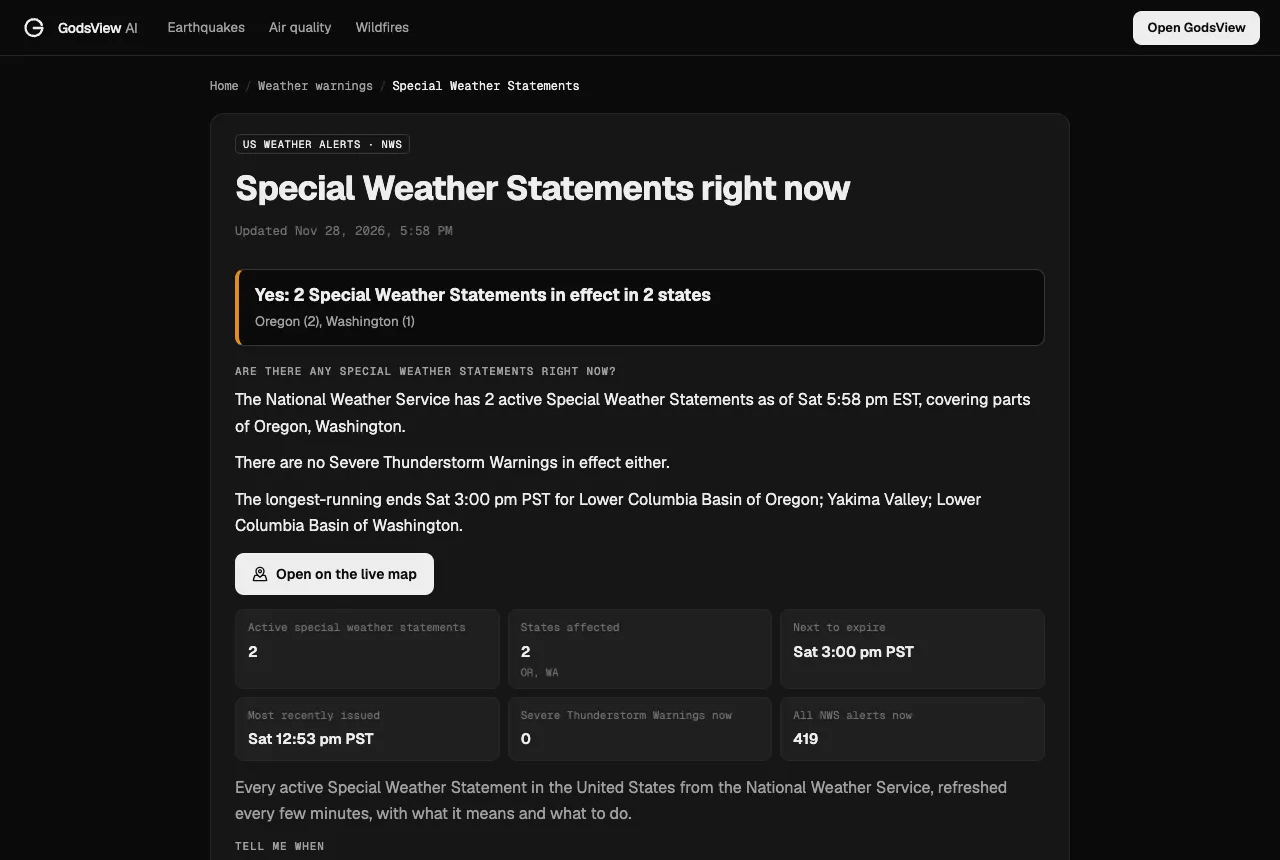
On November 28, 2026, GodsView's live list showed two statements in effect, in Oregon and Washington.
The Special Weather Statement page lists every active one by state, with the area, issue time and expiry, and links the cities inside each area. You can also:
- Check a city: for example Portland or Seattle.
- See the storms themselves on the live weather radar. Our guide to how to read weather radar explains what the colours mean.
- See higher-level alerts: the Severe Thunderstorm Warning list shows storms that crossed the severe line.
- Set up alerts: our weather alerts in your area guide covers phone settings. GodsView Plus ($10.99 a month or $99.99 a year) adds alerts for saved places.
Why the NWS issues statements at all
Warnings are kept for storms that meet fixed criteria, such as 58 mph winds or 1 inch hail. The statement gives forecasters a way to flag a storm that is worth watching but does not meet them, so that warnings keep their meaning. It also fills the gap for hazards that do not have their own product, like black ice on a clear morning, where a short heads-up can prevent crashes.
The short version
A Special Weather Statement is a heads-up from the NWS about a hazard that is real but below warning level, most often a strong thunderstorm with 40 to 57 mph gusts or small hail, or a short-lived problem like black ice. It lasts a few hours at most. Read the text, take simple precautions, and watch for an upgrade to a warning.
Check weather alerts for my city
Frequently asked questions
Is a Special Weather Statement serious?
It is below a watch, warning or advisory, but it flags a real hazard. Most are about strong thunderstorms with gusts of 40 to 57 mph or hail under an inch, which can knock down limbs and bring frequent lightning. Move indoors if the storm is heading your way and watch for an upgrade.
What is the difference between a Special Weather Statement and a warning?
A warning means a dangerous event is happening or imminent and you should act now. A Special Weather Statement gives information about a hazard that does not meet warning or advisory criteria, such as a storm just below severe levels.
How long does a Special Weather Statement last?
Under NWS rules it expires no more than 6 hours after it is issued, or up to 12 hours for an event forecast more than 12 hours ahead. Thunderstorm statements are usually much shorter, often under an hour.
Can a Special Weather Statement become a warning?
Yes. If a strong storm intensifies to severe levels (58 mph winds or 1 inch hail) the NWS issues a Severe Thunderstorm Warning, and a Tornado Warning if rotation or a tornado is detected.
What does a special weather statement mean in Canada?
Environment and Climate Change Canada issues it for information only, when weather is unusual, inconvenient or a cause for potential concern. It is not an alert and has no colour.
Where can I see active Special Weather Statements?
GodsView's Special Weather Statement page lists every active US statement by state, free and without an account.
Sources
- NWS Instruction 10-517, Multi-Purpose Weather Products Specification
- NWS Birmingham — What constitutes a severe thunderstorm?
- National Weather Service — Severe thunderstorm watches and warnings
- Government of Canada — Types of weather alerts
Facts checked on against each provider's own site.