Explainer
Environment Canada Weather Alerts: Colours and Alert Types
Since November 26, 2025, every Environment Canada alert has a colour. Here is what yellow, orange and red mean, how a warning differs from a watch, an advisory or a special weather statement, and which alerts make your phone sound.
Key takeaways
- Since November 26, 2025, every Environment and Climate Change Canada (ECCC) warning, watch and advisory carries a colour: yellow, orange or red, based on the expected impact in your area.
- Yellow means hazardous weather may cause damage, disruption or health impacts; orange means severe weather is likely to cause significant impacts; red means very dangerous, possibly life-threatening weather will cause extreme damage and disruption.
- The alert type says what kind of message it is: a warning means severe weather is happening or will happen, a watch means conditions could produce it, an advisory covers specific hazards, and a special weather statement is information only.
- Alert Ready interrupts TV, radio and compatible phones for tornado warnings and for severe thunderstorm warnings with winds of 130 km/h or more or hail of 7 cm or larger.
- GodsView's Canada weather warnings page checks 149 Canadian cities against ECCC's public alerts, free and without an account.
Environment Canada weather alerts now come with a colour that tells you how bad the impacts could be. Since November 26, 2025, every alert from Environment and Climate Change Canada (ECCC), whether a warning, a watch or an advisory, is yellow, orange or red. Yellow is the most common and means hazardous weather may cause damage, disruption or health impacts. Orange means severe weather is likely to cause significant impacts. Red is rare and means very dangerous, possibly life-threatening weather. ECCC sums it up as "Know the colour, know the risk."
To see which Canadian cities have an alert right now, open GodsView's Canada weather warnings page, or a city such as Toronto, Montreal, Vancouver or Calgary.
Check Canada weather alerts now
What the yellow, orange and red alert colours mean
ECCC introduced the colours with a new Alert Colour Matrix, so that alerts describe what the weather will do and not only what it will be. The government's own descriptions:
| Colour | ECCC description | Typical impacts | How often |
|---|---|---|---|
| Yellow | Hazardous weather may cause damage, disruption or health impacts | Moderate, localized and/or short-term | Most common |
| Orange | Severe weather is likely to cause significant damage, disruption or health impacts | Major and widespread, possibly lasting days | Uncommon |
| Red | Very dangerous and possibly life-threatening weather will cause extreme damage and disruption | Extensive, widespread and prolonged | Rare |
ECCC uses wind to show the difference. A yellow wind alert points to short-lived power outages, broken branches and a risk of injury from flying debris. An orange one means widespread outages, roof damage and snapped trees. A red one means long-duration outages, structural damage to buildings, significant tree damage and a high likelihood of injury.
The colour is about impact, not just about the weather numbers. The same storm can bring a different colour to different places, because ECCC weighs the timing, the location and the population exposed. A snowfall during the morning commute in a big city can rate higher than the same snowfall overnight in a rural area.
Warning, watch, advisory or special weather statement
The colour tells you how serious the alert is. The alert type tells you what kind of message it is.
Warning
A warning tells you that severe weather is occurring or will occur. ECCC's message is to act now to protect yourself. Warnings are usually issued 6 to 24 hours ahead, but a tornado may give less than 30 minutes of notice.
Watch
A watch means conditions are favourable for a significant storm or severe weather to develop. The message is to get ready. As forecasters become more certain about the path and strength of a storm, a watch can be upgraded to a warning.
Advisory
An advisory covers a specific weather or environmental hazard that is occurring, imminent or expected. ECCC issues them for hazards such as blowing snow, fog, freezing drizzle and frost, and for some non-weather hazards such as air quality.
Special weather statement
A special weather statement is information only. It is not an alert and does not carry a colour. ECCC uses it when the weather is unusual, inconvenient or a cause for potential concern, for example an early heads-up about a storm several days away.
Put together, a message such as "Orange Warning - Snowfall" means snow is happening or will happen, and its impacts are expected to be significant and widespread. "Yellow Advisory - Fog" means fog is the hazard, with moderate, local impacts.
Every alert now also includes the impact level, the forecast confidence, a description of the weather, its timing and location, the possible impacts and the safety actions to take. ECCC's advice is to read the full alert text whatever the colour.
Winter alerts you will see most often
Most Canadian alerts from November to March are winter alerts. ECCC's winter alert types include:
- Snowfall: significant snowfall is expected.
- Snow squall: cold air crossing large open water, such as the Great Lakes, creates nearly stationary bands of cloud and heavy snow.
- Freezing rain or freezing drizzle: rain or drizzle falls onto sub-zero surfaces and freezes on contact.
- Winter storm: several types of severe winter weather are expected together.
- Extreme cold: extremely cold temperatures or very low wind chill values.
- Blizzard: winds are expected to create blowing snow that cuts visibility to 400 metres or less over a wide area.
ECCC publishes the detailed criteria in its weather impact guides. Our guides to the US equivalents, the blizzard warning and the extreme cold warning, explain how similar hazards are handled south of the border.
When Alert Ready sounds on your phone
Alert Ready is Canada's emergency alerting system. It sends critical alerts through television, radio and LTE-connected, compatible wireless devices, with a distinctive tone. Most ECCC alerts do not go out this way. According to ECCC, Alert Ready interrupts broadcasts for:
- Tornado warnings, and
- Severe thunderstorm warnings with winds of 130 km/h or more or hail of 7 cm or larger.
For the full set of weather alerts, use ECCC's WeatherCAN app or the weather information map on weather.gc.ca, both of which show every alert with its colour.
How to check Environment Canada alerts right now
GodsView reads ECCC's public weather alerts and matches them to each city:
- The Canada weather warnings page lists every major city under an active alert, with its colour and type.
- City pages such as Ottawa, Edmonton, Winnipeg or Halifax show the alert text, its timing, live weather and the forecast.
- The weather warnings hub finds the nearest city with "Warnings for my location".
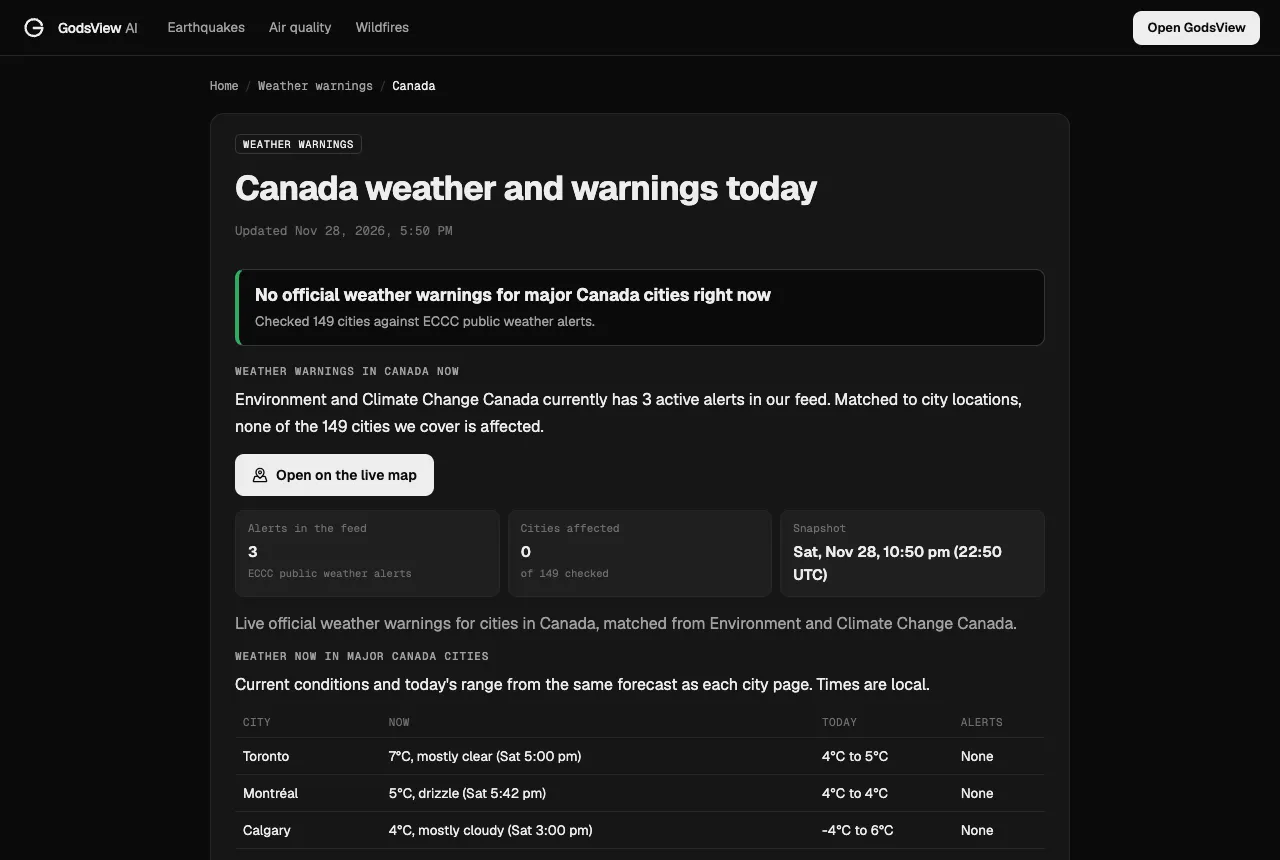
When we checked on November 28, 2026, none of the 149 Canadian cities GodsView tracks had an active ECCC alert. That changes quickly in winter, so check the live page before you travel. Here is what an alert looks like when one is in force:
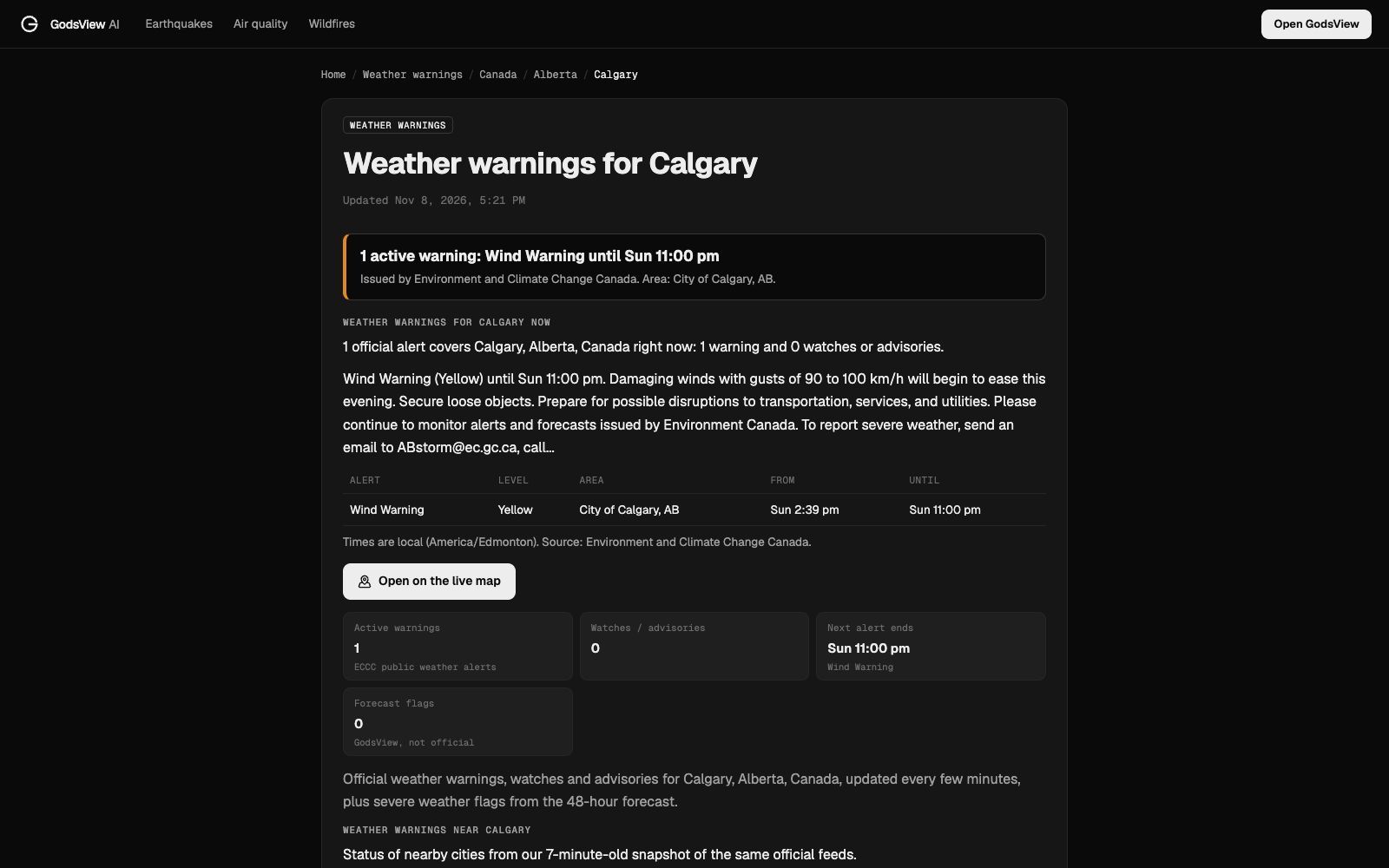
Read that Calgary alert from left to right and it answers three questions. Yellow is the impact level: moderate, local or short-lived impacts are expected. Warning is the alert type: the wind is happening or will happen, not just possible. Wind is the hazard, and the text gives the numbers behind it, gusts of 90 to 100 km/h. The issue and end times tell you how long to plan around it. If the same storm were expected to bring widespread outages and roof damage, the same alert type would carry an orange colour instead, and if it were expected to damage buildings over a wide area, red.
What to do for each colour
Yellow alert
- Read the alert: it names the hazard, the timing and the expected impacts.
- Allow extra travel time and check road conditions from your province.
- Secure loose items for wind, and dress for cold if the alert covers wind chill.
Orange alert
- Change plans that could be affected, especially travel on highways.
- Prepare for power outages: charge phones, find flashlights, and keep a safe way to stay warm.
- Check on neighbours who may need help, especially in extreme cold.
Red alert
- Treat it as a danger to life. Stay off the roads unless authorities say otherwise.
- Follow instructions from local emergency officials.
- Shelter in a sturdy building away from windows during destructive winds.
How the US system compares
Canada's watch, warning and advisory wording looks like the US National Weather Service's, but the US does not add a colour to each alert. Across the border, a "winter storm warning" is defined by its own criteria and the level of concern is carried by the alert type. If you live near the border or travel between the two countries, our watch vs warning guide explains the US system, and our fog warning guide compares fog alerts in Canada, the US and Europe.
Getting alerts on your phone
- WeatherCAN is ECCC's own app, with alerts for the locations you choose.
- Alert Ready reaches compatible phones automatically for the most dangerous weather.
- GodsView Plus ($10.99 a month or $99.99 a year) adds alerts for saved places when an official warning is issued, on the web and in the free iPhone and Android apps.
- Our guide to weather alerts in your area covers phone settings and other options.
The short version
Since November 2025, every Environment Canada alert carries a colour. Yellow means hazardous weather may cause damage or disruption, orange means significant impacts are likely, and red means very dangerous, possibly life-threatening weather. The type, warning, watch or advisory, tells you whether it is happening, could happen or is a specific hazard. Read the alert text, act on the colour, and check the live page for your city.
See Canada weather alerts by city
Frequently asked questions
When did Environment Canada start colour-coded alerts?
On November 26, 2025. Since then every ECCC weather alert, including warnings, watches and advisories, carries a colour: yellow, orange or red, based on the expected impact in your area.
What does an orange warning mean in Canada?
Orange means severe weather is likely to cause significant damage, disruption or health impacts. The impacts are expected to be major and widespread and may last for days. ECCC describes orange alerts as uncommon.
Is a yellow warning serious in Canada?
Yes. Yellow is the most common colour and means hazardous weather may cause damage, disruption or health impacts, usually moderate, local or short-lived. Read the alert text and adjust plans such as travel.
What is the difference between a watch and a warning in Canada?
A watch means conditions are favourable for severe weather to develop, so get ready. A warning means severe weather is happening or will happen, so act now. A watch can be upgraded to a warning as forecasters gain certainty.
Is a special weather statement an alert?
No. ECCC says special weather statements are information only and are not colour coded. They describe weather that is unusual, inconvenient or a potential concern, often before alerts are issued.
Which weather alerts come through Alert Ready?
ECCC says Alert Ready interrupts TV, radio and compatible wireless devices for tornado warnings and for severe thunderstorm warnings with winds of 130 km/h or more or hail of 7 cm or larger.
Sources
- Government of Canada — Colour-coded weather alerts
- Government of Canada — Weather alerts: types and how to receive them
- ECCC backgrounder — Colour-coded weather alerts (November 26, 2025)
- ECCC — Severe winter weather alerts
- Alert Ready — Canada's emergency alerting system
Facts checked on against each provider's own site.