Explainer
INMET Weather Alerts: Yellow, Orange and Red in Brazil
Brazil's national weather institute rates every warning yellow, orange or red: potential danger, danger and great danger. Here is what each level means in rain and wind, how an INMET aviso differs from a Defesa Civil alerta, and how to get warnings on your phone.
Key takeaways
- INMET, Brazil's National Institute of Meteorology, issues weather warnings (avisos) in three colours: yellow for perigo potencial (potential danger), orange for perigo (danger) and red for grande perigo (great danger).
- For rain, yellow corresponds to about 20 to 30 mm an hour or up to 50 mm a day, orange to 30 to 60 mm an hour or 50 to 100 mm a day, and red to more than 60 mm an hour or more than 100 mm a day.
- An INMET aviso is a weather forecast issued up to five days ahead; a Defesa Civil alerta is a local risk assessment that adds river levels, slopes and community vulnerability, with instructions for residents.
- To get Defesa Civil warnings by SMS, text your CEP (postal code) to 40199; the service is free. The Defesa Civil Alerta cell broadcast system reaches phones in a danger zone with no sign-up.
- GodsView reads INMET's live alerts and matches them to each city, free on pages such as São Paulo and Rio de Janeiro.
An INMET alert (aviso) is Brazil's official weather warning, and its colour tells you how dangerous the weather will be. Yellow, "perigo potencial", means potential danger: localised storms, with a low risk of serious damage. Orange, "perigo", means danger: the forecast weather is likely to cause damage and accidents, so stay very alert. Red, "grande perigo", means great danger: weather of exceptional intensity, with serious damage likely and a direct threat to life. For heavy rain, yellow starts at about 20 mm an hour and red at more than 60 mm an hour.
GodsView reads INMET's active warnings and matches them to each city's location, so you can see in seconds whether yours is under an alert: try São Paulo, Rio de Janeiro, Belo Horizonte, Porto Alegre or the full list on the Brazil weather warnings page.
Check INMET alerts for my city
What the three INMET colours mean
INMET (Instituto Nacional de Meteorologia) is the federal weather service. It publishes its warnings on its alert site and as an RSS feed, and every warning carries one of three severity levels.
| Colour | INMET level | In English | What it means for you |
|---|---|---|---|
| Amarelo (yellow) | Perigo potencial | Potential danger | Weather that can cause local disruption, with a low risk of serious damage: isolated power cuts, falling branches, local flooding, lightning |
| Laranja (orange) | Perigo | Danger | Weather with a high chance of causing damage and accidents. Stay very alert and keep checking the forecast |
| Vermelho (red) | Grande perigo | Great danger | Weather of exceptional intensity, with a high chance of serious damage and accidents and a direct threat to life |
There is no "green" INMET warning: if your area has no aviso, there is simply no warning in force.
The rain and wind numbers behind each level
INMET's warning types each have their own thresholds. The ones you will see most often in the rainy season are chuvas intensas (intense rain), acumulado de chuva (rain totals) and tempestade (storms with lightning, gusts and sometimes hail). As reported from INMET's criteria:
| Level | Rain per hour | Rain per day | Wind gusts (storm warnings) |
|---|---|---|---|
| Yellow | 20 to 30 mm | Up to 50 mm | 40 to 60 km/h |
| Orange | 30 to 60 mm | 50 to 100 mm | 61 to 99 km/h |
| Red | More than 60 mm | More than 100 mm | More than 100 km/h |
Storm warnings use the same rain and wind bands and add the chance of hail. INMET also issues warnings for coastal winds, rough seas, cold waves, frost, heat waves, low humidity, snow and sharp temperature drops, each with its own criteria.
Hourly rates matter because Brazil's worst flood and landslide disasters come from short, very intense bursts of rain over steep, crowded hillsides and small rivers. A red warning means rain at a rate that drains and slopes in those places are not built to handle.
Aviso vs alerta: INMET and Defesa Civil
Brazilians hear two words, and INMET itself explained the difference in October 2026:
- Aviso meteorológico (INMET): a forecast of severe weather that may cause impacts, issued up to five days ahead and updated daily. It is about the weather.
- Alerta (Defesa Civil): a risk assessment by civil defence that takes the weather forecast and adds local conditions, such as river levels, slope stability and how vulnerable a community is, then gives residents protective instructions.
So INMET might put a whole region under an orange aviso for heavy rain, while your municipality's Defesa Civil issues a specific alerta to evacuate a hillside neighbourhood. When the two seem to disagree, follow the Defesa Civil instructions for your street: they are the local decision.
Why INMET's areas look so big
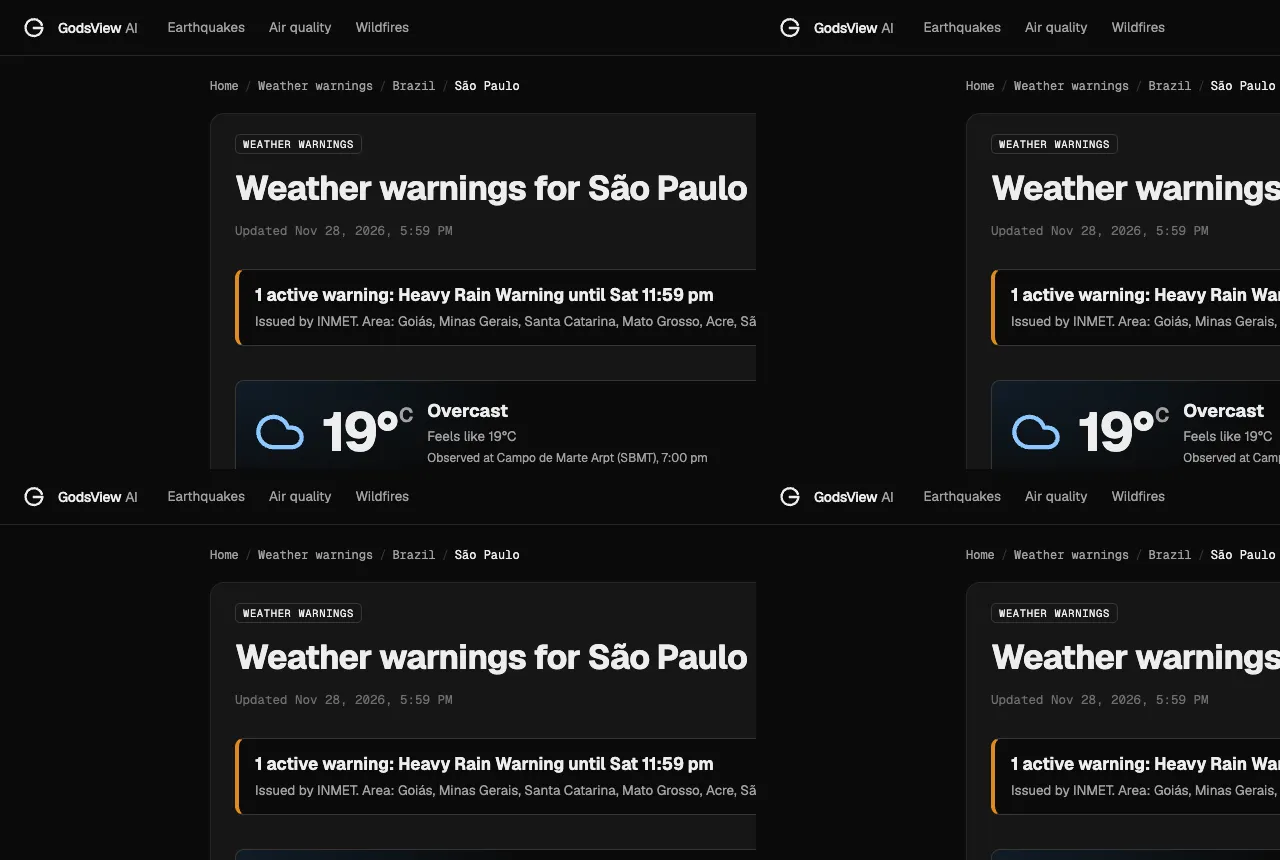
INMET warning polygons are drawn over the area where the weather is expected, which often crosses several states. The São Paulo warning in the screenshot above, for example, covered parts of six states at once. Being inside the polygon means the weather could reach you; it does not mean every town in it will get the worst of it. That is another reason to check the local Defesa Civil.
How to get alerts on your phone in Brazil
Brazil has two phone channels, and they work differently.
SMS 40199 (sign up with your CEP)
Send an SMS with your CEP (postal code) to 40199. The federal government says the service is free and takes effect immediately. You can register more than one CEP, for example home, work and your children's school, by sending one message per CEP. Defesa Civil also offers the same alerts on WhatsApp at (61) 2034-4611. In 2025 the SMS channel sent about 1.16 million messages, according to figures published in January 2026.
Defesa Civil Alerta (cell broadcast, no sign-up)
The newer Defesa Civil Alerta uses cell broadcast: a warning is sent to every phone connected to 4G or 5G in the danger zone, with no registration, no credit and no internet needed. It is used for major hazards such as floods, landslides, fires, storms and hail. In 2025, Defesa Civil and ABR Telecom sent 805 of these high-risk alerts, 698 rated severe and 107 extreme, with Santa Catarina and São Paulo receiving the most.
Cell broadcast is reserved for the most serious, imminent risks, so the 40199 SMS service is the way to also get the lower-level, preventive messages for the places you care about.
What to do under an orange or red INMET alert
- Find out whether your local Defesa Civil has issued an alerta and follow it.
- Avoid slopes, riverbanks and canal edges during heavy rain; landslides and flash floods give little warning.
- Never drive or walk through flooded streets. Water can hide open drains, and cars float in surprisingly shallow water.
- During storms, stay away from trees, billboards and power lines, and unplug electronics if lightning is close.
- Charge your phone and keep a torch and documents in a waterproof bag.
- If told to leave, leave early, ideally before dark, when it is much harder to see rising water or moving ground.
Other INMET warning types
Rain and storms are the warnings most people see, but INMET's list is much longer. It also issues warnings for:
- Ventos costeiros and ressaca: strong coastal winds and rough seas, important for fishing, ports and beach towns.
- Onda de frio, geada and declínio de temperatura: cold waves, frost and sharp temperature drops, mostly in the south.
- Onda de calor: heat waves, when temperatures stay well above normal for several days.
- Baixa umidade: very dry air, which often comes with wildfire season and smoke. On those days the Amazon wildfire map and the live wildfire map show where fires are burning.
- Vendaval, granizo and tornado: damaging winds, hail and tornadoes, usually as part of storm events.
- Neve: snow, which does happen in the highlands of the far south.
Each uses the same yellow, orange and red scale, so the meaning of the colour stays the same even when the hazard changes.
Reading an INMET alert on GodsView
Each GodsView city page shows the warning's type, level, end time and the area INMET defined, together with live weather and a forecast. You can:
- Open a city, such as Curitiba, Salvador, Recife, Manaus or Brasília.
- Use the weather warnings hub and press "Warnings for my location".
- Open the weather radar to watch the storm cells themselves move in.
- On GodsView Plus ($10.99 a month or $99.99 a year), save places and get an alert when something affects them.
GodsView shows INMET's warning as issued; the official source is always INMET and your local Defesa Civil. For more on alert systems in general, see our weather watch vs warning guide and how to get disaster alerts near home.
The short version
INMET's yellow alert means potential danger (about 20 to 30 mm of rain an hour), orange means danger (30 to 60 mm an hour or up to 100 mm a day), and red means great danger (more than 60 mm an hour or 100 mm a day, or gusts over 100 km/h). An aviso is the weather forecast; a Defesa Civil alerta is the local order. Text your CEP to 40199, keep cell broadcast alerts on, and check your city's live warnings before you head out.
Frequently asked questions
O que significa alerta laranja do INMET?
Orange (laranja) is the middle INMET level, "perigo" (danger). The forecast weather has a high chance of causing damage and accidents; for rain that is about 30 to 60 mm in an hour or 50 to 100 mm in a day. Stay very alert and follow Defesa Civil.
What does perigo potencial mean?
It is the yellow INMET level, "potential danger": weather that can cause localised disruption, such as falling branches, local flooding and power cuts, with a low risk of serious damage. For rain, about 20 to 30 mm an hour or up to 50 mm a day.
What is the difference between an INMET aviso and a Defesa Civil alerta?
An INMET aviso is a weather forecast, issued up to five days ahead. A Defesa Civil alerta is a local risk assessment that adds river levels, slopes and community vulnerability, and tells residents what to do.
How do I receive Defesa Civil alerts by SMS?
Text your CEP (postal code) to 40199. The service is free and you can register several CEPs. Cell broadcast alerts (Defesa Civil Alerta) reach 4G and 5G phones in a danger zone with no registration.
Where can I see INMET alerts for my city?
On INMET's alert site, or on GodsView's Brazil weather warnings page, which matches INMET's active warnings to each city, free and without an account.
Sources
- INMET — Aviso meteorológico ou alerta? Entenda a diferença (October 2026)
- CNN Brasil — Entenda os alertas do INMET para temporais (thresholds by level)
- Gov.br — Cadastro para recebimento de avisos e alertas de desastres (SMS 40199)
- Teletime — Defesa Civil e ABR Telecom emitiram 805 alertas de risco em 2025 (January 2026)
Facts checked on against each provider's own site.