Safety guide
Flash Flood Warning: What It Means and What to Do Right Now
A flash flood warning means a sudden, violent flood is happening or about to happen near you. If you are in a low spot, move to higher ground now and never drive into water over a road. Here is what the warning text tells you and why flash floods catch so many drivers.
Key takeaways
- A Flash Flood Warning is issued when a flash flood is imminent or occurring; if you are in a flood-prone area, the NWS says to move immediately to high ground.
- A flash flood is a sudden, violent flood that can develop in minutes to hours, and can hit places that are not receiving rain themselves.
- Warnings carry a damage threat tag: the default, "considerable" or, in exceedingly rare cases, "catastrophic" with a Flash Flood Emergency headline; only considerable and catastrophic warnings trigger Wireless Emergency Alerts.
- The NWS says 6 inches of fast-moving water can knock over an adult, 12 inches of rushing water can carry away most cars and 2 feet can carry away SUVs and trucks.
- More than half of flood-related drownings happen when a vehicle is driven into hazardous flood water, so never drive around barriers or through a flooded road: Turn Around Don't Drown®.
A flash flood warning means a flash flood is happening or about to happen in the warned area. If you are in a low-lying or flood-prone spot, the National Weather Service's instruction is simple: move immediately to higher ground. Do not wait to see the water, and do not drive or walk into flooded roads. A flash flood is a sudden, violent flood that can develop within minutes to hours, and it can even reach places where it is not raining.
This guide covers what to do right now, what the warning text means, how a flash flood warning differs from a flood warning, and when it becomes a flash flood emergency.
See active flash flood warnings now
What to do in a flash flood warning
- Get to higher ground now if you are in a valley, near a creek or river, in a dry wash, in a basement apartment or in any spot that floods. Go up, not out into moving water.
- Do not drive into water on a road, even if it looks shallow. The road beneath may have washed away. Turn around and find another route.
- Do not walk into moving water. The NWS says 6 inches of fast-moving flood water can knock over an adult.
- Avoid low spots such as underpasses, low-water crossings and creek beds, especially at night, when you cannot see how deep or fast the water is.
- Keep getting updates. Flash flood warnings are updated with flash flood statements and can be extended for many hours when rain keeps falling. Check the warning end time and your city's alerts.
- If you are camping or hiking in canyons or along streams, leave the channel at once. NOAA's National Severe Storms Laboratory (NSSL) says a creek only 6 inches deep in mountainous terrain can swell to a 10-foot-deep raging river in less than an hour.
Turn Around Don't Drown®
The NWS flood safety campaign has one message for drivers: when you see water over the road, turn around. The numbers explain why:
| Depth of moving water | What it can do (NWS) |
|---|---|
| 6 inches | Knock over an adult |
| 12 inches | Carry away most cars |
| 2 feet | Carry away SUVs and trucks |
The NWS cites the Centers for Disease Control and Prevention: over half of all flood-related drownings happen when a vehicle is driven into hazardous flood water, and the next largest share happens when people walk into or near flood water. NSSL adds that most flash flood deaths in the US are from vehicles driving into flooded roads. Water hides how deep it is and how fast it is moving, and it can hide a road that is no longer there. Never drive around barriers blocking a flooded road.
Flash flood warning vs flood warning vs flood watch
| Alert | What it means | NWS message |
|---|---|---|
| Flood Watch | Conditions are favorable for flooding; it does not mean flooding will occur, but it is possible | Be prepared |
| Flood Advisory | Flooding that is not expected to be bad enough for a warning but can be a significant inconvenience | Be aware |
| Flood Warning | Flooding is imminent or occurring | Take action |
| Flash Flood Warning | A flash flood is imminent or occurring | Take action: move immediately to high ground if in a flood-prone area |
| Flash Flood Emergency | Exceedingly rare: a severe threat to human life and catastrophic damage from a flash flood is imminent or ongoing | Seek higher ground now, as the warning directs |
The difference between a flood warning and a flash flood warning is urgency. The NWS issues flood warnings for rivers at specific forecast points, and for other high water that threatens life and property but is not a flash flood. A flash flood warning is for sudden, violent rises that need immediate action. The NWS instruction for these products (NWSI 10-922) says the choice between them is based on the level of urgency, not on how long the flooding has lasted. Our guide to flood watch vs flood warning covers the river side in more detail.
How fast flash floods happen
NSSL explains that flash floods happen when heavy rain falls faster than the ground can absorb it, and they can occur within minutes of the rain that causes them. Other causes include ice jams, snowmelt and dam or levee failures. Places most at risk include:
- Cities and suburbs, where buildings, roads, driveways and parking lots reduce the amount of rain the ground can absorb and send it into streets and drains.
- Low spots such as underpasses and basements.
- Mountains and canyons, where water from a storm upstream funnels into narrow channels. This is why a flash flood can reach you under clear skies.
- Areas near rivers with aging levees.
- Burn scars from recent wildfires: NWS flash flood warnings can include the expected rainfall rate over a burn scar.
NSSL also notes that in the US, floods kill more people each year than tornadoes, hurricanes or lightning.
What a flash flood warning says
Flash flood warnings follow the NWS impact-based format, so you can read them quickly:
- First bullet: the counties or areas under the warning.
- "Until": when the warning ends. The NWS sets this to when flooding is expected to end, not when the rain stops.
- "At...": what is happening, followed by HAZARD, SOURCE and IMPACT lines, for example "Flash flooding caused by thunderstorms", "Radar indicated" and the roads or neighborhoods expected to flood.
- Pathcast (optional): specific places, streets or mile markers likely to be affected.
- Tags at the bottom: FLASH FLOOD...RADAR INDICATED or OBSERVED; FLASH FLOOD DAMAGE THREAT...CONSIDERABLE or CATASTROPHIC; and sometimes EXPECTED RAINFALL RATE, such as 2 to 3 inches per hour.
Considerable, catastrophic and flash flood emergencies
The damage threat tag tells you how bad the NWS expects it to be:
- No tag (base): most flash floods, with potential for impacts and damage.
- CONSIDERABLE: flash floods capable of unusual severity of impact, where urgent action is needed to protect lives and property.
- CATASTROPHIC: exceedingly rare, violent flash floods that threaten lives and cause disastrous damage, with water rising rapidly to levels rarely, if ever, seen. These warnings always carry the headline FLASH FLOOD EMERGENCY for the named area.
The NWS instruction gives examples of when a flash flood emergency is used: emergency managers have declared a state of emergency because rapidly rising water is putting people in life-threatening situations; water is rising to levels where people who are normally safe in floods are now in danger, such as several feet above floor level in homes; multiple swift-water rescue teams are being deployed; gauges show water rising rapidly to at least major levels; or a major high-hazard dam has failed.
Will a flash flood warning alert my phone?
Not always. The NWS says Wireless Emergency Alerts are sent only for flash flood warnings with a CONSIDERABLE or CATASTROPHIC damage threat tag. A base flash flood warning does not set off the emergency alert tone on phones. That means you can be under a flash flood warning without your phone sounding.
To make sure you hear about every warning:
- Turn on alerts in your weather app; our guide to weather alerts in your area explains the settings.
- Keep a NOAA Weather Radio, which receives all NWS warnings for your county.
- During heavy rain, check the live list of flash flood warnings or your city's warning page.
- GodsView Plus ($10.99 a month or $99.99 a year, see pricing) sends alerts for severe US weather warnings at your saved places.
Flash flood warnings right now
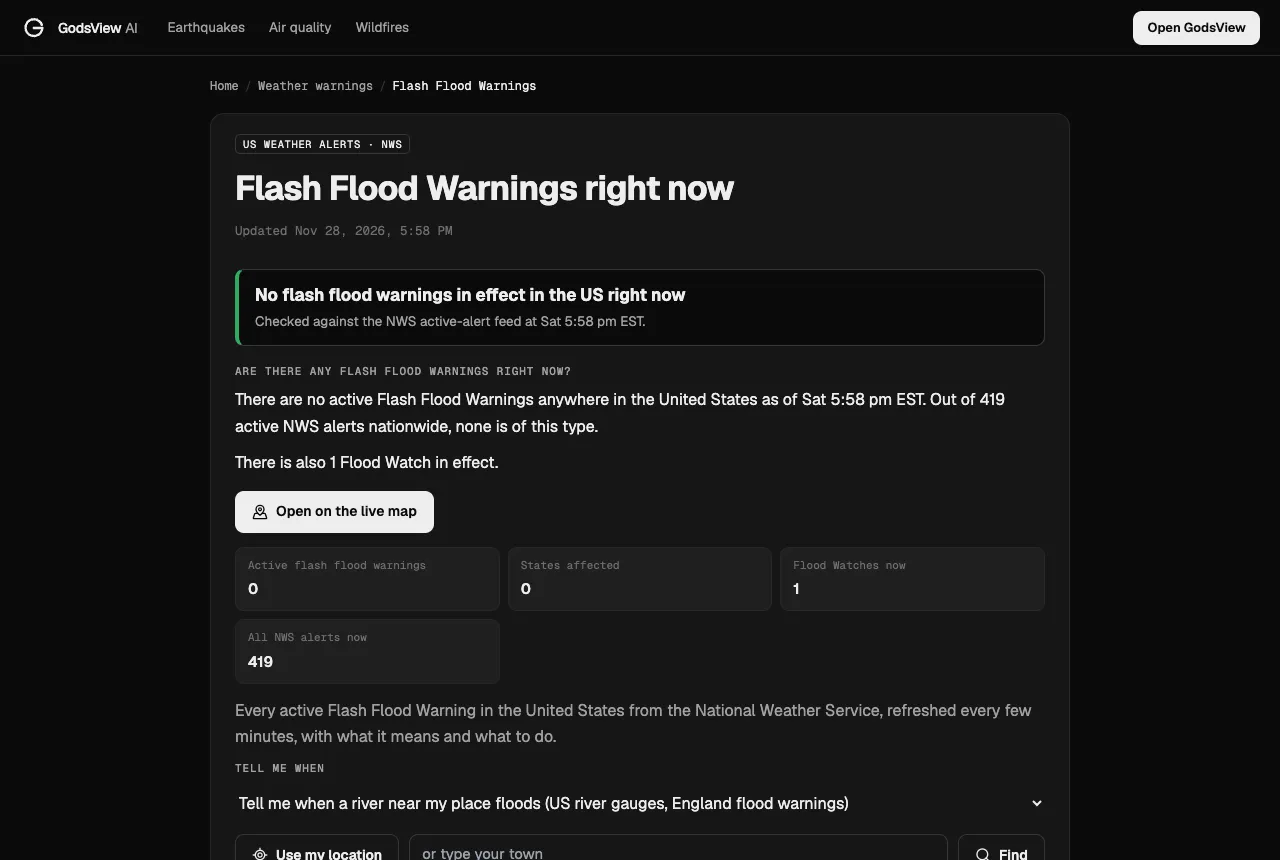
GodsView reads the NWS active-alert feed and keeps a live list of every Flash Flood Warning in the US, with the counties covered and end times. It is free and needs no account.
When this screenshot was taken, on the evening of November 28, 2026, there were none in effect. When storms are active, you can also check flood warnings for rivers and flood watches for the days ahead. City pages such as Houston, San Antonio, Austin, Nashville, Las Vegas and Phoenix show active alerts with the current weather and forecast.
To watch the rain itself, the weather radar page shows live precipitation; our guide on how to read weather radar explains what slow-moving or repeating storms, the classic flash flood setup, look like. Tropical storms and hurricanes bring some of the worst flash floods far inland; the hurricane tracker shows active storms.
The short version
A flash flood warning means fast, dangerous flooding is happening or about to happen. Move to higher ground right away if you are in a flood-prone spot, stay away from creeks, washes and underpasses, and never drive into water over a road: 12 inches of rushing water can carry away most cars. If the warning says FLASH FLOOD EMERGENCY, it is among the most dangerous alerts the NWS issues.
Check flood alerts for my city
Frequently asked questions
What should you do during a flash flood warning?
If you are in a low-lying or flood-prone area, move immediately to higher ground. Do not drive or walk into flooded roads or moving water, avoid underpasses, creeks and washes, and keep checking for updates until the warning ends.
What is the difference between a flood warning and a flash flood warning?
Both mean flooding is imminent or occurring. A flash flood warning is for sudden, violent flooding that develops in minutes to hours and needs immediate action; flood warnings cover river flooding at forecast points and other high water that is not a flash flood.
What is a flash flood emergency?
It is the most severe form of flash flood warning, used in exceedingly rare situations when a severe threat to human life and catastrophic damage from a flash flood is imminent or ongoing, for example when water rises to levels rarely if ever seen or a major dam fails.
How much water does it take to sweep away a car?
The National Weather Service says 12 inches of rushing water can carry away most cars, and 2 feet can carry away SUVs and trucks. Just 6 inches of fast-moving water can knock over an adult.
Why did I not get a phone alert for a flash flood warning?
Wireless Emergency Alerts are only sent for flash flood warnings with a considerable or catastrophic damage threat tag. Base flash flood warnings do not trigger the alert tone, so use a weather app or NOAA Weather Radio for every warning.
How long does a flash flood warning last?
It lasts until the flooding is expected to end, not until the rain stops. The NWS can extend flash flood warnings for 6, 12 or even 24 or more hours when heavy rain continues, and updates them with flash flood statements.
Sources
- National Weather Service — Flood watch vs flood warning
- National Weather Service — Turn Around Don't Drown
- NWS Instruction 10-922, Weather Forecast Office Water Resources Products Specification
- NOAA National Severe Storms Laboratory — Severe Weather 101: Floods
- National Weather Service — Wireless Emergency Alerts
Facts checked on against each provider's own site.