Explainer
NCM Saudi Arabia Weather Alerts: Yellow, Orange and Red
When the National Center for Meteorology puts your city under a yellow, orange or red alert, the colour tells you how far to change your plans. Here is what each level means, which weather it covers, and how to get NCM alerts on your phone.
Key takeaways
- Saudi Arabia's National Center for Meteorology (NCM) issues colour-coded early warnings: yellow means a region may be affected by a weather phenomenon, orange is an advanced warning to take precautions, and red is an explicit warning of severe weather such as floods.
- A red alert also activates Civil Defense instructions and preventive measures for the area marked in red.
- NCM alerts cover rain and thunderstorms, flash floods, hail, active winds with dust and sand, fog and other phenomena, for regions and governorates across the Kingdom.
- Civil Defense sends warning text messages to people in the affected area based on NCM data, and NCM's Anwaa app lets you choose which alert levels you are notified about.
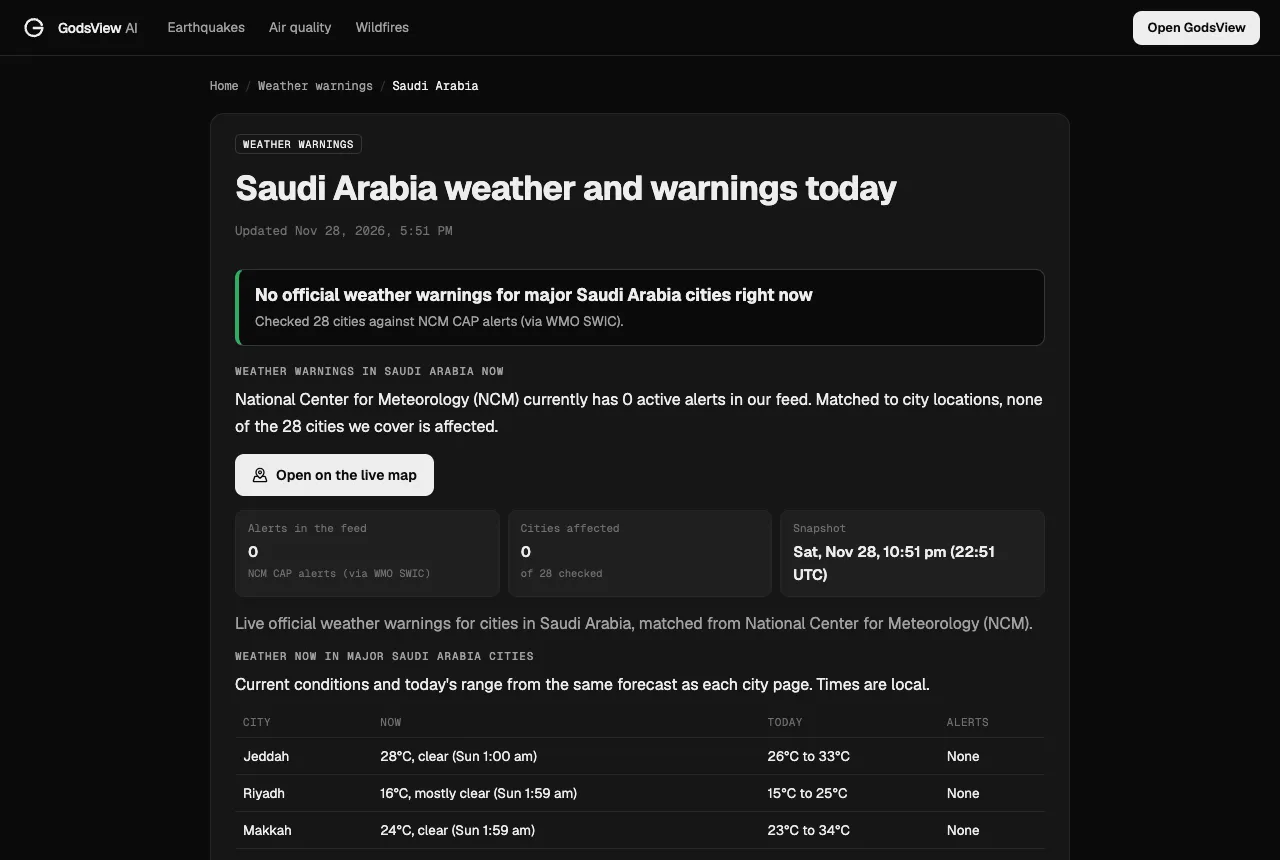
- GodsView's Saudi Arabia weather warnings page checks 28 Saudi cities against NCM's official alerts, free and without an account.
An NCM weather alert is an official early warning from Saudi Arabia's National Center for Meteorology. It comes in three colours. Yellow means a region may be affected by a weather phenomenon such as rain, dust or fog. Orange is an advanced warning: the weather is affecting or will affect the area and you should take precautions. Red is the highest level, an explicit warning of severe weather such as flash floods, and it activates Civil Defense instructions for the area marked in red. If your city is under a red alert, stay away from valleys and low ground, avoid unnecessary travel and follow Civil Defense advice.
To see whether any Saudi city is under an NCM alert right now, open GodsView's Saudi Arabia weather warnings page, or a city such as Riyadh, Jeddah, Makkah, Madinah or Dammam.
Check Saudi Arabia weather alerts now
What yellow, orange and red NCM alerts mean
NCM's automated early warning system, launched on June 21, 2023, shows each alert on a map of the Kingdom with an icon you can open for details: the nature of the phenomenon, its status, the location, the expected start time and the estimated end time. The levels are defined like this:
| Level | NCM meaning | What it asks of you |
|---|---|---|
| Green | Notification: information that regions of the Kingdom may be exposed to weather effects | Stay informed |
| Yellow | The possibility that certain regions will be affected by a weather phenomenon | Check the alert and plan around it |
| Orange | An advanced warning about weather phenomena; take precautions and be careful | Change plans that expose you to the hazard |
| Red | An explicit warning of severe weather such as floods; activates Civil Defense instructions | Follow Civil Defense instructions and avoid danger areas |
The colour applies to a specific area, often a list of governorates within a region, and a specific time window. One storm can put one governorate under red and the next under yellow.
A real example: rain alerts in August 2026
On August 27, 2026, NCM's alerts showed how the three levels work side by side, as reported by Gulf News:
- Red for Taif, Al Kamil and Adham in the Makkah region, for heavy rain and flash floods.
- Orange for Al Ais, Al Mahd and Badr in the Madinah region, for moderate rain.
- Yellow for Rabigh, Jeddah and Al Khurmah in the Makkah region, for light rain and blowing dust.
The same forecast warned of moderate to heavy thunderstorms with hail, strong winds stirring up dust and sand, and fog over eastern coastal areas overnight, while temperatures reached 47°C in Madinah and 46°C in Dammam. In other words, a single day can bring flash flood risk in the mountains near Taif and extreme heat on the plains, each with its own alert.
Which weather NCM warns about
NCM's early warnings cover the phenomena that affect the Kingdom most:
- Rain and thunderstorms, from light showers to heavy downpours.
- Flash floods, when rainwater rushes down valleys (wadis) and low ground.
- Hail, often with strong downdraft winds.
- Active winds with dust and sand, which cut visibility on highways. In July 2025, NCM warned that dust would reduce visibility to between 3 and 5 kilometres across large parts of the Kingdom and urged people with respiratory conditions to avoid unnecessary outdoor activity and monitor official weather alerts.
- Fog, mostly on winter mornings and along coasts, which can drop visibility sharply. Our fog warning guide explains what a "moderate fog warning" on your phone means.
Rain is unevenly spread. According to the Ministry of Environment, Water and Agriculture, the Asir region in the southwest receives the most, about 300 mm a year on average, while most of the Kingdom gets far less. In the 2026 rain alerts cited in this guide, the heaviest rain and flash flood risk was forecast for the Makkah region mountains around Taif, and for Jazan, Asir and Al Baha, while the July 2025 dust warning covered the Eastern Province, Riyadh, Al Qassim, Hail, Al Jouf and the Northern Borders, among others.
What to do in a red or orange alert
Civil Defense advice during rain alerts is consistent. In a September 2026 warning, the General Directorate of Civil Defense told residents to remain in safe places, stay away from valleys and areas vulnerable to flash floods, avoid swimming in floodwaters, and follow safety instructions and updates from the authorities. It also cautioned against crossing flooded valleys or approaching fast-moving water.
In a rain or flash flood alert
- Stay out of wadis. Do not camp, park or drive in valley beds when rain is forecast, even if the sky above you is clear: water can arrive from storms far upstream.
- Never drive into moving water. It is impossible to judge the depth or the current from the driver's seat.
- Avoid low roads and tunnels that collect water.
- Keep your phone charged and watch for Civil Defense text messages.
In a dust alert
- Drive slowly with headlights on and leave a big gap.
- If visibility drops to near zero, pull well off the road and wait.
- Keep windows closed, and if you have asthma or another breathing condition, stay indoors as NCM advises.
In any emergency alert
Civil Defense's general guidance for emergency alerts, published in October 2026, is to stay calm, follow official instructions, and move inside the nearest building or to an interior room away from windows. If you are driving, stop at the side of the road away from bridges and high-rise buildings. The emergency number is 911 in Makkah, Madinah, Riyadh and the Eastern Province, and 998 in other regions.
How NCM alerts reach your phone
There are three official channels, and they work together:
- Civil Defense text messages. Civil Defense sends weather warning messages to citizens and residents based on their geographic location, using NCM's data.
- The NCM website. The Early Warnings section of ncm.gov.sa shows active alerts across the Kingdom's regions, with reports you can view or download.
- The Anwaa app. NCM's own app has an early warning map, warnings by region and governorate, 10-day forecasts, radar and satellite maps, and a Mashaer weather service for Makkah, Madinah and the holy sites during Hajj. You can choose which levels, yellow, orange or red, trigger a notification. It is available in nine languages: Arabic, English, French, Indonesian, Malay, Persian, Spanish, Turkish and Urdu.
How to check NCM alerts on GodsView
GodsView reads NCM's official alerts in the Common Alerting Protocol format, republished with governorate boundaries by the WMO Severe Weather Information Centre, and matches each alert to each city's exact location:
- The Saudi Arabia weather warnings page lists every city under an active alert with its colour and hazard.
- City pages such as Khobar, Al Hufuf, Abha, Tabuk, Najran or Jizan show the alert text, its time window, live weather and the forecast.
When we checked on November 28, 2026, none of the 28 Saudi cities GodsView tracks was inside an active NCM alert. Alerts can cover rural governorates without touching a big city, so NCM's own map remains the full picture. With GodsView Plus ($10.99 a month or $99.99 a year), you can save a city and get an alert when NCM issues one for it. To watch a storm or a dust front move, open the weather radar or the live map with a free account.
Saudi Arabia and its neighbours
NCM's colours are Saudi Arabia's own. Other Gulf countries run separate systems, and GodsView does not carry the official warnings of the UAE or Kuwait: check the UAE's National Center of Meteorology and Kuwait's Meteorological Department directly. Our guides to UAE weather alerts, Kuwait weather warnings and dust storms and haboobs cover the region in more detail.
The short version
NCM's yellow alert means your region may be affected by a weather phenomenon, orange means take precautions, and red means severe weather such as flash floods, with Civil Defense instructions in force. Stay out of valleys when rain is forecast, slow down in dust and fog, watch for Civil Defense text messages, and check the live alerts for your city before you travel.
See NCM alerts for Saudi cities
Frequently asked questions
What does an NCM red alert mean?
It is the highest level of the National Center for Meteorology early warning system: an explicit warning of severe weather such as floods. A red alert activates Civil Defense instructions and preventive measures for the area marked in red. Follow them and stay away from valleys and flood-prone areas.
What is the difference between a yellow and an orange alert in Saudi Arabia?
Yellow means certain regions may be affected by a weather phenomenon, such as light rain, active winds or reduced visibility. Orange is an advanced warning: take precautions and be careful. On August 27, 2026, for example, NCM used yellow for light rain and blowing dust in Jeddah and orange for moderate rain in parts of the Madinah region.
How do I get NCM weather alerts on my phone?
Civil Defense sends warning text messages to people in the affected area based on NCM data, without any sign-up. NCM's Anwaa app also sends notifications and lets you choose whether to be alerted at the yellow, orange or red level.
Is there a weather alert in Riyadh today?
Check GodsView's Riyadh weather warnings page, which shows any active NCM alert for the city with its time window, or the Early Warnings section of the NCM website.
What should I do in a flash flood alert in Saudi Arabia?
Civil Defense advises staying in safe places, keeping away from valleys and areas vulnerable to flash floods, not swimming in floodwaters, and not crossing flooded valleys or approaching fast-moving water. Never drive into moving water.
Does the Anwaa app work in English?
Yes. Anwaa, the official NCM app, is available in nine languages: Arabic, English, French, Indonesian, Malay, Persian, Spanish, Turkish and Urdu.
Sources
- Saudipedia — Automated Early Warning System
- National Center for Meteorology (NCM)
- Ministry of Environment, Water and Agriculture — The Kingdom's climate
- Anwaa — official NCM app (App Store)
- Gulf News — Saudi Arabia issues red alerts as heavy rain, flash floods threaten several regions (August 27, 2026)
- Gulf News — Saudi Arabia warns of flash floods as thunderstorms persist (September 24, 2026)
- Gulf News — Saudi Arabia issues safety instructions for emergency warning alerts (October 12, 2026)
- Gulf News — Saudi Arabia braces for week-long dust storms, NCM issues visibility warning (July 2, 2025)
Facts checked on against each provider's own site.