Explainer
Dust Storms and Haboobs: What They Are and What to Do
A dust storm can take visibility from miles to almost nothing in seconds. Here is what a haboob is, how weather services warn about dust in the US and the Gulf, and the simple steps that keep drivers alive when a wall of dust crosses the highway.
Key takeaways
- A dust storm is dust or sand lifted high into the air by strong, turbulent wind; its front can look like a wide, high wall moving fast.
- A haboob is a dust storm pushed by the outflow winds of a thunderstorm; NOAA says haboobs can reach 10,000 feet, move at up to 60 mph and usually last 10 to 30 minutes.
- In the US, a Dust Storm Warning means dense blowing dust is cutting visibility to a quarter mile or less; a Dust Advisory or Blowing Dust Advisory means visibility between a quarter mile and 1 mile.
- If a dust storm hits while you are driving, pull off the road as far as you can, turn off all lights, set the parking brake and take your foot off the brake pedal: Arizona's 'Pull Aside, Stay Alive' rule.
- In the Gulf, Saudi Arabia, Kuwait and the UAE warn about dust when visibility drops, often below 1,000 to 2,000 metres; GodsView shows Saudi NCM alerts by city, such as Riyadh.
A dust storm is a mass of dust or sand lifted high into the air by strong, gusty wind, often arriving as a brown wall that cuts visibility to almost nothing within seconds. A haboob is the most dramatic kind: a dust storm pushed ahead of a thunderstorm by its outflow winds. If one reaches your road, the rule is "Pull Aside, Stay Alive": get off the road, turn off all your lights, set the parking brake, take your foot off the brake pedal and stay buckled in until it passes.
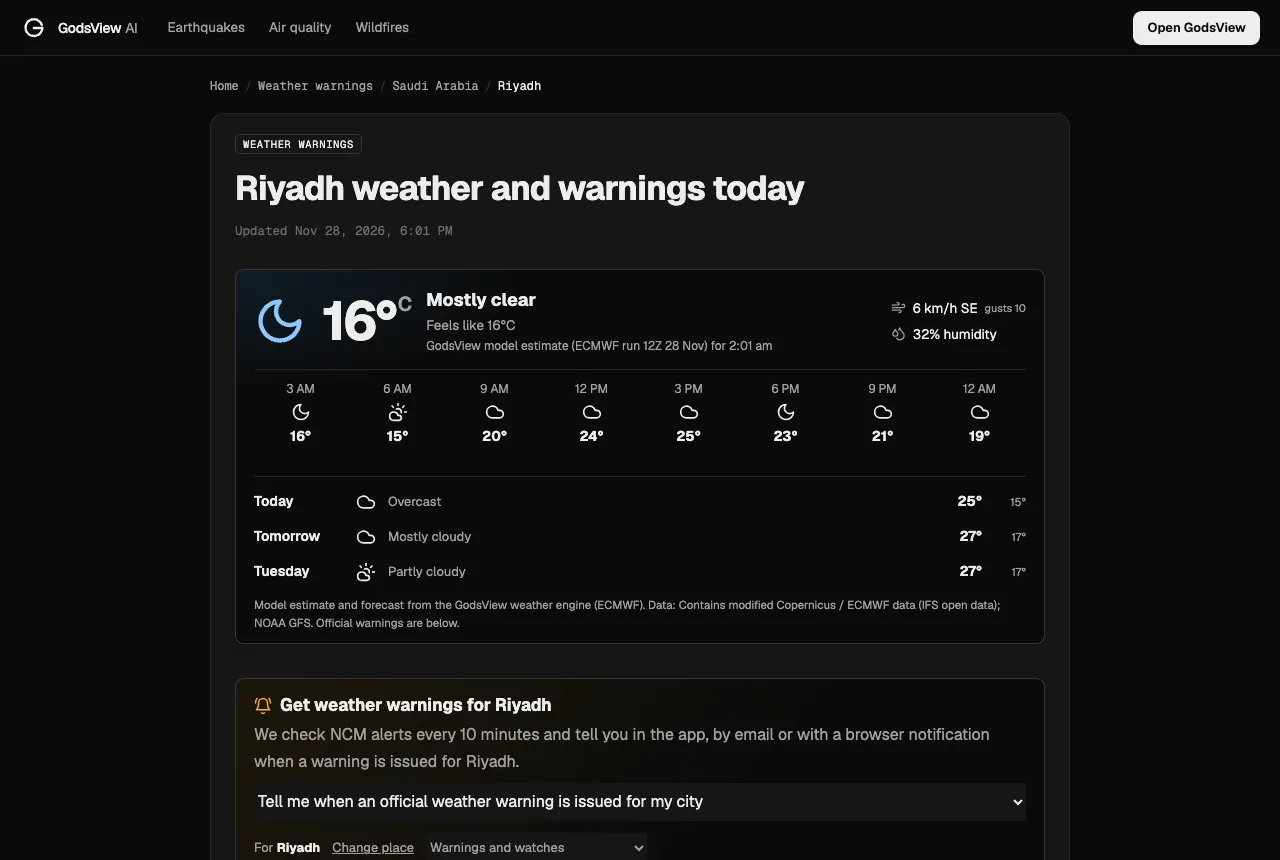
Dust alerts are issued by national weather services. In the US the National Weather Service issues Dust Storm Warnings; in the Gulf, Saudi Arabia's NCM, Kuwait's Meteorological Department and the UAE's NCM issue dust alerts. GodsView shows Saudi Arabia's official NCM alerts by city, for example Riyadh, Jeddah and Dammam, and live weather and forecasts for Phoenix, Tucson and Las Vegas.
Check Riyadh weather and alerts
What a dust storm is
The World Meteorological Organization defines a dust storm or sandstorm as an ensemble of particles of dust or sand energetically lifted to great heights by a strong and turbulent wind. Its International Cloud Atlas adds that the front of a dust storm may look like a wide and high wall that advances fairly rapidly. Dust storms can come with thunderstorm clouds, which the dust may hide, or form along the edge of advancing cold air.
The main sources are the world's arid and semi-arid regions, especially the Sahara, the Gobi and the Arabian Desert, and dust can travel thousands of kilometres across continents and oceans. Human activity makes it worse where land is cleared or poorly managed. The problem is big enough that the United Nations declared 2025 to 2034 the Decade on Combating Sand and Dust Storms, with July 12 as the international day.
What a haboob is
Haboob (pronounced "huh-boob") comes from an Arabic word meaning wind or blow. NOAA describes haboobs as very strong dust and sand storms in hot, dry regions, formed when a thunderstorm pushes air down and forward and drags dust and debris with it.
NOAA's figures for a haboob:
| Feature | Typical value (NOAA) |
|---|---|
| Height of the dust wall | Up to 10,000 feet (about 3 km) |
| Speed | Winds up to 60 mph (about 95 km/h) |
| Duration | Usually 10 to 30 minutes |
| Where | Sahara, Arabian Peninsula, North Africa, Gulf of Guinea, Arizona's Sonoran Desert |
| Phoenix | One to three large dust storms in a typical year |
A haboob is short but violent. Visibility can go from clear to near zero in a few seconds as the wall passes, which makes it most dangerous for people on the road.
Dust storm warnings in the US
The National Weather Service issues four dust products. The names sound similar, so here is how they differ, using the Phoenix office's criteria:
| Product | Visibility | Event type | NWS message |
|---|---|---|---|
| Dust Advisory | 1 mile or less, but more than 1/4 mile | Localised, short (about 90 minutes or less), polygon | Stay alert and be prepared to delay travel |
| Dust Storm Warning | 1/4 mile or less, dense dust | Localised, short (about 90 minutes or less), polygon | Take action and stay off the road |
| Blowing Dust Advisory | 1 mile or less, but more than 1/4 mile | Widespread, long (about 90 minutes or more), by zone | Stay alert for blowing dust over an extended period |
| Blowing Dust Warning | 1/4 mile or less, dense dust | Widespread, long (about 90 minutes or more), by zone | Take action and stay off the road |
In short: warning means a quarter mile or less, advisory means a quarter mile to a mile, and "blowing dust" means a wider, longer event. A haboob crossing a highway is the classic case for a short-fuse Dust Storm Warning.
NOAA says the NWS handles haboobs with severe thunderstorm warnings, dust storm warnings and significant weather advisories, so during monsoon storms also watch for a Severe Thunderstorm Warning for your area. Strong winds without storms have their own product, the High Wind Warning.
Pull Aside, Stay Alive: what to do on the road
The Arizona Department of Transportation's rule, published with the NWS, is short enough to remember:
- Avoid driving into or through a dust storm. If you see a wall of dust ahead, stop before you reach it.
- Check for traffic around you and slow down.
- Completely exit the roadway if you can. Do not stop in a travel lane or the emergency lane.
- Turn off all vehicle lights, including emergency flashers.
- Take your foot off the brake and set the parking brake.
- Stay in your vehicle with your seat belt buckled.
- Wait for the dust to clear.
Why lights off? The NWS explains that drivers behind you use the lights ahead as a guide. If your lights are on while you are parked at the roadside, someone may steer toward them and hit you. With lights off and your foot off the brake, nothing tells them a car is there, so they stay in the lane.
If you cannot get off the road, the NWS says to proceed slowly with your lights on until you find a safe place to pull off.
Dust and sandstorms in the Gulf
In Saudi Arabia, Kuwait and the UAE, dust comes not only from thunderstorm outflows but also from spells of strong wind over the desert, so an episode can last many hours.
- Saudi Arabia: the National Center for Meteorology uses yellow, orange and red alerts. Yellow means the possibility of an area being affected by a weather phenomenon, orange that an area is affected and caution is needed, and red a severe phenomenon where Civil Defense instructions must be followed. When we checked on November 28, 2026 (already November 29 in Saudi Arabia), NCM's early-warning page listed yellow alerts for raised dust in parts of Riyadh Region, including Ad Duwadimi. See our Saudi NCM alerts guide.
- Kuwait: the Meteorological Department issues dust watches and warnings. On April 14, 2025, it warned of winds over 60 km/h and visibility below 1,000 metres, possibly zero in places. Read Kuwait weather warnings.
- UAE: NCM issues yellow and orange dust alerts by area; on September 24, 2025, it put Al Maktoum International Airport under orange for visibility below 1,500 metres. Read UAE weather alerts.
The same road rules apply in the Gulf: slow down, do not drive into a wall of dust, and pull fully off the road if visibility collapses.
Dust and your health
Dust storms carry fine particles deep into the lungs. On dust days:
- Stay indoors if you have asthma, allergies, or heart or lung disease, and keep windows and doors closed.
- Wear a well-fitting mask outside.
- Run air conditioning on recirculate in the car.
- Check air quality before exercise: see air quality in Riyadh, Phoenix or Dubai, and our PM2.5 vs PM10 guide.
Dust also affects flights: low visibility at airports causes delays and diversions. You can see what is moving over Riyadh or Phoenix Sky Harbor live on GodsView.
How to check for dust storm warnings right now
- US: the weather warnings hub shows NWS alerts by city; open Phoenix or Tucson during monsoon storms, and watch storm cells on the weather radar.
- Saudi Arabia: Riyadh and the Saudi Arabia country page show NCM's official alerts matched to each city, free.
- Kuwait and the UAE: GodsView does not carry their warnings; check met.gov.kw and NCM in the UAE. Our Hawalli and Dubai pages show live weather and our own forecast flags, marked as not official.
- Alerts for saved places: GodsView Plus ($10.99 a month or $99.99 a year).
The short version
A dust storm is dust or sand lifted high by strong wind; a haboob is one driven by a thunderstorm's outflow, up to 10,000 feet tall and 60 mph fast, usually over in 10 to 30 minutes. A Dust Storm Warning means visibility a quarter mile or less: stay off the road. If you are caught, pull aside, turn off all lights, set the parking brake, take your foot off the brake and wait.
See dust and weather alerts by city
Frequently asked questions
What is a haboob?
A haboob is a strong dust or sand storm pushed by the outflow winds of a thunderstorm. NOAA says haboobs can reach 10,000 feet, move at up to 60 mph and usually last 10 to 30 minutes. The word comes from Arabic.
What does a Dust Storm Warning mean?
The US National Weather Service issues a Dust Storm Warning when dense blowing dust is reducing visibility to a quarter mile or less, or is about to. The message is: take action and stay off the road.
What is the difference between a Dust Advisory and a Dust Storm Warning?
A Dust Advisory is for visibility between a quarter mile and 1 mile; a Dust Storm Warning is for a quarter mile or less. "Blowing dust" versions of each are used for wider, longer events.
What should you do if you are caught in a dust storm while driving?
Pull completely off the road, turn off all lights including flashers, set the parking brake, take your foot off the brake pedal and stay buckled in until the dust clears. Never stop in a travel lane.
Why should I turn my lights off in a dust storm?
Drivers behind you follow the lights ahead. If your lights are on while you are parked at the roadside, they may steer toward you and crash into your car.
Where can I check dust alerts in Saudi Arabia?
On NCM's early-warning page, or on GodsView's Riyadh page and Saudi Arabia page, which show NCM's official alerts matched to each city.
Sources
- WMO International Cloud Atlas — Dust storm or sandstorm
- WMO — Sand and dust storms
- NOAA — Haboobs: phenomena with unusual name is no joke
- National Weather Service — Dust storm safety
- National Weather Service — Dust products
- NWS Phoenix — Watch, warning and advisory product criteria
- ADOT / NWS — Pull Aside, Stay Alive dust storm safety card
- Saudi National Center for Meteorology — Early warnings
Facts checked on against each provider's own site.