Explainer
Freeze Warning vs Frost Advisory: What They Mean and What to Do
Freeze warnings show up every autumn and spring, often in places that rarely get cold. Here is what a freeze warning, a freeze watch and a frost advisory each mean, the temperatures behind them, and the short list of things to do for your plants, pipes and pets.
Key takeaways
- A Freeze Warning is a National Weather Service alert that temperatures are forecast to drop below 32°F (0°C) for a long period, cold enough to kill sensitive plants and crops.
- A Freeze Watch comes first: significant, widespread freezing temperatures are possible in the next 24 to 36 hours.
- A Frost Advisory is a step below: frost is expected, often with lows of about 33 to 36°F on clear, calm nights, which threatens tender plants.
- These alerts are tied to the growing season, which is why the Gulf Coast sees freeze warnings in late November while northern states have already stopped getting them.
- For pipes, the NWS advises letting faucets drip, opening sink cabinets and keeping the heat at 55°F or higher. For plants, cover them to the ground and remove the cover once it warms up.
A freeze warning means the National Weather Service (NWS) expects temperatures to drop below 32°F (0°C) for a long enough time to kill sensitive plants and crops, and possibly to freeze exposed pipes. It is issued for the coming night, usually a day ahead. Cover or bring in tender plants, protect outdoor pipes and make sure pets have a warm place to sleep.
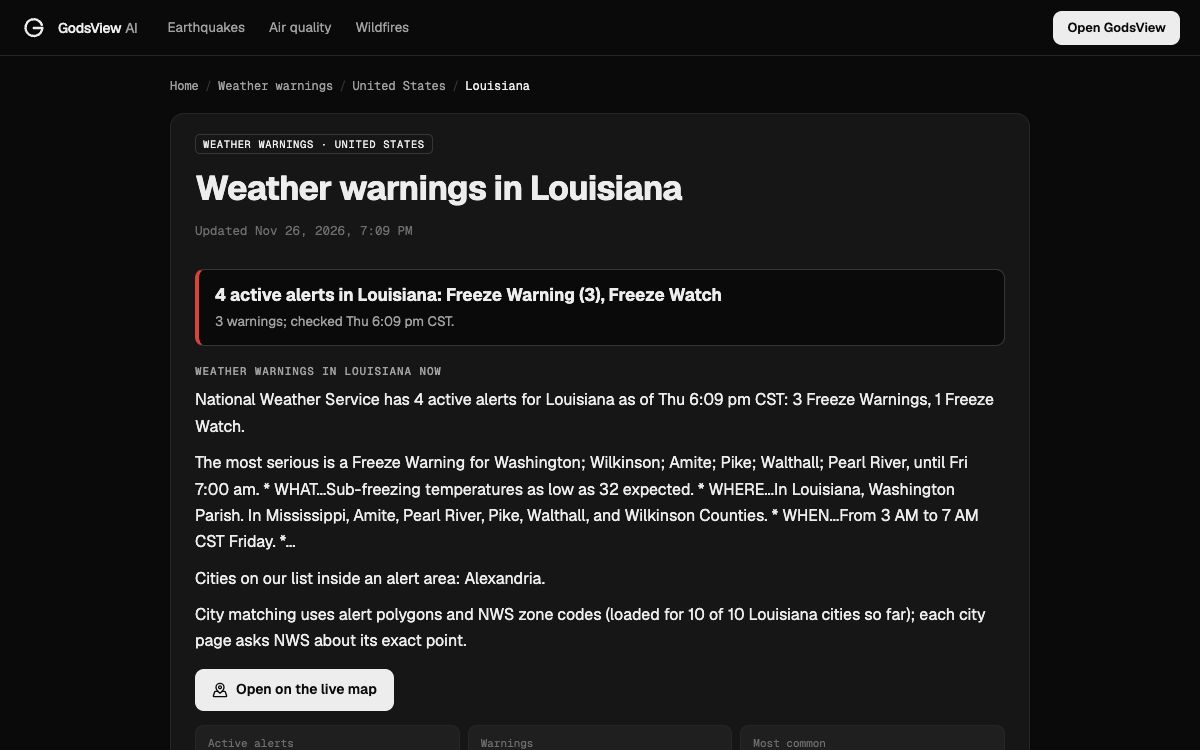
A freeze watch is the earlier heads-up that a freeze is possible, and a frost advisory is the milder alert for frost with temperatures just above freezing. You can see where each one is in effect tonight on GodsView's public weather warnings pages, for example weather warnings in Louisiana or Texas.
Check freeze warnings for your area
What does a freeze warning mean?
The NWS puts it simply: a Freeze Warning "is issued when temperatures are forecasted to go below 32°F for a long period of time" (NWS cold alerts). The same page notes why that matters. Below 32°F some plants are damaged, and temperatures below 28°F for an extended period can kill most commercial crops and residential plants.
Local offices add a second condition: the freeze has to come during the growing season. The NWS office for Baltimore and Washington issues a Freeze Warning when significant, widespread freezing temperatures are expected in autumn until the end of the growing season, or in spring at its start (NWS Sterling, VA).
That explains a pattern people notice every year. In Minnesota a freeze in January is normal, the growing season is long over, and nobody issues a freeze warning for it. In Louisiana in late November, plants are still growing, so a night at 30°F gets a warning.
Here is what one looked like. On November 26, 2026, the NWS had four Freeze Warnings in effect, all along the Gulf Coast states. One covered Vernon, Beauregard, Allen, Evangeline and St. Landry parishes in Louisiana and Tyler, northern Jasper and northern Newton counties in Texas, with the text "Sub-freezing temperatures as low as 30 expected", valid until 9 AM Friday.
Freeze warning vs freeze watch vs frost advisory
The three alerts form a ladder. The table uses the NWS definitions and the criteria from the Baltimore and Washington office, a common standard; your local office may set slightly different numbers.
| Alert | What it means | Typical trigger | What to do |
|---|---|---|---|
| Frost Advisory | Frost is expected or occurring and threatens sensitive vegetation | Lows of 33 to 36°F on clear, calm nights in the growing season | Cover or bring in tender plants |
| Freeze Watch | Significant, widespread freezing temperatures are possible | Possible freeze in the next 24 to 36 hours | Plan: get covers ready, check pipes |
| Freeze Warning | Temperatures below 32°F are expected for a long period | Widespread freeze expected, usually that night | Act: protect plants, pipes and pets |
A few things stand out:
- Frost can form above freezing. On a clear, still night the ground and leaves cool faster than the air at thermometer height, so frost can coat a lawn while the official reading is 34°F. That is why a frost advisory uses temperatures above 32°F.
- A freeze is about the air. Wind can prevent frost but not a freeze. A windy night at 29°F may leave no frost at all and still kill tender plants.
- The watch is a planning alert. It usually turns into a warning, an advisory or nothing as the forecast firms up.
For how watches, warnings and advisories work across every kind of weather, see our weather watch vs warning guide.
What about a hard freeze?
You'll often hear "hard freeze" on the local news. It usually means temperatures well below 32°F, cold enough to kill most plants and freeze unprotected pipes. The NWS's own numbers are the useful ones here: below 28°F for an extended period can kill most commercial crops and residential plants (NWS cold alerts).
There is no separate "Hard Freeze Warning" in the NWS's current list of alert types. The official alerts are Freeze Watch, Freeze Warning and Frost Advisory, and offices describe a hard freeze inside the text of a Freeze Warning, for example by giving a low of 25°F. When you read the alert, look at the WHAT line for the expected low and the WHEN line for how many hours it will stay below freezing. Both matter: a short dip to 31°F at dawn does far less harm than six hours at 26°F.
When cold goes beyond plants and becomes dangerous to people, the NWS moves to other products, such as the Extreme Cold Warning. Snow and ice get their own alerts, starting with the Winter Storm Watch.
How do I protect plants from a freeze?
Extension services in the freeze-prone South give the same core advice. From UF/IFAS, the University of Florida's extension service (UF/IFAS):
- Water first. Make sure plants are well watered before the freeze. Moist soil holds and releases more heat than dry soil.
- Cover to the ground. Drape a sheet, blanket or frost cloth over the plant so it reaches the ground, and weigh the edges down with bricks. The cover traps heat rising from the soil. Covering only the top of a plant, like a lollipop, doesn't work.
- Skip the plastic. UF/IFAS advises against plastic covers because they can heat up like a greenhouse once the sun comes out and cause more problems than the cold.
- Uncover in the morning. Remove the covers once temperatures rise above freezing, so the plants don't overheat in the sun.
A few more tips from experience:
- Bring pots inside. Roots in containers freeze much faster than roots in the ground. A garage or porch is enough for one night.
- Pick the tender ones first. Tropical plants, citrus, succulents, new transplants and vegetables like tomatoes and peppers are the most at risk. Established trees and shrubs usually ride out a light freeze.
- Know your thresholds. The NWS says simply: know the temperature thresholds of your plants and crops (NWS: before the cold).
How do I keep pipes from freezing?
Plants are the reason freeze warnings exist, but pipes are where a freeze costs money. A frozen pipe can split and flood a room when it thaws. The NWS office in New York gives a short checklist for prolonged cold (NWS New York):
- Let faucets drip slowly on taps fed by pipes that run through unheated spaces. Moving water is harder to freeze.
- Open kitchen and bathroom sink cabinets so warm air can reach the plumbing.
- Insulate supply lines that run through unheated areas like crawl spaces, garages and attics.
- Keep the heat on. If you are going away, leave the heat set to at least 55°F.
- Use space heaters with care. Put them on a level, hard surface at least three feet from anything flammable, and never leave them unattended.
Outside, disconnect garden hoses and cover outdoor faucets. Know where your main water shut-off valve is before you need it.
Homes in warm states are often the most exposed, because pipes there may run through exterior walls and unheated attics without insulation. The February 2021 Texas freeze showed what happens when a long freeze meets a strained power grid; our guide to power outages in Texas covers how to check the grid and outages today.
What about pets, cars and people?
- Pets and livestock: the NWS advises making sure animals are not overly exposed to the cold and have plenty of food and unfrozen water (NWS: before the cold). Bring pets inside overnight.
- Cars: expect frosted windshields and slick spots on bridges and overpasses in the early morning, even when roads elsewhere are dry.
- People: a freeze warning on its own is not a dangerous-cold alert, but anyone without heat, especially older people, should be checked on. Never run a generator or grill indoors.
How to check freeze warnings near you
- Open your state page. On November 26, 2026, the Texas page showed one active alert, a Freeze Warning for parishes in western Louisiana and three east Texas counties.
- Open your city page. Pages such as Houston, Baton Rouge or New Orleans list every alert covering that exact point, with its level and end time.
- Read the WHAT and WHEN lines for the expected low and how long it lasts.
- Check again in the evening. A freeze watch is often upgraded to a warning, or replaced by a frost advisory, in the afternoon forecast.
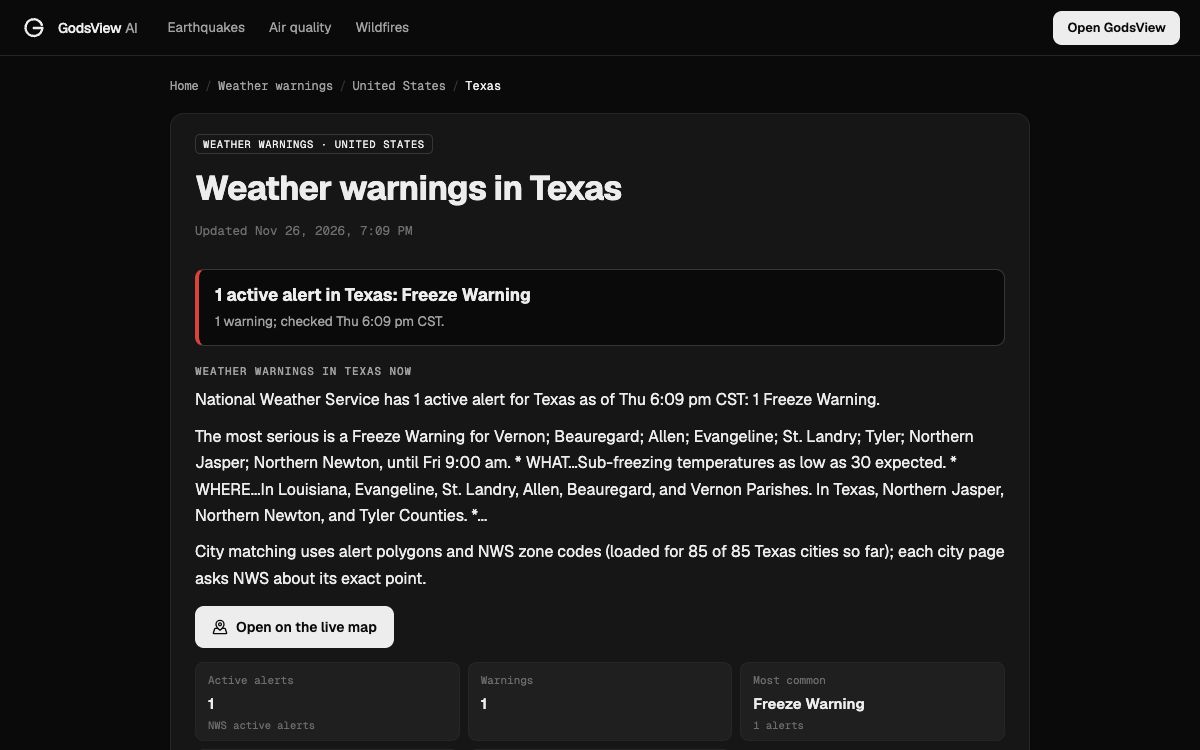
The state and city pages are public and read the NWS feed directly, with the time of the last check shown on the page. The live map behind the "Open on the live map" button needs a free GodsView account; once signed in, you can save your home on My places to get alerts for severe US weather warnings, earthquakes, floods and wildfires nearby. GodsView Plus costs $10.99 a month or $99.99 a year; see pricing.
GodsView repeats official alerts a few minutes after they are published. It does not replace the NWS or your local emergency alerts.
Freeze warning: the short version
A freeze warning means temperatures below 32°F are expected for long enough to kill tender plants, and possibly freeze exposed pipes. A freeze watch says it might happen in the next day or so; a frost advisory says frost is likely with lows just above freezing. When a warning is out: water and cover plants to the ground, bring pots inside, drip faucets on exposed pipes, open sink cabinets and keep pets indoors.
See what is active tonight on the weather warnings page. If wind is the problem instead of cold, read what a wind advisory means.
Frequently asked questions
What does a freeze warning mean?
It is a National Weather Service alert that temperatures are forecast to go below 32°F (0°C) for a long period, usually that night. It is issued during the growing season, when the cold can kill sensitive plants and crops.
What is the difference between a freeze watch and a freeze warning?
A freeze watch means significant, widespread freezing temperatures are possible in the next 24 to 36 hours. A freeze warning means they are expected. The watch is for planning, the warning is for action.
What is the difference between a frost advisory and a freeze warning?
A frost advisory is for frost on clear, calm nights with lows just above freezing, often 33 to 36°F, and mainly threatens tender plants. A freeze warning is for air temperatures below 32°F, which can kill a wider range of plants and freeze exposed pipes.
Should I drip my faucets during a freeze warning?
If you have pipes in unheated spaces such as exterior walls, crawl spaces or garages, yes. The National Weather Service advises letting faucets drip slowly, opening sink cabinets and keeping the heat at 55°F or higher.
What temperature kills plants?
It depends on the plant. The NWS notes that below 32°F some plants are damaged, and temperatures below 28°F for an extended period can kill most commercial crops and residential plants.
Why do some states stop getting freeze warnings in winter?
Freeze warnings and frost advisories are tied to the growing season. Once it has ended in an area, offices usually stop issuing them there, so a hard freeze in a northern January gets no freeze warning while a light freeze on the Gulf Coast in November does.
Sources
- National Weather Service: Freeze and frost alerts
- NWS Baltimore/Washington: Watch, warning and advisory criteria
- NWS New York: Home preparedness tips for prolonged frigid cold
- National Weather Service: Before extreme cold
- UF/IFAS Extension: Cold protection for plants, questions and answers
- National Weather Service API: Alert event types
Facts checked on against each provider's own site.