Explainer
Kuwait Weather Warnings: Fog, Dust and Rain Explained
Kuwait's Meteorological Department uses two stages: a yellow weather watch up to 24 hours ahead and a red warning up to 6 hours ahead. Here is what each means, how fog, dust and rain warnings usually play out, and where to check them, since GodsView cannot republish them.
Key takeaways
- Kuwait's weather warnings come from the Meteorological Department of the Directorate General of Civil Aviation, on met.gov.kw and its free mobile app.
- It uses two stages: a weather watch (yellow icon), issued up to 24 hours ahead when conditions favour severe weather, and a weather warning (red icon), issued up to 6 hours ahead when severe weather is occurring, imminent or likely.
- Fog warnings usually run overnight into the morning when visibility drops below 1,000 metres; on November 9, 2025, fog cut visibility at Kuwait International Airport below 100 metres and flights were diverted.
- Dust warnings come with strong northwesterly or southwesterly winds: in April 2025 the department warned of winds over 60 km/h and visibility below 1,000 metres, possibly zero in places.
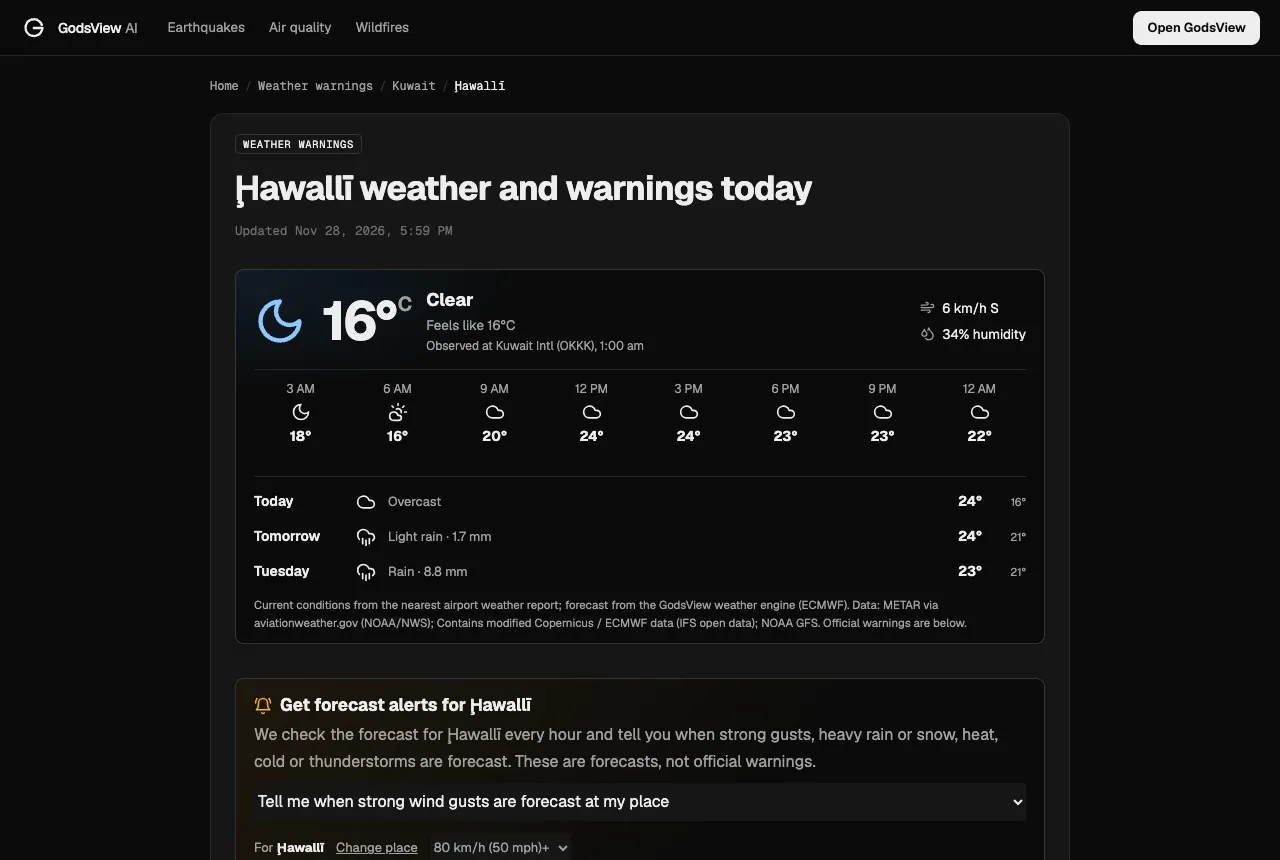
- Kuwait does not allow its warnings to be republished without written approval, so GodsView does not show them; its Hawalli page shows live weather and its own forecast flags, marked as not official.
A Kuwait weather warning is issued by the Meteorological Department of the Directorate General of Civil Aviation, and it comes in two stages. A weather watch (yellow icon) means conditions are favourable for severe weather and is issued up to 24 hours ahead. A weather warning (red icon) means severe weather is occurring, imminent or likely and is a threat to life and property; it is issued up to 6 hours ahead. Most warnings in Kuwait are for fog, dust and rain, and fog and dust warnings usually mean visibility below 1,000 metres.
The official place to check is met.gov.kw (Warnings and Weather Watches) or the department's free mobile app. Kuwait's Meteorological Department does not allow its information to be republished without prior written approval, so GodsView does not copy its warnings. Our Hawalli and Al Ahmadi pages show current weather, a forecast and our own forecast flags, clearly labelled as not official.
Watch vs warning in Kuwait
The department's warnings page defines two stages:
| Stage | Icon | Meaning | Issued |
|---|---|---|---|
| Weather watch (stage one) | Yellow | Conditions are favourable for the development of severe weather | Up to 24 hours before the expected event |
| Weather warning (stage two) | Red | Severe weather is occurring, imminent or likely in the location indicated, and is a threat to life and property | Up to 6 hours before the event |
So a yellow watch is the "get ready" message and a red warning is the "it's happening" message. If a watch is upgraded to a warning, the hazard is now close in time.
How each alert is graded
Each watch or warning is also tagged in the international CAP style used by many weather services:
- Urgency: Immediate, Expected or Future.
- Severity: Extreme (extraordinary threat to life or property), Severe, Moderate or Minor.
- Certainty: Observed, Likely (more than 50% probability), Possible (50% or less) or Unlikely.
When you open a warning on met.gov.kw, these three tags tell you how soon, how bad and how sure. A "Severe, Expected, Likely" dust warning is more serious than a "Minor, Future, Possible" one, even if both are red.
The ten warning types
The department lists these types: light rain, wind, fog, thunderstorm and dust, dust, general alert, high wave, frost, thunderstorm and heavy rain.
Fog warnings
Fog warnings matter most for drivers and flights. They usually cover the night and early morning, and lift as the fog clears.
A typical example: early on Sunday, November 1, 2026, the department issued a fog warning after visibility dropped below 1,000 metres in some areas, valid from 2:16 am to 8:16 am.
The worst cases go much lower. On November 9, 2025, dense fog cut horizontal visibility at Kuwait International Airport to less than 100 metres around 2 am, according to the Directorate General of Civil Aviation; many flights were diverted to neighbouring countries until visibility improved. You can watch arrivals and departures at Kuwait International on GodsView, and our guide can planes fly in bad weather explains why fog causes diversions.
Driving in a Kuwait fog warning
- Delay early-morning trips if the warning runs until 8 am and you can wait.
- Slow down to a speed that lets you stop within the distance you can see.
- Use low-beam headlights; high beams reflect off the fog.
- Keep a long gap and avoid sudden lane changes on the highways.
- If you must stop, pull fully off the road, use hazard lights and stay belted in.
Our fog warning guide compares fog alerts in Kuwait, Saudi Arabia, Europe and the US.
Dust warnings
Dust and sand storms are the other big hazard. They come when strong winds sweep across open desert, and a single episode can last many hours.
On April 14, 2025, for example, the department's acting director warned of active to strong southwesterly winds over 60 km/h, shifting to northwesterly, with visibility expected to drop below 1,000 metres and possibly to zero in some areas by evening, and seas rising above six feet. The department advised people with asthma or allergies to stay indoors and avoid unnecessary outings, drivers to take care on highways, and sea-goers to watch for high waves.
What to do in a dust warning:
- Stay indoors if you have asthma, allergies or heart or lung conditions, and keep windows shut.
- Wear a well-fitting mask if you must be outside.
- Drive slowly with headlights on, and if a wall of dust is coming, pull off the road rather than drive into it.
- Secure loose objects on balconies and roofs before strong winds.
- Keep away from the sea when high-wave warnings accompany the wind.
For more on dust storms and haboobs, including the "pull aside, stay alive" rule, see our dust storm guide. On dusty days, check air quality in Hawalli and our guide to what air quality index is bad.
Rain and thunderstorm warnings
Rain is less frequent than fog or dust, but the department has separate warnings for light rain, heavy rain, thunderstorms and thunderstorms with dust. Short, heavy downpours can flood streets and underpasses quickly. When a heavy rain or thunderstorm warning is in force:
- Avoid underpasses, tunnels and low roads.
- Do not drive through standing water.
- Stay indoors during lightning and keep away from open areas.
- Follow official channels for road closures.
Why GodsView does not show Kuwait warnings
The Meteorological Department's website states that it is not allowed to broadcast, publish or amend any part of the site or its information without prior written approval from the Directorate General of Civil Aviation. We respect that, so GodsView does not carry or copy Kuwait's warnings. Instead:
- City pages such as Hawalli show current conditions, the forecast and GodsView forecast flags: our own check of the forecast for strong gusts, heavy rain, thunderstorms and heat over the next 48 hours, labelled as forecasts, not official warnings, with a link to the department's warnings page.
- The Kuwait country page links to the official service.
- Next door: Saudi Arabia's official NCM alerts are on GodsView, for cities such as Dammam and Riyadh; see our Saudi NCM alerts guide.
GodsView Plus ($10.99 a month or $99.99 a year) adds alerts for saved places, but for Kuwait the department's watches and warnings are the ones that count.
How to get Kuwait warnings on your phone
- The Meteorological Department's free app for iOS and Android.
- met.gov.kw, Warnings and Weather Watches, which also says when there are no warnings in force.
- Local news, which reports the department's statements during fog and dust episodes.
For phone settings and other alert sources, see our guide to weather alerts in your area.
The short version
In Kuwait, a yellow weather watch means severe weather is possible within 24 hours and a red weather warning means it is happening or likely within 6 hours. Most warnings are for fog and dust that cut visibility below 1,000 metres, sometimes below 100 metres or to zero. Delay early drives in fog, stay inside in dust if you have breathing problems, and check met.gov.kw or the department's app.
Frequently asked questions
What is the difference between a weather watch and a weather warning in Kuwait?
A watch (yellow icon) means conditions favour severe weather and is issued up to 24 hours ahead. A warning (red icon) means severe weather is occurring, imminent or likely and threatens life and property; it is issued up to 6 hours ahead.
When does Kuwait issue a fog warning?
When fog reduces horizontal visibility, typically below 1,000 metres in some areas, usually overnight into the morning. In thick fog visibility can fall below 100 metres, as at Kuwait International Airport on November 9, 2025.
What should I do in a Kuwait dust warning?
People with asthma, allergies or heart and lung conditions should stay indoors with windows shut. Drivers should slow down with headlights on and avoid driving into dense dust; sea-goers should watch for high waves.
Where can I see official Kuwait weather warnings?
On met.gov.kw under Warnings and Weather Watches, or in the Meteorological Department's free app for iOS and Android.
Why does GodsView not show Kuwait weather warnings?
Kuwait's Meteorological Department does not allow its information to be republished without prior written approval. GodsView's Hawalli page shows live weather and GodsView forecast flags, marked as not official, with a link to the department.
Sources
- Kuwait Meteorological Department — Warnings and Weather Watches
- Kuwait Meteorological Department — home page (terms of use)
- Kuwait Times — Fog warning in place as rain chances continue (November 1, 2026)
- Khaleej Times — Kuwait flights resume after dense fog (November 9, 2025)
- Arab Times — Kuwait to face dust storm, strong winds (April 14, 2025)
Facts checked on against each provider's own site.