Explainer
Tornado Watch vs Tornado Warning: What Each Means and What to Do
A tornado watch tells you to get ready; a tornado warning tells you to take cover now. Here is who issues each one, what a "particularly dangerous situation" and a tornado emergency add, and exactly where to shelter in a house, an apartment, a mobile home or a car.
Key takeaways
- A tornado watch means conditions favor tornadoes in and near the watch area over the next several hours; a tornado warning means a tornado has been sighted or indicated by radar and you should take shelter immediately.
- Watches come from NOAA's Storm Prediction Center and typically cover about 25,000 square miles; warnings come from your local NWS office and usually cover an area about the size of a city or small county.
- A "Particularly Dangerous Situation" (PDS) watch is used in rare cases when long-lived intense tornadoes are likely, and a Tornado Emergency is the NWS's highest alert, for a violent tornado causing catastrophic damage.
- In a warning, go to the lowest floor of a sturdy building, into a small interior room away from windows, and cover your head; leave mobile homes for a sturdy shelter.
- Tornado warnings trigger Wireless Emergency Alerts on phones automatically, while outdoor sirens are run by local officials and are not meant to be heard indoors.
A tornado watch means conditions are favorable for tornadoes in and near the watch area over the next several hours: be prepared to act. A tornado warning means a tornado has been sighted or indicated by weather radar, with imminent danger to life and property: take shelter now. In the National Weather Service's own words, a watch says "Be Prepared!" and a warning says "Take Action!"
The two come from different offices and cover very different areas. A watch is a large box of counties, often across several states, issued by NOAA's Storm Prediction Center (SPC) in Norman, Oklahoma. A warning is a small polygon drawn by your local NWS forecast office around a specific storm. If you are under a watch, keep your phone on and know where you will go. If you are under a warning, go there.
Check active tornado watches and warnings
Tornado watch vs tornado warning at a glance
| Tornado Watch | Tornado Warning | Tornado Emergency | |
|---|---|---|---|
| What it means | Tornadoes are possible in and near the watch area | A tornado has been sighted or indicated by radar | A violent tornado is on the ground with catastrophic damage |
| Who issues it | Storm Prediction Center | Your local NWS forecast office | Your local NWS forecast office, inside a tornado warning |
| Typical area | About 25,000 square miles, often several states | About the size of a city or small county | The towns named in the warning |
| Time frame | The next several hours | Now, or expected within the hour | Now |
| What to do | Review your plan, check your shelter, keep alerts on | Go to shelter immediately | Take refuge in the safest place you can, right away |
The SPC puts the difference in one sentence: a watch means severe weather is possible during the next few hours, while a warning means it has been observed or is expected within the hour.
What a tornado watch means
The SPC describes a tornado watch as a cluster of counties where tornadoes and other kinds of severe weather are possible in the next several hours. A tornado watch includes the large hail and damaging wind threats of a severe thunderstorm watch, plus the possibility of multiple tornadoes or a single intense tornado. Typical watches cover about 25,000 square miles, roughly half the size of Iowa, and the SPC issues between 500 and 800 watches in most years.
The SPC only issues watches. It does not issue warnings, and it does not decide when your county comes out of a watch: local NWS offices clear counties as the threat moves on. Through the event the SPC also issues watch status reports, which draw a line across the watch showing where the threat remains.
There is no checklist that produces a watch. The SPC says forecasters look for an overlap of moisture, instability, lift and vertical wind shear lasting at least a few hours over an area the size of a typical watch, and that how much of each it takes "can vary greatly" from event to event.
What to do in a tornado watch
The SPC's advice for a watch is practical:
- Turn on local TV or radio, and set the alarm on your NOAA Weather Radio.
- Take any phone that receives Wireless Emergency Alerts out of Do Not Disturb mode.
- Make sure you can get to safe shelter quickly, and store a mattress, sleeping bags or thick blankets in or next to it.
- Tell friends and family that tornadoes are possible.
- If you live in a mobile home, decide now where you will go if a warning is issued.
What is a PDS tornado watch?
Some watches carry the line "THIS IS A PARTICULARLY DANGEROUS SITUATION". The SPC uses PDS wording in tornado watches for rare situations when long-lived intense tornadoes are likely. It is a forecaster's judgment based on many atmospheric clues, with no hard criteria, but the SPC's goal is for 3 out of every 4 PDS tornado watches to verify with multiple intense tornadoes. PDS watches are most often issued on days when the SPC's Day 1 outlook shows a High risk.
If your area is in a PDS tornado watch, treat the whole day as dangerous. Plan to be near a sturdy shelter for the hours the watch is in effect, rather than on the road.
What a tornado warning means
A tornado warning means a tornado has been spotted, or Doppler radar shows a thunderstorm circulation that can produce one. The NWS says warnings typically cover a much smaller area than watches, around the size of a city or small county, drawn around the storm that a forecaster has identified on radar or that a trained spotter or law enforcement officer is watching.
Warnings are judgment calls too. The SPC notes that some storms with little radar-detected rotation produce weak tornadoes, while others with frightening-looking circulations produce none, so forecasters combine radar, spotter reports and the storm environment. There is a built-in trade-off: efforts to cut false alarms almost always reduce detection and lead time, and the reverse. Do not ignore a warning because the last one missed you.
Considerable tornadoes and tornado emergencies
NWS tornado warnings carry a damage threat tag. The default warning has no tag. When a tornado is confirmed by radar or by reliable observers and the threat is high, the office can add "considerable", which inserts the phrase "This is a PARTICULARLY DANGEROUS SITUATION" in the warning text. In exceedingly rare cases, when catastrophic damage from a tornado is imminent or ongoing, the office uses the "catastrophic" category and the headline TORNADO EMERGENCY for the named towns. The NWS calls the tornado emergency its highest alert level.
Where to shelter in a tornado warning
Flying debris is the greatest danger in tornadoes; the SPC says most of the roughly 60 people killed by tornadoes in an average year die from flying or falling debris. These are the SPC's instructions by location:
- House with a basement: avoid windows. Get in the basement under sturdy protection, such as a heavy table or workbench, or cover yourself with a mattress or sleeping bag. Do not shelter under spots where heavy objects such as a piano or refrigerator rest on the floor above.
- House without a basement, a dorm or an apartment: go to the lowest floor, to a small center room such as a bathroom or closet, under a stairwell, or into an interior hallway with no windows. Crouch low, face down, and cover your head with your hands. Cover yourself with thick padding against falling debris. A helmet adds protection.
- Office building, hospital, nursing home or high-rise: go to an enclosed, windowless area in the center of the building on the lowest floor possible. Interior stairwells are usually good. Stay out of elevators.
- Mobile or manufactured home: get out, even if it is tied down. Go to a sturdy building or an underground shelter, ideally decided in advance.
- In a car or truck: there is no safe option, only less dangerous ones. If the tornado is far away and traffic is light, you may be able to drive out of its path at right angles to it. If you are caught by extreme wind or debris, park out of traffic lanes, keep your seat belt on, and get your head below the windows, covered. If you can get noticeably lower than the road, leave the car and lie there, covering your head. Do not shelter under bridges.
- Outdoors with no shelter: lie flat and face down on low ground, protect the back of your head with your arms, and get away from trees and cars.
- Shopping mall, large store, church or theater: move quickly to an interior bathroom, storage room or other small enclosed space away from windows.
Forget the old idea of opening windows to equalize pressure. The SPC is blunt: the tornado will blast them open for you.
Signs of a tornado
Not every tornado gets a warning in time. The SPC lists signs to watch and listen for: strong, persistent rotation in the cloud base; whirling dust or debris on the ground under a cloud base, since tornadoes sometimes have no visible funnel; hail or heavy rain followed by dead calm or a fast, intense wind shift; and a loud, continuous roar or rumble that doesn't fade like thunder. At night, small bright blue-green or white flashes at ground level near a storm can mean power lines snapping in very strong wind.
How tornado warnings reach your phone
You do not need to sign up for anything to get the most important alert. Tornado warnings automatically trigger Wireless Emergency Alerts (WEA) on capable phones in the warned area. The NWS says WEA messages are broadcast from cell towers to phones in the threat area, come with a special tone and vibration repeated twice, are free, and do not count toward texting limits. Tornado watches do not trigger WEA, so you need an app, TV, radio or a weather radio to hear about them.
Outdoor sirens are a separate, local system. The NWS office in the Quad Cities explains that sirens are typically activated by city or county officials, are designed only to alert people who are outside, and are not meant to be heard indoors. Policies differ by community: some sound sirens for destructive hail and wind as well as tornadoes. Our guide on why tornado sirens are going off covers what they mean and why you may hear them with no tornado nearby.
The safest setup is layered: WEA on, a NOAA Weather Radio with battery backup for night-time warnings, and a weather app or site you check during a watch. Our guide to weather alerts in your area explains each option.
Check tornado watches and warnings right now
GodsView keeps live lists of every NWS tornado watch and tornado warning in the US, read from the NWS active-alert feed, with the counties covered and the end time. Both are free and need no account.
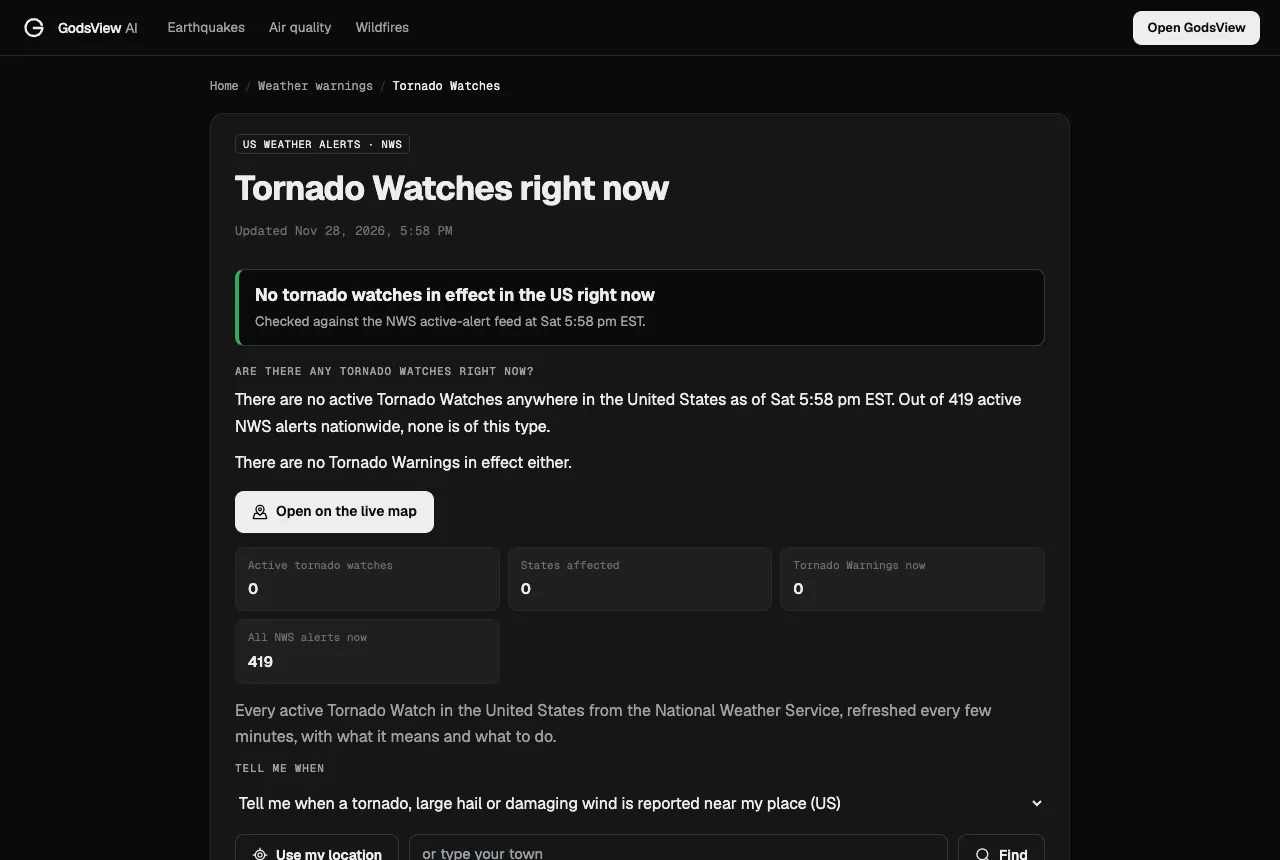
When this screenshot was taken, on the evening of November 28, 2026, there were no tornado watches anywhere in the US. Tornadoes can happen in any month, though: the SPC notes that the peak season shifts north from late winter through mid summer, with May into early June in the southern Plains, earlier spring on the Gulf Coast and June or July in the northern Plains.
For a single place, open its page, such as Oklahoma City, Tulsa, Dallas, Birmingham, Nashville or Kansas City. To see the storms themselves, the weather radar page shows live precipitation, and our guide on how to read weather radar explains what a hook echo and a velocity couplet look like. Severe thunderstorm warnings often come before or alongside tornado warnings; our severe thunderstorm warning guide explains those.
GodsView Plus ($10.99 a month or $99.99 a year, see pricing) adds alerts for severe US weather warnings at your saved places. Do not rely on any single app for tornado warnings: keep WEA on as well.
After the tornado
The SPC's advice once it has passed: keep your family together and wait for emergency crews. Stay away from power lines and puddles with wires in them, watch for broken glass and nails, stay out of heavily damaged buildings, and do not use matches or lighters in case of gas leaks. Listen for instructions from local officials.
The short version
A tornado watch means "tornadoes are possible today, be ready". A tornado warning means "a tornado is here or about to be, take cover now". The watch comes from the Storm Prediction Center over a large area; the warning comes from your local NWS office for your part of a county. During a warning, get to the lowest floor, into a small interior room, away from windows, and protect your head.
Frequently asked questions
What is the difference between a tornado watch and a tornado warning?
A tornado watch means conditions are favorable for tornadoes in and near the watch area in the next several hours, so be prepared. A tornado warning means a tornado has been sighted or indicated by radar, so take shelter immediately. Watches come from the Storm Prediction Center; warnings come from your local NWS office.
Which is worse, a tornado watch or a tornado warning?
A tornado warning is more urgent. It means a tornado is happening or about to happen near you. A watch covers a much larger area where tornadoes are possible but none has been detected yet.
How long does a tornado watch last?
Watches are issued for a period of several hours. The Storm Prediction Center describes severe weather watches as covering an organized episode expected over roughly two to eight hours, and local NWS offices can clear counties early as the threat moves on.
What does PDS mean in a tornado watch?
PDS stands for Particularly Dangerous Situation. The Storm Prediction Center uses it in tornado watches for rare situations when long-lived intense tornadoes are likely, and aims for 3 of every 4 PDS tornado watches to verify with multiple intense tornadoes.
What is a tornado emergency?
It is the National Weather Service's highest tornado alert, added to a tornado warning in exceedingly rare cases when a violent tornado is causing or about to cause catastrophic damage to the named towns. Take refuge in the safest place you can immediately.
Do tornado watches send alerts to my phone?
Tornado warnings trigger Wireless Emergency Alerts automatically; tornado watches do not. Use a weather app, TV, radio or a NOAA Weather Radio for watches, or check the live tornado watch page.
Where is the safest place in a house during a tornado warning?
A basement, under sturdy protection. Without a basement, go to the lowest floor, into a small interior room such as a bathroom or closet, or an interior hallway with no windows, crouch low and cover your head. Mobile homes are not safe; go to a sturdy building.
Sources
- National Weather Service — Tornado watch, warning and emergency
- NOAA Storm Prediction Center — SPC FAQ (watches, PDS wording)
- NOAA Storm Prediction Center — The Online Tornado FAQ (safety, watches, warnings)
- NWS Instruction 10-511, WFO Severe Weather Products Specification
- National Weather Service — Wireless Emergency Alerts
- NWS Quad Cities — Outdoor warning sirens FAQ
Facts checked on against each provider's own site.