Explainer
Flood Watch vs Flood Warning: What Each Alert Means
A flood watch is the heads-up, a flood warning is the alarm, and a flash flood warning means minutes matter. Here is how the National Weather Service uses each flood alert, and what to do when one covers your street.
Key takeaways
- A Flood Watch means conditions are favorable for flooding. It does not mean flooding will happen, but it is possible, so it is the time to prepare.
- A Flood Warning means flooding is imminent or already happening. A Flash Flood Warning means a flash flood, one that develops within about six hours of heavy rain, is imminent or occurring: move to higher ground now.
- A Flood Advisory is the lowest level: flooding that is a nuisance, but could still put lives or property at risk if people are careless.
- Six inches of fast-moving water can knock over an adult, 12 inches of rushing water can carry away most cars, and 2 feet can carry away SUVs and trucks, according to the NWS.
- GodsView has public live pages listing every active US Flood Watch and Flood Warning, plus a weather warnings page for each state and city.
A flood watch means the National Weather Service (NWS) thinks conditions are favorable for flooding in your area, usually because heavy rain is forecast over wet ground or rivers are already high. It does not mean flooding will happen, only that it could, so a flood watch is your cue to get ready. A flood warning is the next step up: flooding is imminent or already happening, and you should act.
That one difference, possible versus happening, is the whole story behind most flood alerts. The rest of this guide covers the other flood products you'll see (flash flood warnings and flood advisories), how long each one lasts, and what to do at each level. To see which flood alerts are active right now, open GodsView's live list of Flood Watches or Flood Warnings.
What does a flood watch mean?
The NWS defines a Flood Watch as an alert "issued when conditions are favorable for a specific hazardous weather event to occur." Its short label is Be Prepared. In the NWS's own words, a watch "does not mean flooding will occur, but it is possible" (NWS flood alerts).
In practice, forecasters issue a flood watch hours to a day or more ahead. Typical setups:
- Heavy rain on soaked ground. A slow storm system or a line of thunderstorms is forecast to sit over an area that already had rain, so the soil can't take much more.
- Rivers already running high. Snowmelt or earlier rain has rivers near their banks, and more rain is coming.
- Tropical rain. A hurricane or tropical storm is forecast to dump rain far inland, well away from the coast.
- Burn scars. Ground that burned in a wildfire absorbs very little water, so even moderate rain can run straight off it.
A flood watch usually covers a large area, often several counties, because the forecast can't yet say exactly where the heaviest rain will fall. That's normal. Most places inside a watch area never flood; some do, and those places get a warning.
GodsView's own description of the alert reflects that range: a Flood Watch can be about flooding or flash flooding, usually because heavy rain is forecast over saturated ground or rivers are already high.
Flood watch vs flood warning: what's the difference?
The difference is timing and certainty. A watch is about what might happen; a warning is about what is happening or about to.
| Alert | NWS label | What it means | What to do |
|---|---|---|---|
| Flood Advisory | Be Aware | Flooding that may be a nuisance, such as water on low roads or in poor-drainage areas | Take care; it can still become dangerous if you are careless |
| Flood Watch | Be Prepared | Conditions are favorable for flooding; it is possible, not certain | Make a plan, check your route to higher ground, move valuables up |
| Flood Warning | Take Action | Flooding is imminent or already happening | Act now: follow local instructions, move to higher ground if told to |
| Flash Flood Warning | Take Action | A flash flood is imminent or occurring | Move immediately to higher ground |
Sources: the NWS definitions of each product on its flood alert page.
The general rule of thumb is the same as for tornadoes and winter storms: a watch means "get ready", a warning means "do it now". If you want the side-by-side for every hazard, our guide to weather watches vs warnings explains the system in general. This guide sticks to floods, because flood alerts have a few twists of their own.
What is a flash flood warning, and why is it the most urgent?
A flash flood is exactly what it sounds like. The NWS says flash floods "generally develop within 6 hours of the immediate cause" (NWS flood hazards), and its Philadelphia office describes flash flooding as flooding that begins within 6 hours, and often within 3 hours, of heavy rainfall (NWS Mount Holly). The cause can be a thunderstorm stalled over one spot, a dam or levee failure, or an ice jam breaking up.
A Flash Flood Warning means one is imminent or occurring, and the NWS advice is to "move immediately to high ground." There is often no flood watch before it. A single slow thunderstorm can drop enough rain on a steep valley or a city underpass to cause a flash flood, even on a day with no watch in effect.
Flash floods are dangerous for three reasons:
- Speed. Water can rise from a trickle to a torrent in minutes, faster than you can drive around it.
- Night. Many flash floods happen after dark, when you can't see how deep or fast the water is.
- Roads. Low-water crossings, dips and underpasses fill first, and that's where people drive.
What is a flood advisory?
A Flood Advisory is the lowest flood alert. The NWS issues it when a weather event "may become a nuisance", such as ponding on roads, water in drainage ditches or minor flooding in low-lying areas. The NWS adds that, "if caution is not exercised, it could lead to situations that may threaten life and/or property."
Advisories are easy to ignore, and that's the risk. A flood advisory for "urban and small stream flooding" can still mean a flooded intersection on your commute. Treat it as a reason to pick a different route, not as permission to drive through standing water.
On the coast you may also see a Coastal Flood Advisory, for minor flooding from high tides or onshore wind. On November 26, 2026, the Pennsylvania weather warnings page listed one alongside wind alerts.
How do river flood warnings differ from flash flood warnings?
Flood warnings come in two broad kinds, and the difference matters for how much time you have.
River flood warnings are for rivers rising above their banks. The NWS describes river flooding as river levels rising and overflowing "the edges of their main channel" to cover areas that are normally dry. These floods build over hours or days and can last days, because a big river takes time to crest and fall. The warning usually names a river gauge, a forecast crest and a time.
Areal flood warnings cover flooding of an area rather than a single river, for example prolonged heavy rain flooding streets and fields.
Flash flood warnings are short, sharp and local, usually drawn as a polygon around the area at risk for a few hours.
| River flood | Flash flood | |
|---|---|---|
| How fast it rises | Hours to days | Minutes to a few hours |
| Typical warning length | Can be days, until the river falls | Usually a few hours |
| Where | Along a named river, below flood stage points | Streams, steep valleys, cities, burn scars |
| Warning before it | Often a watch first | Often no watch |
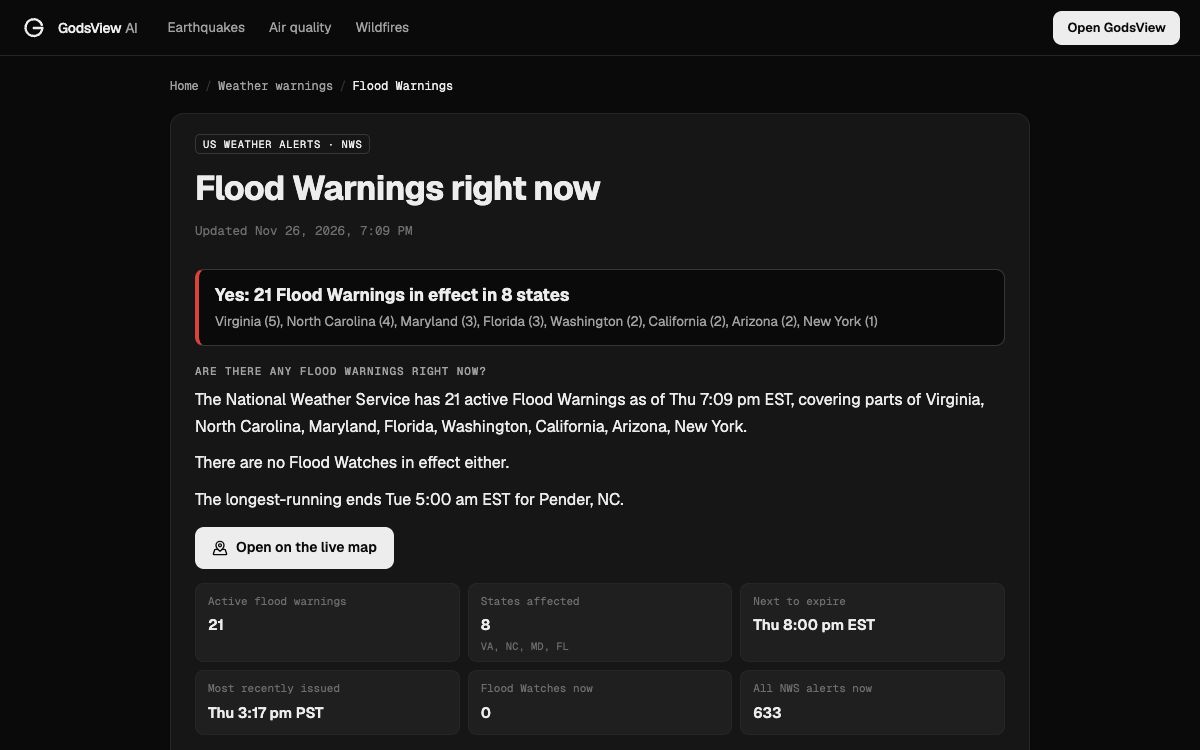
When you open GodsView's Flood Warnings page, you'll often see that mix: some warnings expire within hours, others run for days. On November 26, 2026 at 7:09 pm EST it listed 21 active Flood Warnings in 8 states, led by Virginia (5) and North Carolina (4), and the longest-running one ended the following Tuesday morning for Pender County, North Carolina. That's a river flood: slow, long, and tied to a crest downstream.
What should you do during a flood watch?
A watch is your preparation window. The NWS list of things to do before a flood (NWS: before a flood) translates into a short checklist:
- Know your risk. Find out whether your home, your street or your commute sits in a floodplain or a low spot, and know the fastest way to higher ground.
- Make a contact plan. Decide who you will call for updates and where your household will meet if you're separated.
- Check your kit. The NWS suggests food, water and medicine for at least three days, plus flashlights, batteries, a first aid kit and a NOAA Weather Radio.
- Move valuables up. Lift important papers, electronics and anything you can't replace off the floor, especially in a basement.
- Charge your phone and a power bank.
- Check the sump pump and know where your electrical breakers are.
- Don't wait for an order if you know your area floods. The NWS advice is plain: "Don't wait to be ordered to leave; evacuate yourself."
One thing a watch is too late for: flood insurance. The NWS notes that many flood insurance policies take at least 30 days to go into effect, so buy cover well before the rainy season, not when the watch is issued.
What should you do during a flood warning?
When the watch becomes a warning, switch from planning to acting:
- Follow local officials. If you're told to evacuate, go, and use the routes they give you.
- Get to higher ground if water is rising near you. In a flash flood warning, don't wait.
- Stay off flooded roads. The NWS campaign is called Turn Around, Don't Drown for a reason. Over half of all flood-related drownings happen when a vehicle is driven into hazardous flood water (NWS).
- Don't walk through moving water. Just 6 inches of fast-moving flood water can knock over an adult.
- Don't trust the depth. 12 inches of rushing water can carry away most cars, and 2 feet can carry away SUVs and trucks. The road under the water may also be gone.
- Keep kids and pets away from creeks, storm drains and flooded yards.
Water at night is the worst case. You can't judge its depth or speed, and the road under it may be washed out. If you can't see the road surface, treat it as closed.
Where can you check for flood watches and warnings right now?
The fastest place is your phone. In the US, the most dangerous warnings, including flash flood warnings, are sent as Wireless Emergency Alerts, so keep Emergency Alerts switched on in your phone's settings. A NOAA Weather Radio is the backup if power or mobile coverage goes.
For the full picture, GodsView has public pages built on the NWS active-alert feed:
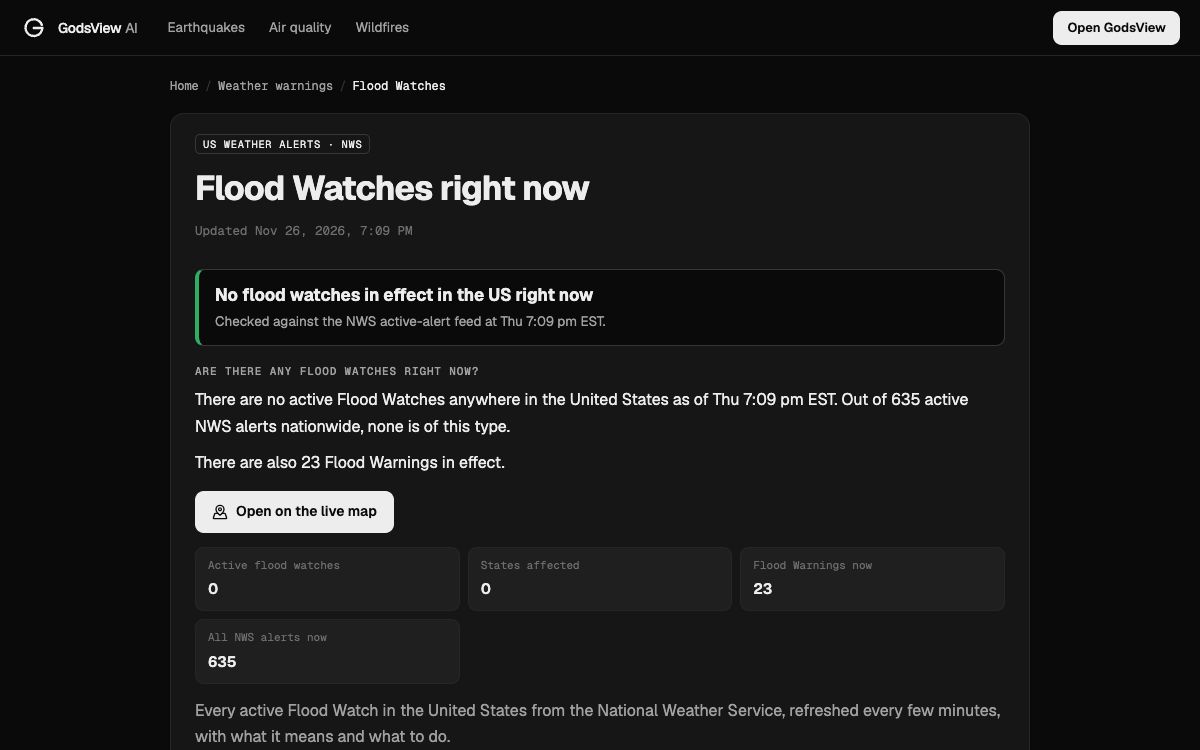
- Flood Watches right now lists every active US Flood Watch, with its area, issue time and expiry. When we checked on November 26, 2026 at 7:09 pm EST, there were none: of 635 active NWS alerts nationwide, not one was a Flood Watch, while 23 Flood Warnings were in effect.
- Flood Warnings right now and Flash Flood Warnings do the same for warnings.
- State pages such as weather warnings in Virginia or North Carolina group every active alert by type, so you see a flood watch next to a wind advisory or a winter storm warning.
- City pages on the weather warnings hub show what covers one town.
On the live map at /globe, the weather alerts layer draws warning areas next to rivers, storms, fires and earthquakes. The map needs a free account. If you save your home on GodsView Plus ($10.99 a month or $99.99 a year, see pricing), you can turn on an alert for when a severe US weather warning covers your place. For a wider look at alert apps, read how to get disaster alerts near home.
Why do flood watches cover such large areas?
People often ask why their county was under a flood watch and nothing happened. There are three reasons.
Rain is hard to place. Forecasters can be confident that a storm will drop 2 to 4 inches of rain across a region, but much less confident about which valley gets the 4.
Soil matters as much as rain. The same storm can do nothing on dry ground and cause flooding a week later on soaked ground. A watch reflects both the rain forecast and how wet the ground already is.
A miss is cheaper than a surprise. A watch costs you an hour of preparation. Not having one before a flash flood can cost lives. So watches are drawn wide on purpose.
That's also why a watch can end early, be extended, or be replaced by warnings for only part of the area. Keep checking until it expires. If you're travelling, check alerts along your route, not only at home; our guide to weather alerts in my area shows how.
The short version
A flood watch means flooding is possible: prepare. A flood warning means flooding is imminent or happening: act. A flash flood warning means a fast, dangerous flood is imminent or occurring: get to higher ground now. A flood advisory is a nuisance flood that can still catch out a careless driver. Whatever the alert, never drive or walk into flood water.
To see the alerts in force right now, open Flood Watches or Flood Warnings on GodsView, or your own state's page. For hurricane rain and storm surge, see how to watch a hurricane live.
Frequently asked questions
What does a flood watch mean?
A Flood Watch means the National Weather Service thinks conditions are favorable for flooding. It does not mean flooding will happen, but it is possible, so it is time to prepare: check your route to higher ground, charge your phone and move valuables up.
Which is worse, a flood watch or a flood warning?
A flood warning is worse. A watch means flooding is possible; a warning means flooding is imminent or already happening and you should act now. A flash flood warning is the most urgent: move to higher ground immediately.
How long does a flood watch last?
It varies. A watch covers the period when flooding is possible and can be extended, cancelled early or replaced by warnings. Check the expiry time in the alert, or on the live Flood Watches page.
What is the difference between a flood warning and a flash flood warning?
A flood warning usually covers slower flooding, such as a river rising above its banks over hours or days. A flash flood warning covers flooding that develops quickly, generally within 6 hours of heavy rain, a dam failure or an ice jam, and often with little warning.
What is a flood advisory?
A Flood Advisory is the lowest NWS flood alert. It means flooding may become a nuisance, such as water on low roads, but the NWS warns it can still threaten life or property if people are careless.
How deep does water have to be to sweep a car away?
According to the National Weather Service, 12 inches of rushing water can carry away most cars, and 2 feet can carry away SUVs and trucks. Six inches of fast-moving water can knock over an adult.
Sources
- NWS: Flood watch, warning and advisory definitions
- NWS: Flood-related hazards (flash, river, coastal floods)
- NWS Mount Holly: Flash flooding definition
- NWS: Turn Around, Don't Drown
- NWS: Before a flood
Facts checked on against each provider's own site.