Guide
Why Are Tornado Sirens Going Off? Warning, Test or Storm
The sirens are wailing and you are not sure if it is a drill. Treat it as real until you know otherwise, and you can usually find out in under a minute. Here is why sirens sound, how local tests work, and what to do while they are going.
Key takeaways
- If outdoor sirens sound outside a scheduled test, assume there is a tornado warning or another life-threatening hazard nearby: go inside a sturdy building, then check for a warning.
- Sirens are owned and sounded by cities and counties, not by the National Weather Service. Each community decides when to sound them; many use them for tornado warnings, and some also for severe thunderstorms with winds of about 70 mph or more.
- Most communities test on a fixed schedule, such as the first Tuesday of each month at 10 a.m. across Illinois, or noon on Saturdays in Oklahoma City. A test outside that time, on a stormy day, or with a forecast for severe weather, is not a test.
- Sirens are an outdoor warning system and are not designed to be heard indoors or to wake you up. Use phone alerts and NOAA Weather Radio at home.
- There is no all-clear siren. When sirens stop, the danger may not have passed; stay sheltered until the warning expires.
Tornado sirens go off for one of three reasons: a tornado warning for your area, another life-threatening hazard that your community uses sirens for (often a severe thunderstorm with very strong winds), or a scheduled test. If you cannot immediately tell which, act as if it is real: go inside a sturdy building now, away from windows, then check whether a warning is in effect. The National Weather Service (NWS) advice is the same everywhere: when you hear sirens, go inside and get more information.
The fastest check is GodsView's live list of Tornado Warnings in the US, or your city's page on the weather warnings hub.
Check active tornado warnings now
Is it a tornado warning, a storm or a test?
Run through these in order. It takes under a minute.
- Is it a scheduled test time? Many communities test at a fixed time each week or month (see the table below). If it is not that time, it is very unlikely to be a test.
- Is the weather stormy, or is severe weather in the forecast? A siren during or just before a storm is almost certainly real.
- Is there a warning? Check the tornado warning list and the severe thunderstorm warning list, a weather app, local TV or radio, or NOAA Weather Radio.
- Did your phone get a Wireless Emergency Alert? The NWS sends tornado warnings as WEAs to capable phones in the warned area automatically.
If you are still unsure, stay inside until you are.
Why outdoor sirens sound
Outdoor warning sirens are local equipment. The NWS office in Minneapolis puts it plainly: "Counties and cities own the sirens, and therefore decide how and when to activate them. The National Weather Service does not sound them." They are typically activated by city or county officials such as police, fire or emergency management staff.
That means the rules differ from place to place. The NWS notes that policies range from sounding sirens only for tornado warnings to also sounding them for severe thunderstorm warnings with winds of 70 to 80 mph or more. In the Quad Cities area of Iowa and Illinois, for example, local guidelines sound sirens for tornadoes, hail the size of golf balls or larger, and winds over 70 mph, conditions that "pose a direct risk to life if people are caught outdoors."
Some systems are all-hazards. Illinois describes its sirens as an all-hazards warning that may be used for severe storms, tornadoes, earthquakes, hazardous materials incidents, extreme winds, biological hazards or attack. Oklahoma City sounds its sirens in and near areas where the NWS has issued a tornado warning or where a tornado has been sighted.
| Community | Test schedule | What the sirens are used for |
|---|---|---|
| Illinois (statewide) | First Tuesday of each month, 10 a.m. | All hazards, including severe storms and tornadoes |
| Oklahoma City | Noon on Saturdays, unless severe weather threatens | Tornado warnings and confirmed tornado sightings |
| Quad Cities (Iowa and Illinois) | First Tuesday of each month | Tornadoes, golf-ball hail or larger, winds over 70 mph |
| Minnesota | Set by each city or county; statewide drill on April 16, 2026 at 1:45 p.m. and 6:45 p.m. CDT | Varies by community |
Schedules come from the NWS, the State of Illinois and the City of Oklahoma City, checked on November 28, 2026. Your own town's schedule is on its emergency management website.
What to do when tornado sirens go off
The NWS tornado warning advice: "Move to an interior room on the lowest floor of a sturdy building. Avoid windows."
At home
- Go to your basement, safe room, or an interior room away from windows on the lowest floor.
- Take your phone so you can keep checking the warning.
- Keep monitoring local news or a NOAA Weather Radio for updates.
In a mobile home or outdoors
- The NWS is clear that a mobile home or tent is not a safe shelter. Go to the closest sturdy building or designated shelter.
- Sheds and storage buildings are not safe either.
In a car
- The NWS says being in a vehicle during a tornado is not safe; the best action is to drive to the closest shelter.
- If you cannot, get down in the car and cover your head, or leave the car for a low-lying area such as a ditch or ravine.
At school or work
- Follow your tornado drill and go to the shelter area calmly.
- Stay away from windows and avoid large open rooms such as cafeterias, gyms and auditoriums.
Why you cannot always hear sirens indoors
Sirens are designed for people outside. The NWS Quad Cities office is blunt: warning sirens "are not meant to be heard indoors or to wake you up at night!" Oklahoma City notes its sirens can often be heard indoors, but that their primary purpose is to alert people who are outside.
For warnings indoors, the NWS recommends NOAA Weather Radio, which it calls "like a smoke detector for severe weather" because it can wake you when a warning is issued. Also:
- Turn on emergency alerts on your phone. Wireless Emergency Alerts need no sign-up and do not count toward texting limits.
- Use more than one source: a weather app, local TV or radio, and a weather radio.
- Our guide to weather alerts in your area walks through the phone settings.
Why sirens sound for some severe thunderstorms
If your sirens go off and the warning turns out to be a Severe Thunderstorm Warning rather than a Tornado Warning, your community is probably one that sounds them for the most dangerous storms too. The NWS Quad Cities office explains why: "When thunderstorm winds exceed 70 mph, trees can be uprooted or snapped. Hail that is golf ball sized or larger can break windows." Those conditions put anyone outdoors at direct risk, just as a tornado would.
Treat it the same way. Get inside a sturdy building, away from windows, and wait for the storm to pass. The NWS notes that straight-line winds in strong thunderstorms can exceed 100 mph. Our severe thunderstorm warning guide covers the damage threat tags that appear on these warnings.
Why there is no "all clear" siren
Many people expect a second siren when the danger is over. There isn't one. The NWS explains that people should be indoors and monitoring local media for updates, and Minneapolis NWS adds that "there is no such thing as an 'all-clear' for storms."
Sirens normally sound for about three minutes and then go silent, according to the NWS. Silence does not mean the tornado has passed; Oklahoma City stresses that when the sirens stop, it does not indicate the threat has passed. Sirens may sound again if a new warning is issued. Stay in shelter until the tornado warning for your area expires or is cancelled, which you can check on the tornado warning list.
Tornado watch vs tornado warning
Sirens are tied to warnings, not watches:
- Tornado Watch: tornadoes are possible in and near the watch area. Review your plans, check supplies and your safe room. Sirens usually do not sound.
- Tornado Warning: a tornado has been sighted or indicated by weather radar, and there is imminent danger to life and property. This is when sirens usually sound.
Our tornado watch vs tornado warning guide explains both, and the severe thunderstorm warning guide covers the storms some communities also sound sirens for.
Checking for warnings right now
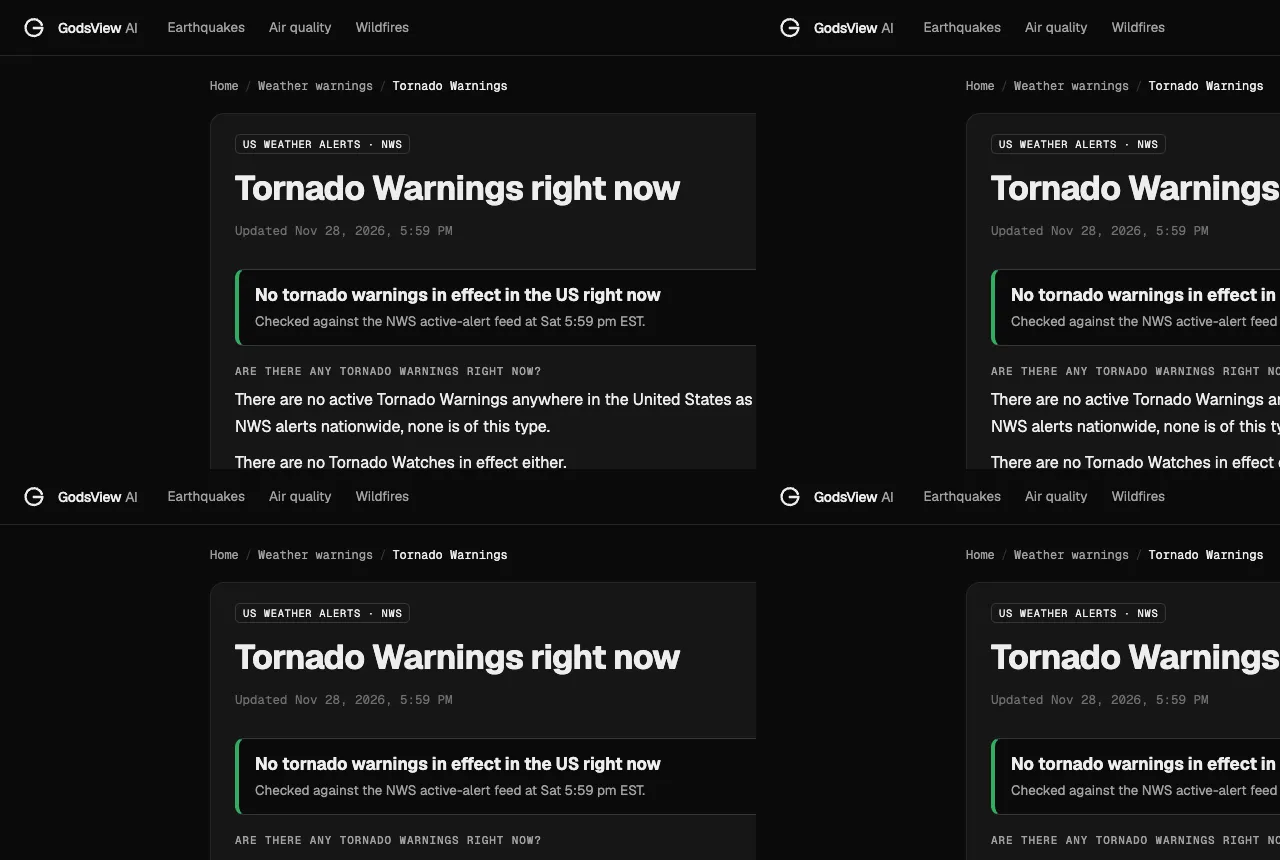
On November 28, 2026, GodsView's live list showed no tornado warnings in effect in the US.
When the sirens go off, check:
- US tornado warnings: the Tornado Warning list and Tornado Watch list.
- Your city: for example Oklahoma City, Dallas, Kansas City, Wichita or Chicago.
- The storm itself on the live weather radar. Our guide to how to read weather radar explains hook echoes and velocity couplets.
- Alerts for saved places: GodsView Plus ($10.99 a month or $99.99 a year).
The short version
If tornado sirens go off and it is not your town's test time, go inside a sturdy building now, then check for a warning. Sirens are run by your city or county, are meant for people outdoors, last a few minutes, and have no all-clear. Shelter in an interior room on the lowest floor and stay there until the warning ends.
Check tornado warnings for my city
Frequently asked questions
Why are the tornado sirens going off right now?
Usually because of a tornado warning, a severe storm that your community sounds sirens for, or a scheduled test. If it is not your town's test time, go inside a sturdy building and check the tornado warning list or local media.
When are tornado sirens tested?
Each community sets its own schedule. Illinois tests on the first Tuesday of each month at 10 a.m., and Oklahoma City tests at noon on Saturdays unless severe weather threatens. Check your city or county emergency management website.
Who turns on tornado sirens?
City or county officials, usually police, fire or emergency management staff. The National Weather Service issues warnings but does not sound the sirens.
Do tornado sirens mean a tornado is coming?
They mean a tornado warning or another life-threatening hazard is affecting or near your area. Some communities also sound them for severe thunderstorms with winds of about 70 mph or more. Take shelter either way.
Is there an all-clear siren?
No. Sirens usually sound for about three minutes and stop; that does not mean the danger has passed. Stay sheltered and check local media until the warning expires.
Why can't I hear tornado sirens inside my house?
Sirens are an outdoor warning system and are not designed to be heard indoors or to wake you. Use phone emergency alerts and a NOAA Weather Radio at home.
Sources
- NWS Quad Cities — Outdoor warning sirens FAQ
- NWS Twin Cities — Severe Weather Awareness Week 2026
- Ready Illinois — Outdoor warning sirens
- City of Oklahoma City — How to prepare for tornadoes
- National Weather Service — Tornado watches and warnings
- National Weather Service — During a tornado
- National Weather Service — Wind safety
- National Weather Service — Wireless Emergency Alerts
Facts checked on against each provider's own site.