Power
Why Does the Power Go Out? Common Causes and What to Do
The lights go off, the router blinks out, and the first question is why. Most outages have one of a handful of causes, and the cause usually tells you how long you will wait. Here is what knocks the power out, how to check whether it is just you, and what to do next.
Key takeaways
- Most outages start on the local distribution network: a tree or branch on a line, an animal on equipment, a failed transformer, or a car hitting a pole.
- Weather is behind the longest outages. In 2024 the average US customer was without power for about 11 hours, and major events such as Hurricanes Beryl, Helene and Milton caused 80% of those hours, according to the EIA.
- Without major events, US customers average about two hours of interruptions a year.
- Some outages are deliberate: planned maintenance, wildfire Public Safety Power Shutoffs, and rotating outages a grid operator orders to prevent a wider blackout.
- If your power goes out, check your breaker panel and your neighbours first, then your utility's outage map, and report it. Do not assume someone else has.
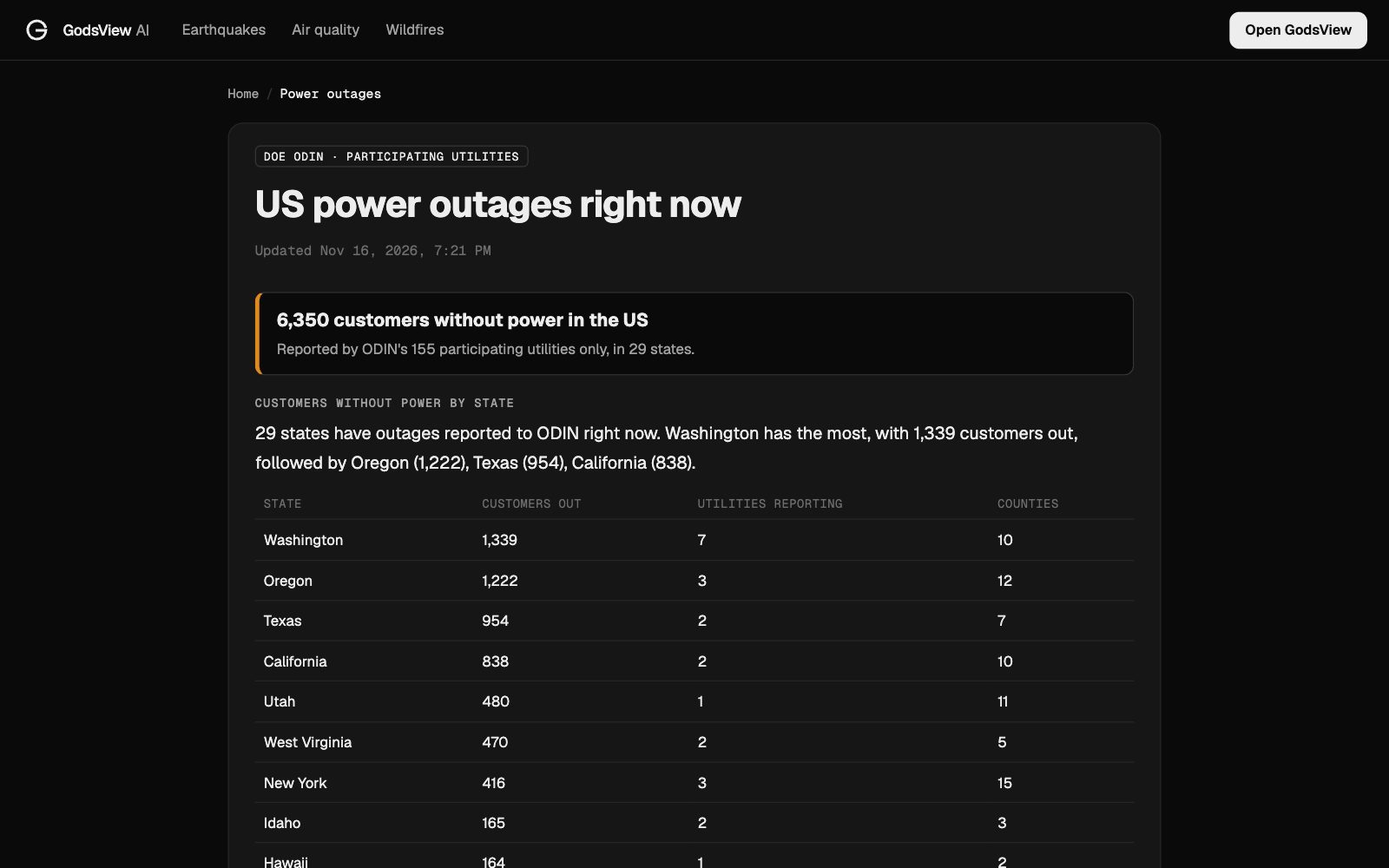
- GodsView's power outages page shows live outages from utilities that publish to the Department of Energy's ODIN feed. Coverage is partial, so your utility's own map is the final word.
Power outages are usually caused by something physically damaging or tripping the local lines: wind and storms, trees and branches touching wires, animals on equipment, worn-out transformers or a vehicle hitting a pole. Fewer are deliberate, such as planned maintenance, wildfire safety shutoffs or rotating outages during a grid emergency. If your power is out right now, check your breakers and your neighbours, then look at your utility's outage map, which usually lists the cause once a crew has found it.
The cause matters because it sets how long you wait. A blown fuse on a pole can be fixed in an hour or two. A hurricane that snaps hundreds of poles can leave a region dark for days. This guide walks through the common causes, how to tell which one you are dealing with, and how to check outages live.
See US power outages right now
Is it just my house? Check this first
Before blaming the grid, rule out your own wiring. It takes two minutes.
- Look at your breaker panel or fuse box. If one room or one appliance is dead, a breaker has probably tripped. Switch it fully off, then on. If it trips again straight away, unplug things on that circuit and call an electrician.
- Check GFCI outlets. Kitchens, bathrooms, garages and outdoor sockets often have outlets with a reset button. One tripped outlet can cut power to others downstream.
- Look outside. Are the street lights and your neighbours' windows dark too? If the whole street is out, it is the utility's problem, not yours.
- Check your utility's outage map or app. If your area already shows an outage, it may list a cause and an estimated restoration time.
- Report it. Utilities often learn about outages from customer calls and smart meters. Report it online, by text or by phone. Do not assume a neighbour already has.
If you see a downed line, stay well away from it and anything it touches, including fences and puddles, and call your utility or 911. Treat every fallen wire as live.
The common causes of power outages
Most outages happen on the distribution system: the poles, wires and transformers that carry power from a local substation to your street. Big transmission failures are rare, but they affect far more people when they happen. Here are the usual causes and what each one tends to mean for you.
| Cause | What happens | Typical wait |
|---|---|---|
| Wind, storms and ice | Lines snap, poles break, branches fall on wires | Hours for a single fault; days after a hurricane or ice storm |
| Trees and vegetation | Branches touch or fall on lines, even on calm days | An hour or two to several hours |
| Animals | Squirrels, birds or snakes bridge live parts of a transformer or pole | Often an hour or two |
| Equipment failure | Old or overloaded transformers, cables and switches fail | Hours; longer if a part must be replaced |
| Vehicle accidents | A car or truck hits a pole | Several hours while the pole is replaced |
| Heat and high demand | Equipment overheats; in extremes the grid is short of supply | Minutes to hours |
| Planned outages | The utility switches power off to work safely | Usually announced in advance, with a window |
| Public Safety Power Shutoffs | Power is cut ahead of high wildfire risk | Until the wind drops and lines are inspected, often a day or more |
| Grid emergencies | The grid operator orders rotating outages | Rotating blocks, often an hour or so each, while the emergency lasts |
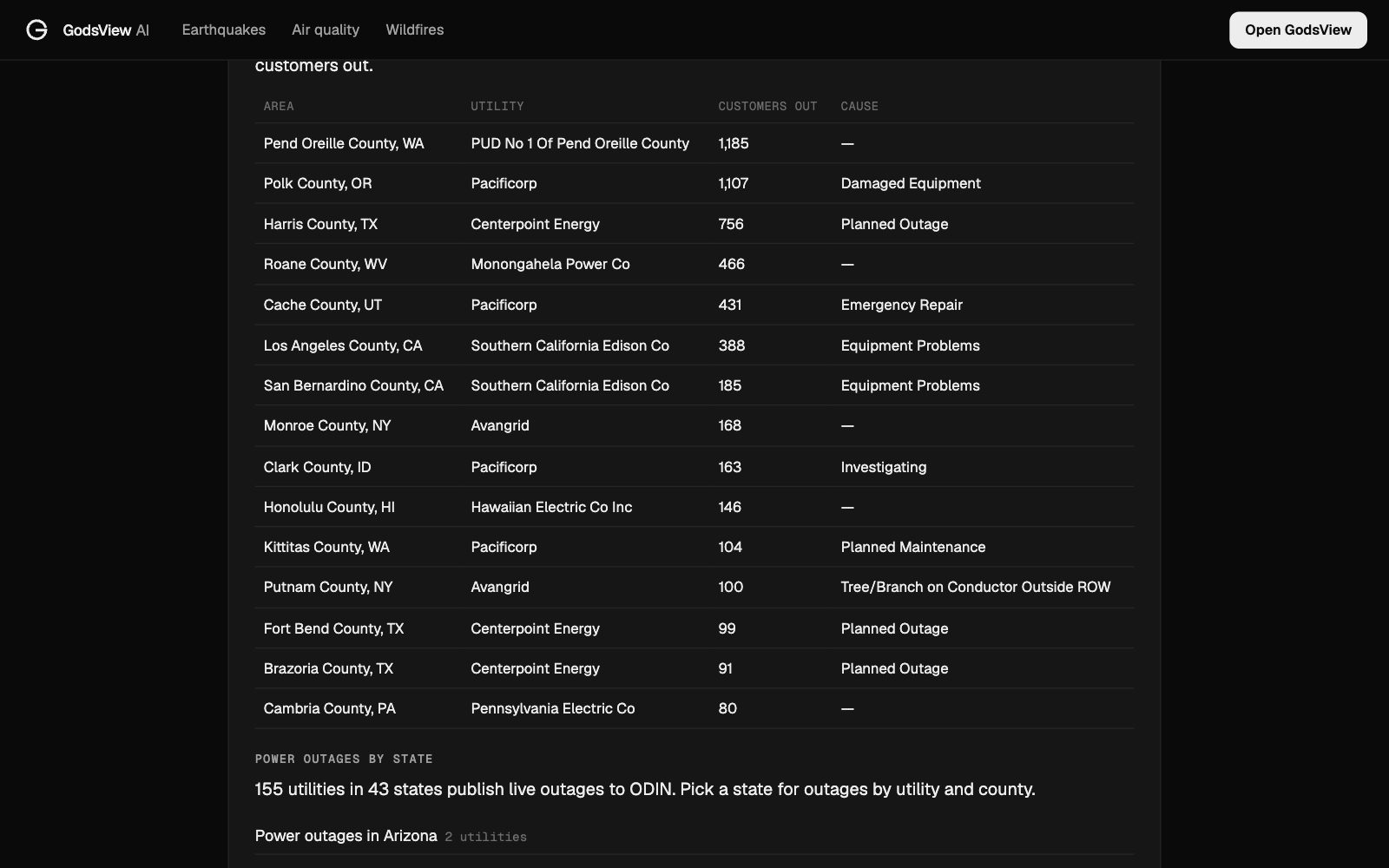
You can see these causes in live outage data. On November 16, 2026, the GodsView power outages page listed the largest outage areas with the cause each utility gave: a vehicle accident in Polk County, Oregon (PacifiCorp, 1,079 customers out), planned outages in Harris County, Texas (CenterPoint Energy, 1,099), and equipment problems in San Bernardino County, California (Southern California Edison, 185). The biggest, in Los Angeles County, was still listed as "Analyzing Problem".
Weather: wind, storms, ice and heat
Weather causes the longest outages by far. The US Energy Information Administration (EIA) tracks how long the average customer goes without power each year, a reliability measure called SAIDI (System Average Interruption Duration Index). In 2024 that figure was about 11 hours, nearly twice the average of the decade before. Major events, such as Hurricanes Beryl, Helene and Milton, accounted for 80% of those hours. South Carolina had the longest interruptions of any state, nearly 53 hours, mostly from Helene (EIA).
Take the big events out and the picture is steady. EIA says outages not caused by major events have averaged about two hours a year since 2013 (EIA). In other words, ordinary faults are an inconvenience; storms are what leave people without power for days.
Different weather breaks the grid in different ways:
- Wind pushes trees and branches into lines and can snap poles. Thunderstorms, derechos and tropical storms all do this. Even a tropical storm well below hurricane strength can cut power to hundreds of thousands of people. Our guide to when hurricane season is covers when that risk peaks.
- Ice coats lines and branches until they break under the weight. Ice storms are notorious for long outages because the damage is spread over a wide area.
- Lightning can trip protective equipment or destroy a transformer.
- Flooding reaches underground cables and substations.
- Heat strains equipment that is already working hard. Transformers rely on cool nights to recover, and air conditioning pushes demand to its highest of the year.
Check weather warnings near you before a storm arrives. A high wind warning or an ice storm warning is a good reason to charge your phone and power banks. If the alert names confuse you, see weather watch vs warning.
Trees, animals, equipment and accidents
These are the everyday causes. They explain most of the short outages you have on a calm day.
Trees and vegetation. Branches growing into lines are one of the most common causes of outages, which is why utilities spend heavily on tree trimming along their lines. A branch does not have to fall; one brushing a line in a breeze can trip it. EIA lists vegetation as one of the main reasons for interruptions alongside major weather (EIA).
Animals. A squirrel on a transformer, a bird across two wires or a snake inside a substation can create a short circuit. The protective equipment trips to stop damage, and the outage that follows can cover a whole neighbourhood. Utilities fit covers and guards to reduce this, but it remains a routine cause.
Equipment failure. Transformers, underground cables, switches and connectors wear out. Many US distribution lines and transformers are decades old. A failure can happen on a perfectly clear day, often under heavy load in summer or winter peaks.
Vehicle accidents. A car hitting a power pole can bring down the lines on it and cut power to everyone fed from that section. The repair means a crew, a new pole and rewiring, so these outages often run several hours. Utility outage maps frequently list "vehicle accident" or "car hit pole" as the cause.
Momentary blinks. If your lights flicker off for a second and come back, that is usually protective equipment called a recloser doing its job. It cuts the line briefly when it senses a fault, such as a branch touching a wire, then tries again. If the fault clears, power returns. If it doesn't, the recloser stays open and you get a full outage.
Planned outages and wildfire safety shutoffs
Some outages are on purpose.
Planned outages let crews work safely: replacing a pole, upgrading a transformer, connecting a new building. Utilities usually notify affected customers in advance by mail, text, email or app, with a time window. If your power goes off at the start of an announced window, that is probably why.
Public Safety Power Shutoffs (PSPS) are a wildfire measure that began in California. When strong, dry winds and high fire danger are forecast, utilities may switch off lines in high-risk areas, because wind can push branches or debris into energized lines and spark a fire. The California Public Utilities Commission describes them as a temporary measure to reduce the risk of fires caused by electric infrastructure (CPUC). Utilities in several other western states now have similar programmes. Power stays off until the wind dies down and crews have patrolled the lines for damage, which can take a day or longer.
Grid emergencies and rolling blackouts
The rarest cause, and the one that worries people most, is a shortage across the whole grid. The power system has to match supply and demand every second. If demand outruns the electricity available, because of extreme heat or cold, power plant failures or both, the grid operator can order utilities to cut customers off in turns. These rotating outages, or rolling blackouts, are a controlled step to stop a much wider uncontrolled blackout.
The best-known recent example is Winter Storm Uri in February 2021. Extreme cold pushed demand up while generators across Texas failed. The joint FERC and NERC report found that ERCOT, the Texas grid operator, had to shed 20,000 MW of firm load at the worst point, and more than 4.5 million people in Texas lost power, some for as long as four days (NERC). Rotating outages are meant to move around so no area is out too long; in 2021 many stayed off far longer because so much supply was lost.
Grid operators warn before this happens, through conservation appeals and energy emergency alerts. If you are in Texas, is the power out in Texas? explains how to tell an ERCOT emergency from a local outage.
How long do power outages last?
It depends almost entirely on the cause and the scale.
- A single local fault (a tripped recloser that doesn't reset, a blown fuse, an animal on a transformer) is usually fixed within a few hours.
- A broken pole or failed transformer often takes several hours, because a crew has to bring and install new equipment.
- A major storm can take days. Utilities restore the biggest lines and critical facilities such as hospitals first, then substations and main feeders, then smaller lines and finally individual homes. The last customers back on are often those served by a single damaged line or with damage to their own service connection.
Your utility's estimated restoration time is a guess that gets better once crews have assessed the damage. Early estimates after a big storm are often broad.
While you wait, a few safety rules matter more than comfort:
- Food. A closed refrigerator keeps food cold for about 4 hours. A full freezer holds its temperature for about 48 hours, or 24 hours if half full (USDA FSIS). Keep the doors shut.
- Generators. Never run one indoors, in a garage or near windows. Carbon monoxide kills people after every major storm.
- Appliances. Unplug sensitive electronics so a surge when power returns doesn't damage them. Leave one light switched on so you know when power is back.
How to check power outages live on GodsView
The GodsView power outages page shows customers without power across the US right now, by state, county and utility, with the biggest outage areas and their stated causes. The data comes from ODIN, the Outage Data Initiative Nationwide, which Oak Ridge National Laboratory runs for the Department of Energy. Participating utilities send standardised outage reports every few minutes, and GodsView refreshes them about every five minutes.
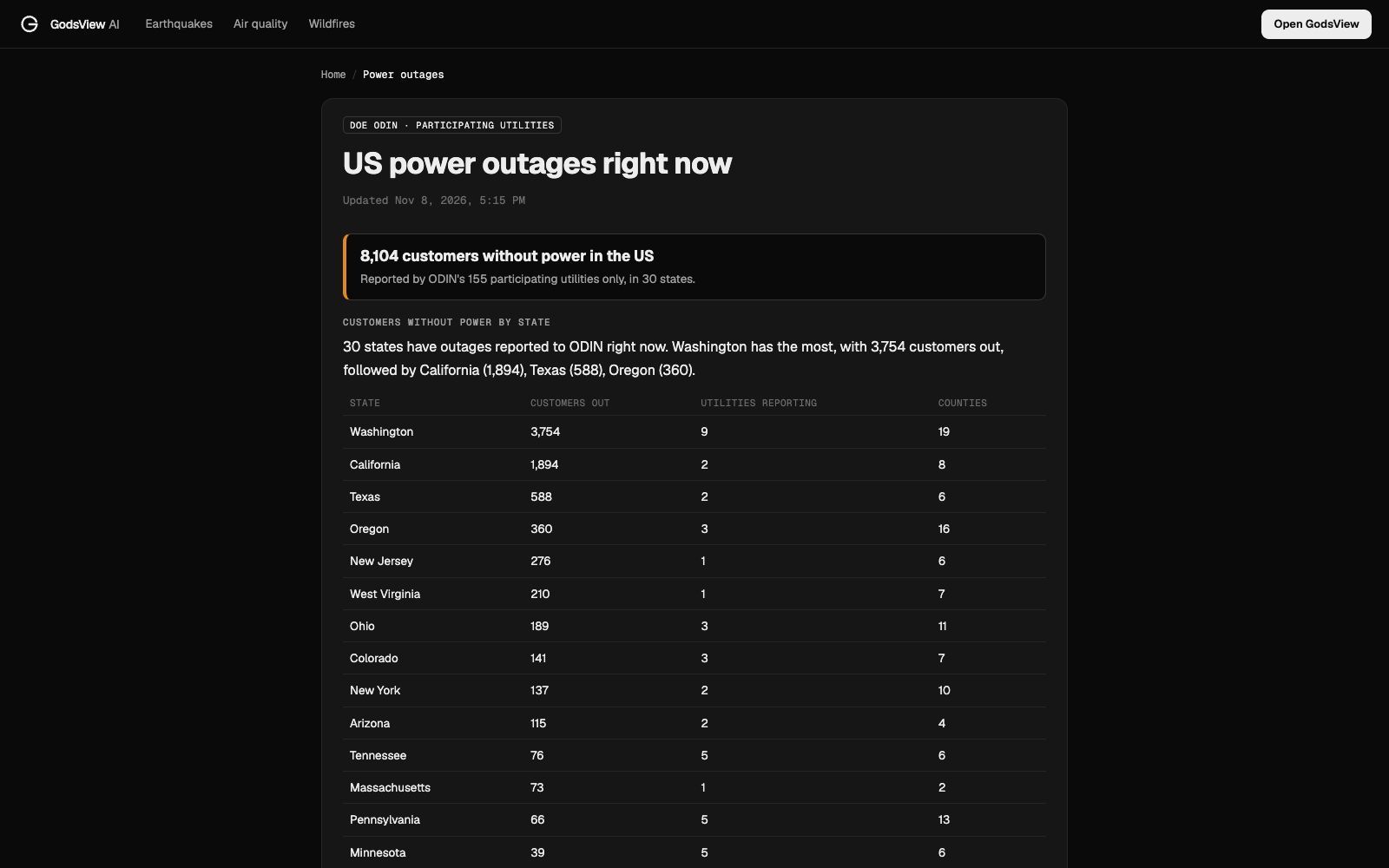
On November 16, 2026, the page showed 8,551 customers without power, reported by ODIN's 155 participating utilities in 43 states, with outages in 30 states. California had the most, 1,755 customers, followed by Washington, Texas and Oregon. Each state has its own page, such as power outages in California, listing which utilities report there.
The coverage is partial, and that matters. ODIN only includes utilities that choose to publish to it. Customers of other utilities, including many city-owned systems, co-ops and some large investor-owned utilities, can be without power and not appear at all. So an empty or small number on GodsView does not prove your area has power. Your own utility's outage map is the final word. Our power outage map near me guide explains how to find your utility and its map.
You can also switch on the power outage and weather alert layers on the live map to see outages next to storms and warnings. To be told when severe weather or a tropical cyclone threatens your area, save your home on My places and turn on alerts; that needs GodsView Plus or Pro, and how to get disaster alerts near home walks through it.
Frequently asked questions
Why is my power out?
Most often a storm, a tree or branch on a line, an animal on equipment, a failed transformer or a vehicle hitting a pole. Check your breakers and your neighbours, then your utility's outage map, which usually shows the cause once a crew has found it.
Why is there a power outage near me on a clear day?
Calm-day outages usually come from equipment failure, animals, trees growing into lines, car crashes or planned maintenance. In hot weather, heavy air conditioning load can also overheat equipment.
How long do power outages usually last?
Local faults are typically fixed within a few hours. After major storms outages can last days. EIA says US customers average about two hours of interruptions a year outside major events, but 2024 averaged about 11 hours including hurricanes.
Should I report a power outage?
Yes. Report it to your utility online, by text or by phone, even if neighbours are out too. Utilities use reports and smart meter data to work out where a fault is.
What is a Public Safety Power Shutoff?
A deliberate outage a utility makes when strong, dry winds create a high wildfire risk, so that damaged or swaying lines cannot start a fire. Power returns after the wind drops and crews inspect the lines.
What are rolling blackouts?
Rotating outages a grid operator orders when demand is higher than the power available. Utilities cut power to groups of customers in turn to prevent a wider, uncontrolled blackout.
Does GodsView show every power outage?
No. The power outages page uses DOE and Oak Ridge National Laboratory ODIN data, which only covers utilities that publish to it. Always check your own utility's outage map.
Sources
- EIA: Hurricanes in 2024 led to the most hours without power in the United States in 10 years
- EIA Today in Energy: U.S. electricity interruptions in 2022
- California Public Utilities Commission: Public Safety Power Shutoffs
- FERC and NERC: February 2021 Cold Weather Outages in Texas and the South Central United States
- USDA FSIS: Keep your food safe during emergencies
- DOE / Oak Ridge National Laboratory: ODIN (Outage Data Initiative Nationwide)
Facts checked on against each provider's own site.