Explainer
Winter Weather Advisory Meaning: Snow Amounts and Driving Tips
A winter weather advisory is the lowest of the National Weather Service winter alerts, but it is the one most likely to catch drivers out: a few inches of snow or a glaze of ice at rush hour. Here is what it means, how much snow it usually takes where you live, and how to drive in it.
Key takeaways
- A Winter Weather Advisory means snow, blowing snow, sleet, freezing rain or a mix is expected, but not severe enough for a warning; the NWS says to expect winter driving conditions and possible travel difficulties.
- Typical snow amounts are set locally: 3 to 5 inches around Omaha, 3 to 5 inches in 12 hours in central Illinois, 4 inches or more in 12 hours in central New York, and more than 1 inch in the Memphis area.
- Forecasters can issue an advisory for less snow when timing makes it worse, such as light snow during the morning or evening commute, or an unusually early or late-season event.
- An advisory is issued when forecasters have 80 percent or greater confidence; if the storm trends worse, it can be upgraded to a Winter Storm, Ice Storm or Blizzard Warning.
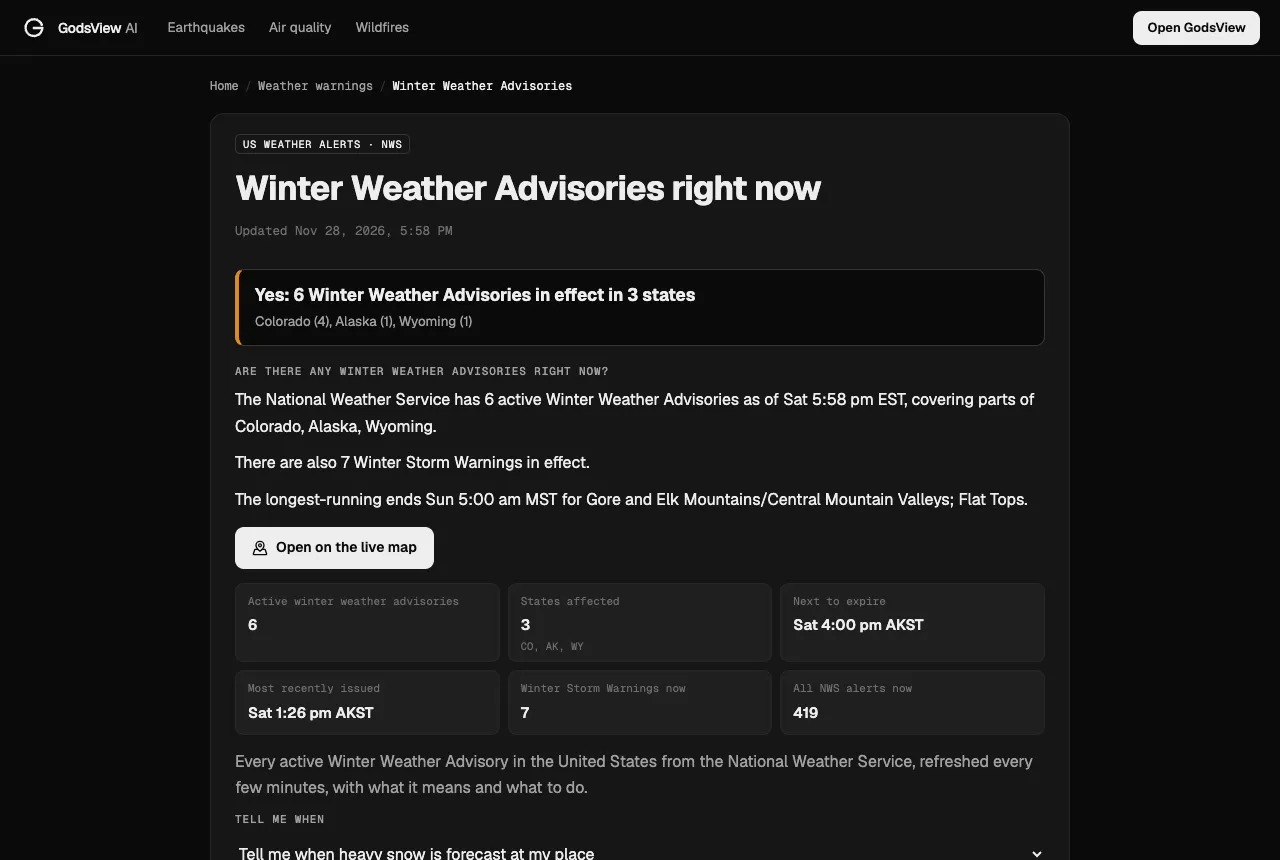
- GodsView's Winter Weather Advisory page lists every active NWS advisory by state; on November 28, 2026 it showed 6 in Colorado, Alaska and Wyoming.
A winter weather advisory means the National Weather Service expects snow, blowing snow, sleet, freezing rain or a mix of them, but not enough to meet warning criteria. It is a heads-up for slick roads and a slow commute. The NWS advice: be prepared for winter driving conditions and possible travel difficulties, and use caution when driving.
"Less than a warning" does not mean harmless. The NWS describes advisories as being for conditions that cause significant inconvenience and that, if caution is not exercised, could lead to situations that threaten life or property. The NWS also warns that even roads that only look wet can be slick.
See active winter weather advisories
Winter weather advisory vs winter storm warning
| Alert | Meaning | What to do |
|---|---|---|
| Winter Weather Advisory | Snow, blowing snow, sleet, freezing rain or a mix below warning criteria | Expect slippery roads; allow extra time; drive with caution |
| Winter Storm Watch | A significant winter storm is possible, timing or location uncertain | Prepare in case it becomes a warning |
| Winter Storm Warning | A significant storm with snow, sleet or ice at warning level | Travel difficult or impossible; delay travel |
| Ice Storm Warning | Damaging ice, usually a quarter inch or more | Travel dangerous or impossible; expect power cuts |
| Blizzard Warning | 35 mph winds with snow cutting visibility under a quarter mile for 3 hours | Do not travel |
Both advisories and warnings are issued when a winter weather event is occurring, imminent or very likely: the NWS instruction says offices issue them when forecasters have 80 percent or greater confidence of meeting local criteria. The difference is severity, not certainty. If a storm trends heavier, the advisory can be upgraded to a warning, so check for updates through the day. Our guides explain the winter storm warning, the ice storm warning and the blizzard warning in detail.
How much snow for a winter weather advisory?
Each local NWS office sets its own advisory criteria, usually as a snow amount over 12 or 24 hours, plus amounts for sleet and ice. Here are real examples from local office pages, checked on November 28, 2026.
| Area (NWS office) | Snow | Sleet and ice |
|---|---|---|
| Eastern Nebraska and western Iowa (Omaha) | Typically 3 to 5 inches | Sleet under half an inch; freezing rain or drizzle under a quarter inch |
| Central Illinois (Lincoln) | 3 to 5 inches in 12 hours | Sleet up to a quarter inch; freezing rain mixed with sleet or snow (a Freezing Rain Advisory covers ice alone up to a quarter inch) |
| Southeast Michigan (Detroit) | More than 3 inches in 6 hours, or at least 4 inches but below warning amounts | Ice that causes driving or walking problems but no damage to trees or power lines |
| Central New York and northeast Pennsylvania (Binghamton) | 4 inches or more in 12 hours or less | Any ice under half an inch; may also be issued for black ice |
| Memphis area | More than 1 inch but below warning criteria | |
| NWS Pacific Region, including Hawaii | Up to 6 inches in 24 hours | Thin icing up to a quarter inch on roads and structures |
Offices also issue advisories for blowing snow that cuts visibility. Detroit, for example, lists blowing snow reducing visibility to 1 mile or less with winds under 35 mph.
The midpoint rule
As with warnings, offices use the midpoint of the forecast snow range, rounded up. Binghamton gives an example: a forecast of 2 to 5 inches has a midpoint of 3.5, rounded up to 4, which meets its 4-inch advisory threshold. So a forecast of "2 to 5 inches" with an advisory attached is consistent even if you end up with 2.
Advisories for less snow
The criteria are guidance, not strict rules. The NWS instruction allows advisories, and even warnings, for small amounts when the impact is high: a minor snowfall near rush hour, or early in the season. Omaha's office spells it out, saying advisories may be issued for light snow affecting a morning or evening metro rush hour commute, or for an unusually early or late-season event.
What is inside a winter weather advisory
Advisories use the same layout as warnings, so you can scan them quickly:
- WHAT: the hazard and amounts. One example in the NWS instruction reads "Lake effect snow expected. Three to five inches of snow with squalls lowering visibility to a quarter mile."
- WHERE: the counties or zones.
- WHEN: the start and end time; this is the window for slick travel.
- IMPACTS: how the weather is likely to affect you, such as hazardous roads during a commute.
- PRECAUTIONARY/PREPAREDNESS ACTIONS: one or two short safety instructions.
Winter weather advisories right now
GodsView reads the NWS active-alert feed and keeps a live list of every Winter Weather Advisory in the US, by state, with the areas covered and end times. It is free and needs no account.
On the evening of November 28, 2026, there were six advisories: four in Colorado, one in Alaska and one in Wyoming. The same three states had seven Winter Storm Warnings at the time: when one storm brings heavy snow to some zones and lighter amounts to others, the NWS issues a warning for the first and an advisory for the second. See the Winter Storm Warning page for those, and the Winter Storm Watch page for storms a day or two out.
To check a single place, open its page, for example Denver, Colorado Springs, Cheyenne, Anchorage, Salt Lake City or Chicago.
Driving in a winter weather advisory
The NWS's short version is "take it slow in the snow", and the numbers back it up: on average, more than 5,000 people are killed and more than 418,000 injured each year in weather-related vehicle crashes, the NWS says. Before and during your trip:
- Check the road first. Every state offers 511 road-condition information; call or check it before you leave. GodsView's live traffic cameras show public highway cameras, and our 511 traffic cameras by state guide lists each state's official site.
- Clear the whole car, including the roof. The NWS warns that flying snow from cars causes accidents.
- Slow down, even if the roads look only wet; they can still be slick.
- Watch for black ice. The NWS describes it as patchy, clear ice that is hard to see, most common in the early morning, especially after melted snow refreezes overnight. If it is near freezing, drive as if you are on ice.
- Treat bridges and overpasses as icy. They freeze before other surfaces.
- Leave more space and brake gently. If you start to skid, ease off the gas and steer where you want the front of the car to go. With anti-lock brakes, apply steady pressure; never pump them.
- If you cannot see, pull off the road and stop until visibility improves. The NWS advises turning off your lights and setting the parking brake so another car does not follow your tail lights into you.
- Keep the tank near full and carry a phone charger and a basic winter kit, in case a short trip becomes a long wait.
Snow squalls during an advisory
Watch for a separate alert: a Snow Squall Warning. The NWS can issue these during a Winter Weather Advisory for short, intense bursts of snow and wind that drop visibility quickly and usually last less than an hour. Snow squall warnings set off Wireless Emergency Alerts on phones; winter weather advisories do not. If you get one while driving, the NWS advice is to consider avoiding or delaying travel until the squall passes.
Getting winter alerts
Because winter weather advisories do not trigger Wireless Emergency Alerts, you need to set up alerts yourself. Our guide to weather alerts in your area explains phone settings and agency apps. GodsView Plus ($10.99 a month or $99.99 a year, see pricing) sends alerts for severe US weather warnings at your saved places, and the free weather warnings hub shows every active alert for your city. If ice takes your power out, the power outage map shows how widespread it is, and our freeze warning vs frost advisory guide covers alerts for freezing temperatures.
The short version
A winter weather advisory means a few inches of snow, some sleet or a glaze of ice: below warning level, but enough to make roads slippery and commutes slow. How much snow it takes depends on your local NWS office, from just over an inch around Memphis to 4 inches or more in central New York. Slow down, watch for black ice and keep an eye out for upgrades to a warning.
Check winter alerts for my city
Frequently asked questions
What does a winter weather advisory mean?
It means snow, blowing snow, sleet, freezing rain or a combination is expected, but not severe enough to meet warning criteria. The NWS says to be prepared for winter driving conditions and possible travel difficulties, and to use caution when driving.
How much snow is a winter weather advisory?
It depends on your local NWS office. Typical criteria are 3 to 5 inches around Omaha, 3 to 5 inches in 12 hours in central Illinois, 4 inches or more in 12 hours in central New York, and more than 1 inch in the Memphis area. Light snow at rush hour can also bring an advisory.
Is a winter weather advisory worse than a winter storm warning?
No. A winter storm warning is more serious. An advisory is for wintry weather below warning criteria; a warning is for a significant storm that makes travel difficult or impossible. An advisory can be upgraded if the forecast worsens.
Is it safe to drive during a winter weather advisory?
Usually, with care. Slow down, leave extra space, treat bridges and overpasses as icy, watch for black ice, and check 511 road conditions before you go. If visibility drops sharply, pull off the road and stop.
Can a winter weather advisory be for ice only?
Yes. Advisories cover freezing rain and sleet below warning level, and some offices issue a separate Freezing Rain Advisory for light ice. Some, such as Binghamton, may issue a winter weather advisory for black ice.
Where can I see all active winter weather advisories?
GodsView's Winter Weather Advisory page lists every active NWS advisory by state with areas and end times, free and without sign-in.
Sources
- National Weather Service — Winter weather warnings, watches and advisories
- NWS Instruction 10-513, WFO Winter Weather Products Specification (November 6, 2024)
- NWS Omaha — Winter products
- NWS Lincoln, IL — Winter storm watch, warning and advisory criteria
- NWS Binghamton — Expanded winter weather terminology
- NWS Detroit — Winter watch, warning and advisory definitions
- NWS Memphis — Criteria for winter storm watches, warnings and advisories
- National Weather Service — What to do if caught in a winter storm
- National Weather Service — Ice storms, black ice and frost
Facts checked on against each provider's own site.