Explainer
Blizzard Warning Meaning: Criteria, Ground Blizzards and Travel
A blizzard is defined by wind and visibility, not by how much snow falls. A blizzard warning means whiteouts that make travel extremely dangerous, and the National Weather Service advice is not to travel at all. Here is what triggers one, why ground blizzards catch people out, and what to do if you are stuck.
Key takeaways
- A Blizzard Warning means sustained wind or frequent gusts of 35 mph or more, with falling or blowing snow frequently cutting visibility to less than a quarter mile, for three hours or more.
- There is no snowfall amount in the definition, and snow does not even have to be falling: wind lifting snow already on the ground can create a ground blizzard.
- The NWS advice for a Blizzard Warning is: do not travel; if you must, carry a winter survival kit, and if you get stranded, stay with your vehicle.
- There is no set temperature for a blizzard, but the NWS says the danger increases dramatically when temperatures fall below 20°F.
- GodsView's Blizzard Warning page lists every active NWS Blizzard Warning by state, free and without sign-in.
A blizzard warning means the National Weather Service expects strong winds and snow to create whiteout conditions for hours. Specifically, it is issued for sustained wind or frequent gusts of 35 mph or more, with falling and/or blowing snow that frequently reduces visibility to less than a quarter mile, for three hours or more. The NWS message is blunt: do not travel. If you must, carry a winter survival kit, and if you get stranded, stay with your vehicle and wait for help.
What makes a blizzard is not the amount of snow. Heavy snow in light wind is not a blizzard, however much falls, while a few inches already on the ground can turn into one when an Arctic front brings 50 to 60 mph gusts.
See active blizzard warnings now
Blizzard criteria: wind, visibility and time
The NWS winter weather instruction (NWSI 10-513) sets three conditions, and all three have to be expected together:
| Condition | Blizzard threshold |
|---|---|
| Wind | Sustained wind or frequent gusts of 35 mph or greater |
| Visibility | Considerable falling and/or blowing snow frequently reducing visibility below a quarter mile |
| Duration | Three consecutive hours or longer |
| Snowfall amount | None required |
| Temperature | None required, but danger rises sharply below 20°F |
The NWS notes that although there is no temperature requirement, the life-threatening nature of the cold combined with wind, snow and poor visibility "increases dramatically" when the temperature falls below 20°F. The Omaha office states it plainly on its winter page: there is no snowfall amount criterion for a blizzard warning.
Unlike snow totals for a winter storm warning, which each NWS office sets locally, the blizzard definition is national. A blizzard in North Dakota and a blizzard on Cape Cod meet the same wind, visibility and time test.
Blizzard warning vs winter storm warning
| Alert | Main hazard | What it means for you |
|---|---|---|
| Winter Storm Watch | Possible significant winter storm, which may include blizzard conditions | Prepare; the WHAT line may read "Blizzard conditions possible" |
| Winter Storm Warning | Heavy snow, sleet, ice or a mix meeting local criteria | Travel difficult or impossible in places; delay travel |
| Blizzard Warning | Wind-driven snow and whiteouts for 3 hours or more | Travel extremely difficult; do not travel |
| Winter Weather Advisory | Snow, blowing snow or ice below warning level | Slippery roads; use caution |
| Snow Squall Warning | A short, intense burst of snow and wind, usually under an hour | Avoid or delay travel until it passes |
There is no separate "blizzard watch" in the national instruction: the Winter Storm Watch covers the possibility, and its WHAT line says "Blizzard conditions possible" when that is the threat. If a Winter Storm Warning is already in effect and blizzard conditions become likely, the office upgrades that area to a Blizzard Warning.
A snow squall is different from a blizzard. The NWS describes squalls as intense but brief periods of moderate to heavy snow with gusty winds, often causing whiteouts, that move quickly and typically last less than an hour. Snow squall warnings are kept separate from blizzard warnings and are not issued during an ongoing blizzard or winter storm warning. Our winter storm warning guide covers the snow-total side of winter alerts.
What is a ground blizzard?
A ground blizzard happens with little or no new snow falling. Strong winds pick up snow that is already on the ground and blow it around until visibility drops to near zero. The NWS glossary lists a Ground Blizzard Warning for when blizzard conditions are caused solely by blowing and drifting snow.
The NWS explains that a typical ground blizzard comes when an Arctic cold front sweeps through, temperatures drop and winds increase quickly, often with gusts of 50 to 60 mph. If there are several inches of fresh snow on the ground, that wind creates whiteouts almost at once, and the cold behind the front puts anyone stranded at risk of frostbite and hypothermia.
The NWS describes ground blizzards as a Midwest hazard, where they develop with little or no new snowfall. It points to the Children's Blizzard of 1888, a ground blizzard that killed an estimated 235 people in the Great Plains. Unseasonably warm air came first, so many people went out without proper winter clothing just before the front arrived.
The lesson for today: a blizzard warning can be issued on a day with blue sky and little snow in the forecast. Read the warning, not the snowfall map.
Blowing snow and drifting snow
Two terms often appear in blizzard warnings:
- Blowing snow is snow lifted by the wind to a height of 6 feet or more and blown about enough to reduce visibility below 7 miles. In a blizzard it is far worse than that.
- Drifting snow is snow lifted by the wind to less than 6 feet. It can happen during or after a snowfall and usually comes with blowing snow.
Blizzard warnings right now
GodsView reads the NWS active-alert feed and keeps a live list of every Blizzard Warning in the US, with the areas covered and the end times, free and without sign-in.
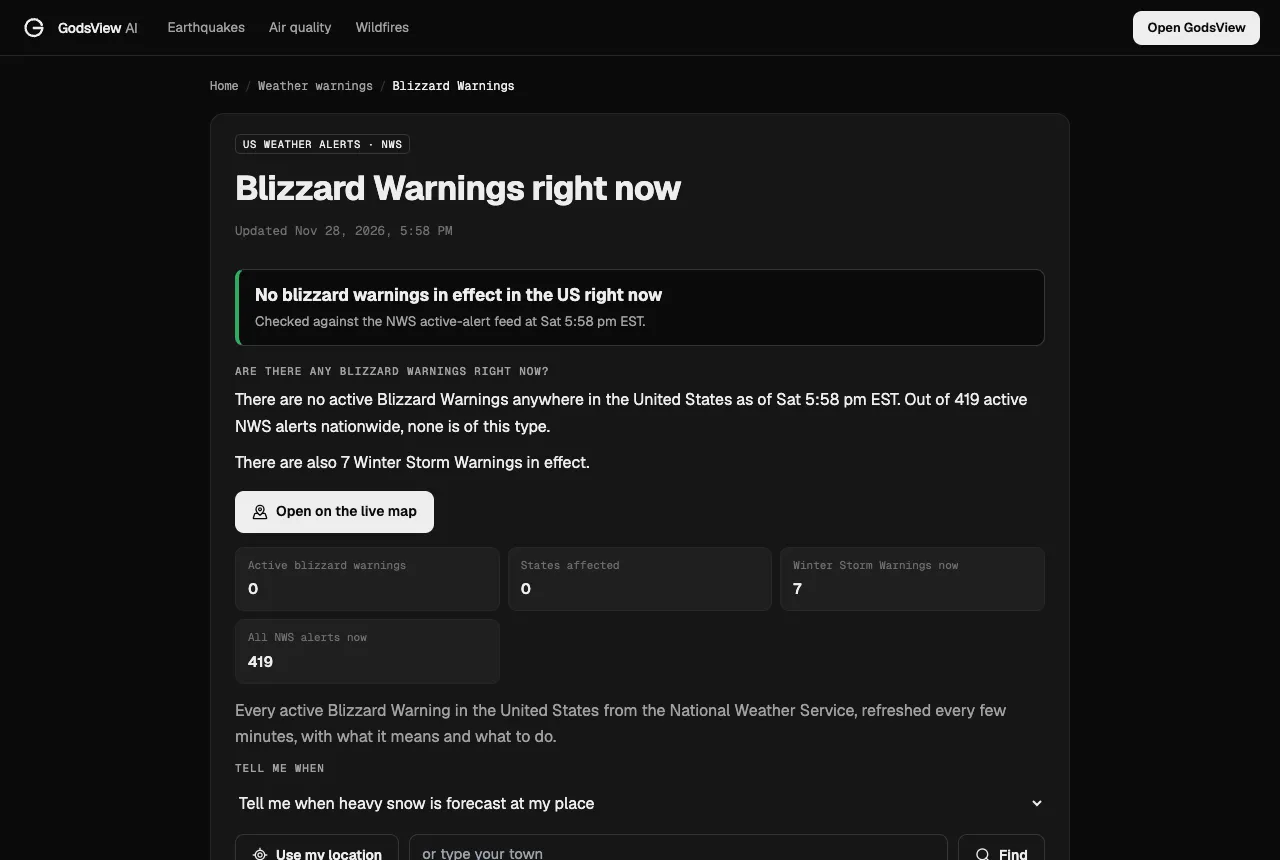
On November 28, 2026, there were no blizzard warnings in effect, though there were seven Winter Storm Warnings in Colorado, Alaska and Wyoming on the Winter Storm Warning page. For a single place, open its page, for example Fargo, Bismarck, Grand Forks, Sioux Falls, Cheyenne or Boston. Each city page shows any active alert with the current wind, temperature and forecast.
Before driving in winter, it also helps to look at the road. GodsView's live traffic cameras show public highway and city cameras, and our guide to 511 traffic cameras by state lists each state's official road-condition site.
What to do in a blizzard warning
Before the blizzard
- Cancel or move trips. The NWS advice for a blizzard warning is not to travel.
- Stock up at home. The NWS lists a battery-powered NOAA Weather Radio, food that needs no cooking, water, extra heating fuel, and a working carbon monoxide detector. Never run a generator in an enclosed space.
- Pack the car kit if anyone has to drive: blankets, food, water, a phone charger, a flashlight, and a compass and road maps, since a phone battery may not last.
- Bring pets and animals to shelter, with water.
If you are driving when it hits
The NWS says that if you are having trouble seeing, pull off to the side of the road and stop until visibility improves. Turn off your lights and set the parking brake, so another driver does not follow your tail lights and hit you. Slow down well before you reach whiteouts; even roads that only look wet can be slick. Weather is a big factor on the roads: the NWS says that each year, on average, more than 5,000 people are killed and more than 418,000 injured in weather-related crashes.
If you get stranded
Stay with your vehicle. The NWS warns that if you leave it, you will become disoriented quickly in wind-driven snow and cold. Then:
- Run the motor about 10 minutes each hour for heat, and open a window a little for fresh air.
- Clear snow from the exhaust pipe to avoid carbon monoxide poisoning.
- Turn on the dome light at night while the engine runs, so rescuers can see you.
- Tie a bright cloth, preferably red, to the antenna or door.
- Once the snow stops falling, raise the hood to show you need help.
- Move your arms, legs, fingers and toes from time to time to keep blood flowing, but avoid overexertion such as digging out heavy snow, which can trigger a heart attack.
After the blizzard
Ground blizzards in particular are followed by Arctic cold. If an extreme cold warning follows, limit time outside and cover all exposed skin. If you have a gas furnace, the NWS advises making sure its vent is not blocked by a snowdrift as soon as it is safe to go out, and clear snow from a car's exhaust pipe before running the engine.
Blizzard warnings in Canada and elsewhere
Environment and Climate Change Canada colors its alerts yellow, orange or red according to expected impact, and handles blizzards under its "Visibility (including blizzards, blowing snow, dust, fog)" impact guide, with separate guides for snow, snow squalls and winter storms. Check Canada's live warnings or a city such as Winnipeg. For Europe and other regions, the weather warnings hub has a page for each country GodsView covers.
Getting blizzard alerts
Blizzard warnings are not on the NWS list of warnings that trigger Wireless Emergency Alerts on phones; snow squall warnings are. To be told about a blizzard warning, turn on alerts in your weather app (see our guide to weather alerts in your area), keep a NOAA Weather Radio, or use GodsView Plus ($10.99 a month or $99.99 a year, see pricing), which sends alerts for severe US weather warnings at your saved places.
The short version
A blizzard warning means at least three hours of 35 mph wind and blowing snow with visibility under a quarter mile: whiteouts, drifting roads and no safe travel. It does not depend on how much snow falls, and a ground blizzard can strike with almost none. Stay off the roads, and if you are caught out, stay with your car, keep the exhaust clear and wait for help.
Check blizzard and winter alerts for my city
Frequently asked questions
What are the criteria for a blizzard warning?
Sustained wind or frequent gusts of 35 mph or greater, with considerable falling and/or blowing snow frequently reducing visibility to less than a quarter mile, expected for three consecutive hours or longer. There is no snowfall amount or temperature requirement.
What is the difference between a blizzard warning and a winter storm warning?
A winter storm warning is about heavy snow, sleet or ice meeting local accumulation criteria. A blizzard warning is about wind and visibility: whiteouts from wind-driven snow for at least three hours. When blizzard conditions become likely, the NWS upgrades a winter storm warning to a blizzard warning.
Can there be a blizzard without snow falling?
Yes. A ground blizzard happens when strong winds pick up snow already on the ground. The NWS says blizzard conditions do not require snow to be falling, and its glossary lists a Ground Blizzard Warning for blizzards caused solely by blowing and drifting snow.
Should I drive during a blizzard warning?
No. The NWS advice for a blizzard warning is not to travel. If you must, carry a winter survival kit, tell someone your route, and if you get stranded, stay with your vehicle and wait for help.
What should I do if I am stuck in my car in a blizzard?
Stay with the car. Run the engine about 10 minutes each hour with a window slightly open, keep the exhaust pipe clear of snow, turn on the dome light at night, tie a bright cloth to the antenna, and raise the hood once the snow stops.
Is there a blizzard watch?
Not as a separate national product. The NWS covers the possibility of a blizzard with a Winter Storm Watch, whose WHAT line reads "Blizzard conditions possible", and then issues a Blizzard Warning when blizzard conditions are expected.
Sources
- National Weather Service — Winter weather warnings, watches and advisories
- NWS Instruction 10-513, WFO Winter Weather Products Specification (November 6, 2024)
- National Weather Service — Ground blizzards
- National Weather Service glossary — Blizzard and Ground Blizzard Warning
- NWS Omaha — Winter products
- National Weather Service — What to do if caught in a winter storm
- National Weather Service — Prepare for a winter storm
Facts checked on against each provider's own site.