Explainer
What Is Space Debris? Space Junk, Reentries and the Risks
Every launch leaves something behind: a spent rocket stage, a dead satellite, a bolt, a fleck of paint. Here is what counts as space junk, how much of it is up there, what happens when it falls, and how to see the tracked part of it yourself.

Key takeaways
- Space debris is any human-made object in orbit that no longer does a useful job: dead satellites, spent rocket stages, fragments from explosions and collisions, and small items like paint flakes.
- As of August 2026, the US Space Surveillance Network had cataloged more than 34,000 objects in Earth orbit, according to NASA. ESA estimates over 1.2 million pieces larger than 1 cm.
- How long debris stays up depends on altitude: below 600 km usually a few years, around 800 km often centuries, above 1,000 km a thousand years or more.
- More than three intact satellites or rocket bodies reenter the atmosphere each day on average. Most burn up, and no one is known to have been injured by falling space debris.
- Reentry times are predicted from tracking data and stay uncertain until the final hours: a common rule of thumb is plus or minus 20% of the time remaining.
Space debris, or space junk, is any human-made object in orbit around Earth that no longer serves a purpose: dead satellites, spent rocket stages, and the fragments left by explosions and collisions. As of August 2026 the US Space Surveillance Network had cataloged more than 34,000 objects in orbit, and the European Space Agency estimates there are over 1.2 million pieces larger than 1 cm. Most of it stays up for years or centuries; the pieces that fall back mostly burn up on the way down.
That's the short answer. The longer one explains why a fleck of paint can damage a spacecraft, why some orbits are getting crowded, and what really happens when a satellite "falls to Earth".
See tracked satellites on the 3D globe
What counts as space debris?
Engineers sort orbital objects into working spacecraft and everything else. The "everything else" is debris, and it comes in a few main types:
- Dead satellites. Spacecraft that ran out of fuel, failed or were simply switched off but were never moved out of the way.
- Rocket bodies. Upper stages that reached orbit along with their payload and were left there. Many still carry leftover fuel, which is why some have exploded years later.
- Mission-related objects. Lens covers, separation bolts, adapters and other hardware released during launch or deployment.
- Fragmentation debris. Pieces from satellites or stages that exploded, collided or were deliberately destroyed. This is the largest group by count.
- Tiny particles. Paint flakes, solid rocket motor slag and other millimetre-sized bits. They're far too small to track but numerous.
Natural objects such as micrometeoroids also pass through orbit, but "space debris" normally means the human-made kind.
How much space debris is there?
Two kinds of number get quoted, and it helps to keep them apart: objects that are actually tracked, and estimates from models of what's really up there.
Tracked objects. Radar and optical sensors routinely follow objects larger than about 10 cm in low orbit. NASA's Orbital Debris Program Office says that, as of August 2026, the US Space Surveillance Network had cataloged more than 34,000 objects in Earth orbit, including active and defunct spacecraft, rocket bodies and fragments (NASA ODPO). ESA's Space Environment Report 2025, using data to the end of 2024, put the number tracked by surveillance networks at about 40,000, of which about 11,000 were active payloads (ESA). The two figures differ because different networks track and publish different sets of objects.
Estimated objects. ESA's MASTER model estimates what can't be tracked. The 2025 report gave these numbers, as of August 2024:
| Size | Estimated number in orbit | Can it be tracked? |
|---|---|---|
| Larger than 10 cm | About 54,000 | Mostly, in low orbit |
| 1 cm to 10 cm | About 1.2 million | Generally no |
| 1 mm to 1 cm | About 130 million | No |
Even the smallest of these matter. In low orbit, NASA says debris travels at roughly 7 to 8 km per second, and the average impact speed between two objects is about 10 km per second. At that speed a 1 cm fragment carries the energy of a small explosion, which is why the International Space Station has shielding and sometimes moves out of the way of tracked debris.
The trend is up. ESA's Space Environment Report 2026, published in September 2026, recorded more than 300 launches and over 4,000 new payloads placed in orbit during 2025, and warned that even with no new launches the debris population would keep growing because fragmentation events add pieces faster than they reenter (ESA).
How long does space junk stay in orbit?
The answer is almost entirely about altitude. Even hundreds of kilometres up, there's a trace of atmosphere. It drags on anything orbiting through it, slowly lowering the orbit until the object falls back. The thinner the air, the slower the decay.
NASA's rough guide:
- Below 600 km: debris normally falls back within several years.
- Around 800 km: decay often takes centuries.
- Above 1,000 km: debris normally keeps orbiting for 1,000 years or more.
The Sun also plays a part. Around solar maximum, extra solar activity heats and expands the upper atmosphere, so drag rises and objects come down faster. Near solar minimum the air thins and things linger. You can follow current solar activity on the space weather page.
Rules have tightened as orbits have filled. For decades the international guideline was to remove a satellite from low Earth orbit within 25 years of the end of its mission. In 2022 the US Federal Communications Commission adopted a five-year rule for the satellites it licenses, and ESA's report tracks compliance with both standards. For a refresher on orbits in general, see how satellite tracking works.
Kessler syndrome: the chain-reaction worry
In 1978 NASA scientists Donald Kessler and Burton Cour-Palais described a scenario in which the number of objects in a crowded orbit grows so large that collisions create fragments faster than the atmosphere removes them. Each collision makes more debris, which makes more collisions. This runaway process became known as the Kessler syndrome.
It isn't a single dramatic moment, as in films. It's a slow rise in collision risk that could eventually make some orbital bands too costly or dangerous to use. ESA's 2025 and 2026 reports both warn that even with no new launches, the amount of debris would keep growing, because fragmentation events add pieces faster than old ones reenter. That is the core of Kessler's argument. That's why space agencies now push for active debris removal and for operators to remove their satellites promptly.
Notable debris events
A few events created a large share of today's debris. NASA singles out the first two as the biggest single jumps in the large-debris population.
2007: China's anti-satellite test. On January 11, 2007, China destroyed its old Fengyun-1C weather satellite with a missile at about 850 km altitude. It produced thousands of trackable fragments, still the largest debris-creating event on record, and at that altitude many will stay up for decades or longer.
2009: Iridium 33 and Cosmos 2251. On February 10, 2009, a working Iridium communications satellite and a defunct Russian Cosmos satellite collided at about 790 km above Siberia. It was the first accidental collision between two intact satellites, and it created well over 1,500 cataloged fragments.
2021: Russia's anti-satellite test. On November 15, 2021, Russia destroyed its defunct Cosmos 1408 satellite with a missile. The US State Department said the test created more than 1,500 pieces of trackable debris and likely hundreds of thousands of smaller pieces, and the crew of the International Space Station sheltered in their docked spacecraft as a precaution. Because the satellite was at around 480 km, much of that debris has since reentered.
These events are why many countries have committed not to conduct destructive anti-satellite missile tests.
Space debris falling to Earth: what happens at reentry
Reentries are common. ESA's 2026 report says more than three intact satellites or rocket bodies reenter the atmosphere every day on average. When an object drops low enough, friction with the air heats it to the point where most of it melts and vaporises, with most satellites breaking apart roughly 80 km up.
Most objects burn up completely. Large or dense parts, such as fuel tanks, pressure vessels, engine parts and items made of titanium or stainless steel, can survive and reach the ground. Because about 70% of Earth is ocean and much of the land is empty, surviving pieces usually land where no one sees them.
What's the risk to people? Very small. ESA puts the annual risk of any individual being injured by space debris at under 1 in 100 billion, and says you are about 65,000 times more likely to be struck by lightning (ESA). No one is known to have been injured. The best-known close call was in 1997, when a woman in Oklahoma was brushed on the shoulder by a light piece of a Delta II rocket and was unhurt. In March 2024 a piece of hardware discarded from the International Space Station crashed through the roof of a house in Naples, Florida; NASA confirmed where it came from.
ESA's 2026 report also notes that casualty risk on the ground is creeping up as more objects reenter, which is why operators increasingly plan controlled reentries that steer large objects into remote ocean areas.
What it looks like. A reentry seen from the ground is a slow fireball that breaks into a trail of glowing pieces and can last tens of seconds. That's much slower than a natural meteor. If you saw something like that, see what was that light in the sky for how to tell the two apart. If you heard a bang as well, our guide to what was that loud boom covers fireball sounds.
How satellite reentries are predicted
Uncontrolled reentries are predicted from tracking data. The US Space Force maintains the public satellite catalog and publishes it on Space-Track.org, which also lists decay predictions. For larger objects due to come down, US Space Command issues Tracking and Impact Prediction (TIP) messages in the last days before reentry, updated more often in the final 24 hours. ESA's Space Debris Office and the Aerospace Corporation, a US nonprofit research centre, also publish reentry forecasts for objects of interest.
Predictions stay uncertain until late, because drag depends on how the object tumbles and how dense the upper atmosphere is that day. The Aerospace Corporation uses a rule of thumb of plus or minus 20% of the remaining time: a reentry predicted in five days could come a day either side (Aerospace Corporation). An object circles the Earth about every 90 minutes, so a one-hour error moves the landing point by thousands of kilometres along its track. That's why early headlines about where a rocket stage will fall are usually wrong, and why only the last few predictions are worth watching.
Starlink and deliberate deorbiting
Large constellations change the picture. SpaceX's Starlink is by far the largest, with thousands of satellites in low orbit. Its satellites are designed to be lowered and burned up at the end of their lives, and to come down naturally within a few years if they fail, because they fly low where drag is strong.
In January 2026 SpaceX said it would lower about 4,400 Starlink satellites from around 550 km to roughly 480 km during the year. The company said the lower altitude would shorten the time a failed satellite takes to fall out of orbit, ahead of the solar minimum when the upper atmosphere thins. The flip side is that deorbiting satellites now reenter often, and scientists are studying what the aluminium oxide left by burning satellites does to the upper atmosphere.
To see the constellation, open the Starlink tracker. The Starlink layer needs GodsView Plus or Pro. The Starlink position page and our guide to how to see Starlink satellites tonight explain when a fresh "train" of satellites is visible.
How to see satellites and debris on GodsView
GodsView's live satellite tracker draws objects from the public catalog on a 3D globe. Positions are calculated from CelesTrak orbital elements, refreshed hourly, using the standard SGP4 model. They are predictions, not live radar, and objects that aren't in the public element sets don't appear. The satellite layer is free.
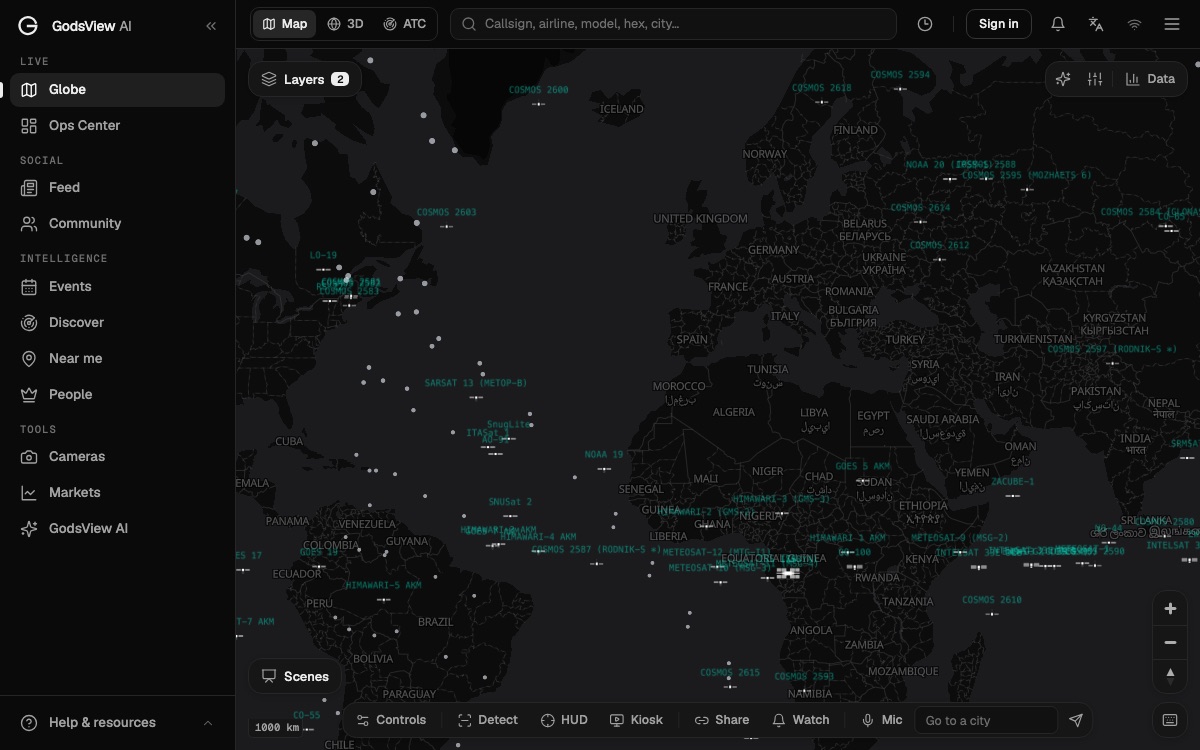
A few things to know when you look:
- Debris carries its parent's name. A rocket body or fragment is labelled after the mission it came from, so a familiar name might be a spent stage rather than the satellite itself.
- Overlapping dots aren't colliding. Objects that touch on screen are usually far apart in altitude.
- Close approaches are a separate layer. Predicted conjunctions from CelesTrak SOCRATES are a Pro layer. They show forecast close passes, not a collision-avoidance service.
If you'd rather know what you can actually see with your own eyes, the What's overhead page lists upcoming satellite passes for your location and marks which ones should be visible.

For the space station in particular, see how to track the ISS in real time or open the ISS tracker. And for the navigation satellites much higher up, at about 20,000 km where nothing reenters on any human timescale, see the live GPS satellite map.
Frequently asked questions
What is space debris?
Any human-made object in orbit that no longer serves a purpose: dead satellites, spent rocket stages, hardware released during missions, and fragments from explosions and collisions, down to flecks of paint.
How much space junk is there?
NASA says the US Space Surveillance Network had cataloged more than 34,000 objects in orbit as of August 2026. ESA estimates about 54,000 objects larger than 10 cm, 1.2 million from 1 to 10 cm and 130 million from 1 mm to 1 cm (as of August 2024).
Can space debris fall on my house?
It has happened, but it is extremely rare. ESA puts the yearly risk of any one person being injured at under 1 in 100 billion. Most reentering objects burn up, and most surviving pieces fall in the ocean or on empty land.
How often do satellites reenter the atmosphere?
Often. ESA's 2026 Space Environment Report says more than three intact satellites or rocket bodies reenter every day on average, plus many smaller fragments.
Why are reentry predictions so uncertain?
Drag depends on the upper atmosphere and how the object tumbles, which change daily. A common rule of thumb is plus or minus 20% of the time remaining, so the landing area is only known in the last hours.
What is the Kessler syndrome?
A scenario described by NASA scientists Donald Kessler and Burton Cour-Palais in 1978, in which collisions in a crowded orbit create debris faster than it decays, causing more collisions.
Can I see space debris on a map?
Cataloged debris appears on the free satellite layer of the GodsView live satellite tracker when it is in the public element sets. Positions are calculated from orbital elements, not radar.
Sources
- NASA Orbital Debris Program Office: Frequently asked questions
- ESA Space Environment Report 2025
- ESA Space Environment Report 2026
- ESA Rocket Science blog: ERS-2 reentry FAQ
- The Aerospace Corporation: A quick guide to understanding reentry predictions
- Space-Track.org (US Space Force satellite catalog)
Facts checked on against each provider's own site.